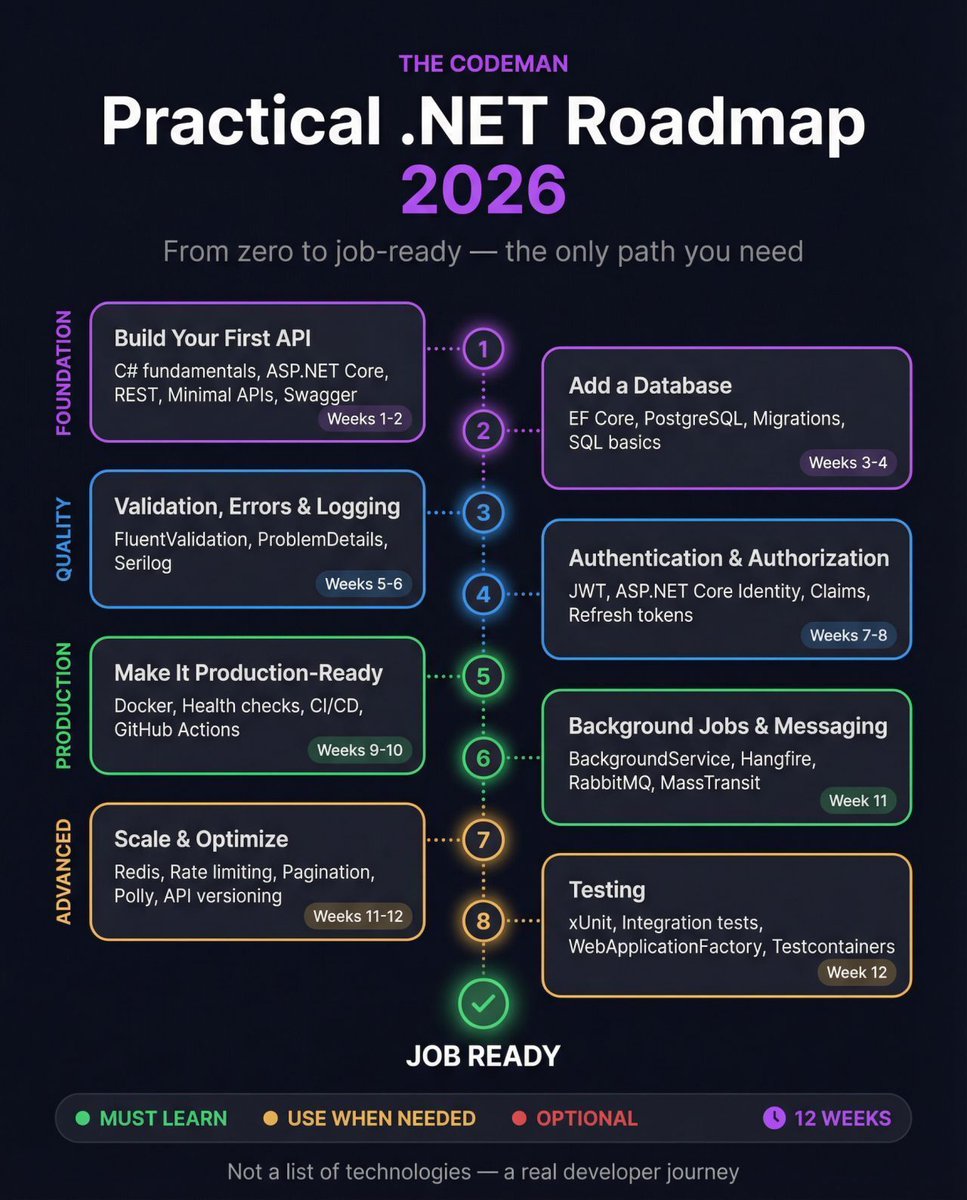
Over 1,000 developers downloaded this in a few days.
And my inbox is full.
Not with “thanks”.
But with messages like:
→ “This is the first time a roadmap actually makes sense”
→ “Now I finally know what to build next”
→ “I’ve been wasting months jumping between random tutorials”
That’s exactly why I made it.
Because most .NET roadmaps?
They look like this:
→ 50 boxes
→ Random arrows
→ Zero context
They don’t tell you what to build.
They don’t tell you what to skip.
And they definitely don’t tell you when you’re ready.
So I built something different.
𝗧𝗵𝗲 𝗣𝗿𝗮𝗰𝘁𝗶𝗰𝗮𝗹 .𝗡𝗘𝗧 𝗥𝗼𝗮𝗱𝗺𝗮𝗽 𝗳𝗼𝗿 𝟮𝟬𝟮𝟲
Not a list of technologies.
A step-by-step path based on how real developers actually build applications.
Here’s the journey:
𝗦𝘁𝗲𝗽 𝟭 → Build your first API
𝗦𝘁𝗲𝗽 𝟮 → Add a real database
𝗦𝘁𝗲𝗽 𝟯 → Validation, error handling & logging
𝗦𝘁𝗲𝗽 𝟰 → Authentication
𝗦𝘁𝗲𝗽 𝟱 → Production-ready (Docker, CI/CD, health checks)
𝗦𝘁𝗲𝗽 𝟲 → Background jobs & messaging
𝗦𝘁𝗲𝗽 𝟕 → Scale & optimize
𝗦𝘁𝗲𝗽 𝟴 → Testing
Each step builds on the previous one.
Each step tells you what to learn AND what to ignore.
Each step has a clear “you’re ready when” checklist.
What you get:
✅ 8-step learning path (beginner → job-ready)
✅ 12-week action plan
✅ 7 portfolio projects
✅ Production-ready templates
✅ MUST vs OPTIONAL breakdown
✅ What NOT to learn (this saves months)
Here’s the uncomfortable truth:
Most developers spend 6 months consuming content…
…and still don’t have a single real project.
Or:
You spend 3 months building properly
→ and walk into interviews with proof of work.
The difference isn’t talent.
It’s direction.
🔗 Get it here: https://t.co/0HEdXHtZMO
📩 Next issue goes to 20,000+ engineers → https://t.co/gI46R2Kc0c
Now I’m curious:
If I turned this into something more hands-on…
Not a course.
But guided learning.
Real projects.
Private group.
Weekly direction + feedback.
👉 Would you join something like that?
Or what would you want it to include?
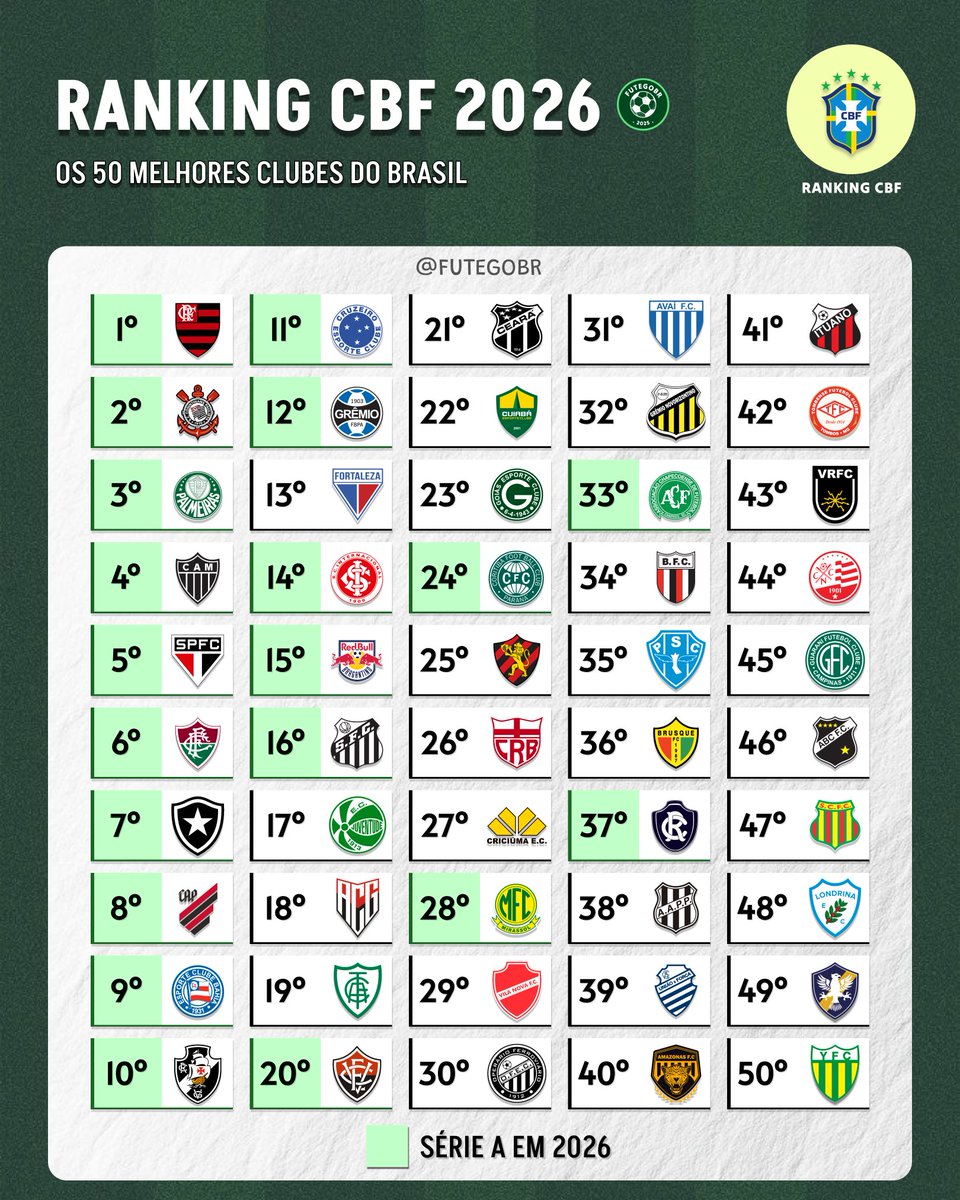
Cadê o blogueiro aquele que disse que era um absurdo o Juventude pedir garantias pelo pagamento do Abner, que o Botafogo tinha grana sobrando e blá blá?
After building 10+ production .NET projects with Clean Architecture, here's what I always set up on day one:
1. Domain layer has zero NuGet packages. No EF Core. No https://t.co/5lU2uiIwnK Core. Just pure C# — entities, value objects, domain events, business rules. If you can't build this layer without referencing a single framework, something is wrong.
2. Application layer owns the business workflows. Use Cases, Commands, Queries, DTOs, and Validation. This is where MediatR or Wolverine lives. No HTTP concerns.
3. Infrastructure is the replaceable plumbing. EF Core, Dapper, PostgreSQL, messaging, external APIs. You should be able to swap PostgreSQL for SQL Server by changing only this layer.
4. Presentation is just the face. Minimal APIs, Blazor, or even Next.js as a BFF. Auth and authorization belong here. Controllers/endpoints are thin — they just translate HTTP to application commands.
5. Cross-cutting concerns (logging, caching, security) go through middleware or pipeline behaviors. Never baked into individual services.
I mapped all of this into a single reference diagram for .NET 10. Save it.
For more practical architecture content, join my free newsletter - https://t.co/sxuxaJCzag
I just uploaded a new .NET 10 video.
Full walkthrough of a CRUD Web API built the way I'd actually ship it in 2026. .NET 10, EF Core 10, Postgres on Docker, Minimal APIs, Scalar. 23 minutes start to finish.
Most CRUD tutorials still skip the parts that actually matter. Controllers with 200 lines. Public setters on every property. In-Memory database pretending to be Postgres. Swagger that Microsoft already dropped from the .NET 10 templates.
This one goes in the other direction.
𝗧𝗵𝗲 𝗱𝗼𝗺𝗮𝗶𝗻 𝗲𝗻𝘁𝗶𝘁𝘆
Sealed Movie class. Private setters. A static Create method that validates inputs before the object exists. EF Core handles the private constructor without any special config.
𝗧𝗵𝗲 𝗱𝗮𝘁𝗮𝗯𝗮𝘀𝗲
Postgres 17 on Docker with a single compose file. EF Core 10 with IEntityTypeConfiguration, HasData seeding, and named query filters. No InMemory.
𝗧𝗵𝗲 𝘀𝗲𝗿𝘃𝗶𝗰𝗲 𝗹𝗮𝘆𝗲𝗿
IMovieService. AsNoTracking on reads. CancellationToken on every async call. DTOs that never leak entities into the API contract.
𝗧𝗵𝗲 𝗲𝗻𝗱𝗽𝗼𝗶𝗻𝘁𝘀
MapGroup for organization. TypedResults for proper OpenAPI metadata. Real status codes on every response.
𝗧𝗵𝗲 𝗱𝗲𝗺𝗼
Live Scalar test at the end, hitting a real Postgres container. Five endpoints, all working.
Here is the video: https://t.co/awvQXL8yLo
New .NET videos every week on the channel from now.
Cheers!
🇳🇬 Juventude encaminha acerto com novo patrocinador master
Clube troca contratos para assinar vínculo de duas temporadas com a ZeroUm Bet, que estampou sua marca na camiseta alviverde contra o Grêmio na semifinal do Gauchão.
@RadioCaxias
https://t.co/auObp43kUI