📝The end of an informative week leading my first workshop! We welcomed qualitative researchers and guideline developers to discuss concrete options for improving the use of qualitative syntheses #QES when developing guidelines #READIt@FCDOHealthRes@Cochrane_IDG@LSTMnews
This applies to in- country (HIC & LMIC) practices too where research careers in privileged (urban) institutions are built on data collection in rural, remote and First Nations communities.
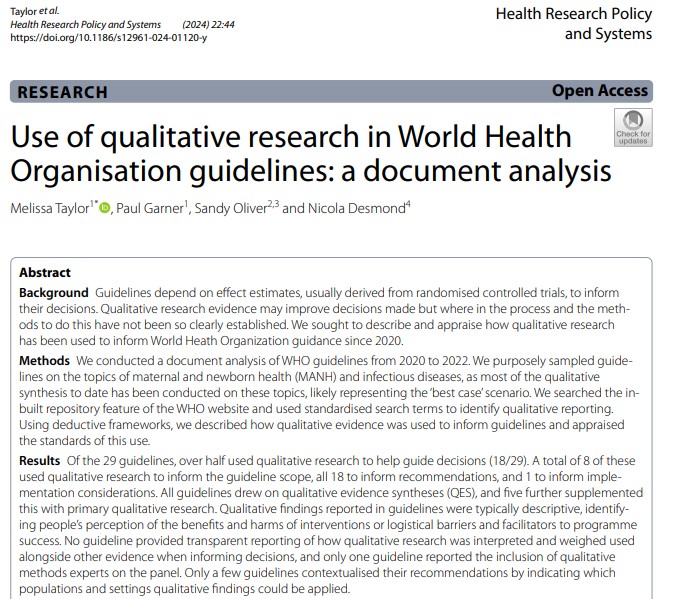
#QualitativeResearch can be valuable when developing recommendations – particularly for WHO guidelines about maternal and newborn health (MANH) and infectious diseases #QES https://t.co/zZMhuNTnnN
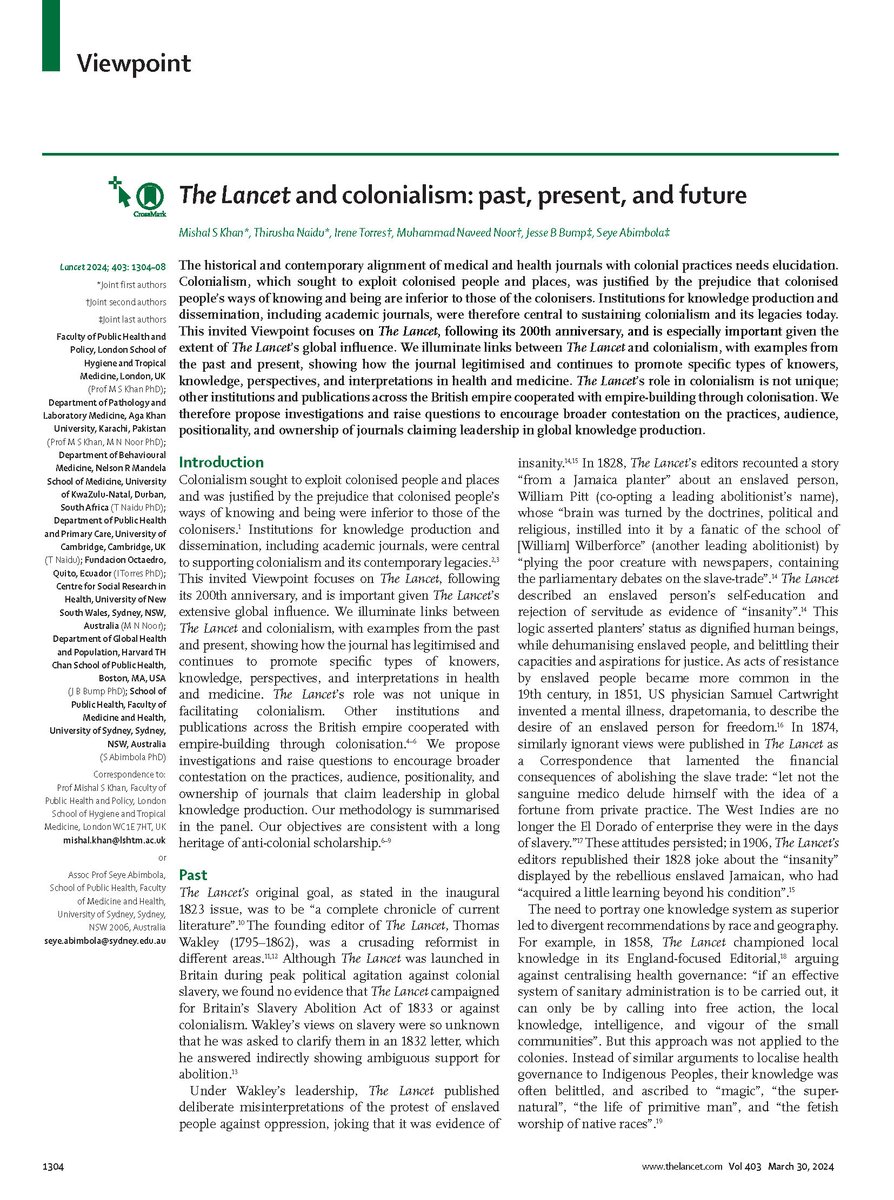
The Lancet and colonialism: past, present, and future https://t.co/2Xvh77PDnA
Please read our brief look @TheLancet's past, what it says about its present, & might about its future.
"Influence unfairly accumulated through colonialism must be redirected to egalitarian purposes."
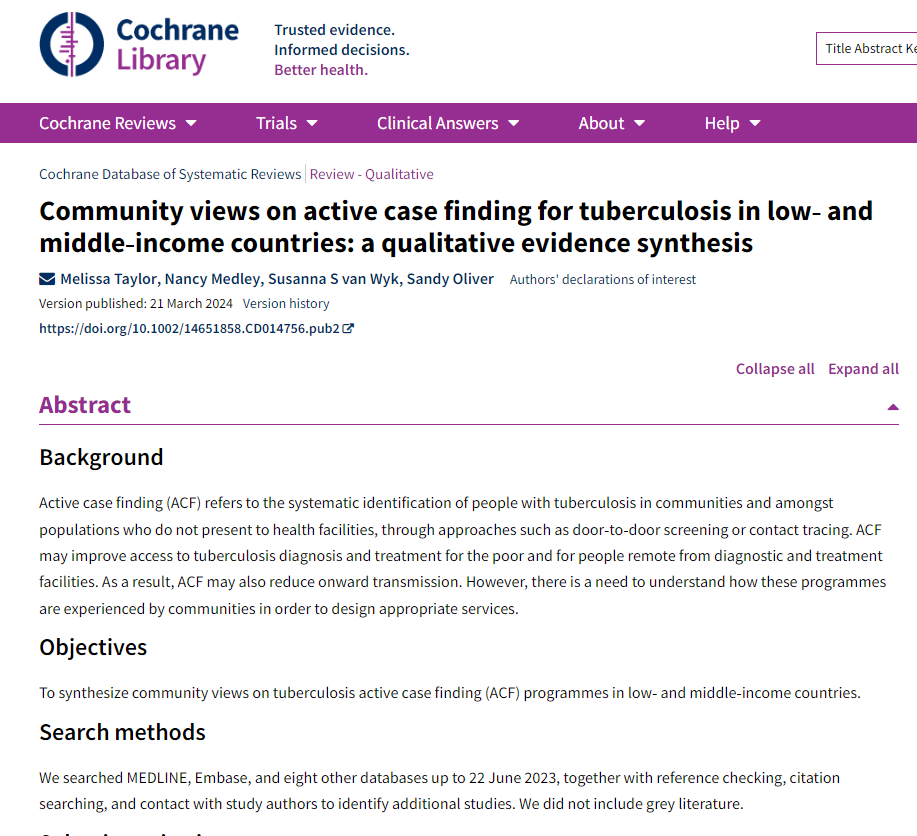
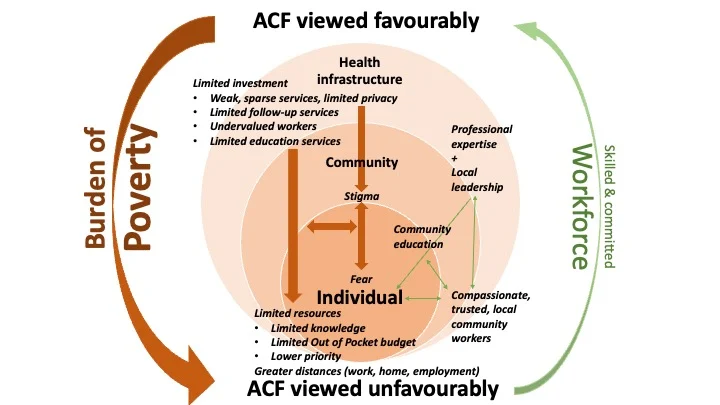
The review found that people who receive a #TB diagnosis must contend with a complex and unsustainable cascade of care, affecting their decision to engage 🫁
Many thanks to my amazing co-authors! @profsandyoliver@UCL, Nancy Medley, and Susan Van Wyk @StellenboschUni#WorldTBDay
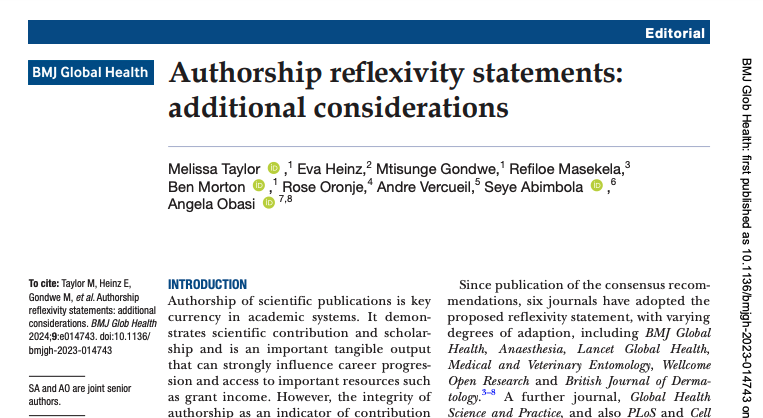
"Integrity of authorship as an indicator of contribution is threatened by normalised unfair practices."
🚨Important @GlobalHealthBMJ piece by Melissa Taylor et al. discussing how to ensure meaningful engagement with reflexivity statements⬇️
https://t.co/FHodaOMyod
Reflexivity statements are an important tool to promote equity in the global health research ecosystem 🌎.
We reflect on some of the emerging questions and invite your discussion!
https://t.co/gx2xi7fVRh
@GlobalHealthBMJ@seyeabimbola@Obasi_TropMed @benjamesmorton
Very pleased to continue synthesising community views on MDA programmes with @Cochrane_IDG and @TillyFox16, this time for #SoilTransmittedHelminths 🪱
Excited to seeing how the data builds on the previous #QES on #filariasis, which you can read here: https://t.co/zERxPbL3zh
It's great to see another @Cochrane_IDG#QualitiveEvidenceSynthesis#QES underway. It's so important to understand how communities respond to policies and programmes https://t.co/2UUPuckgCg
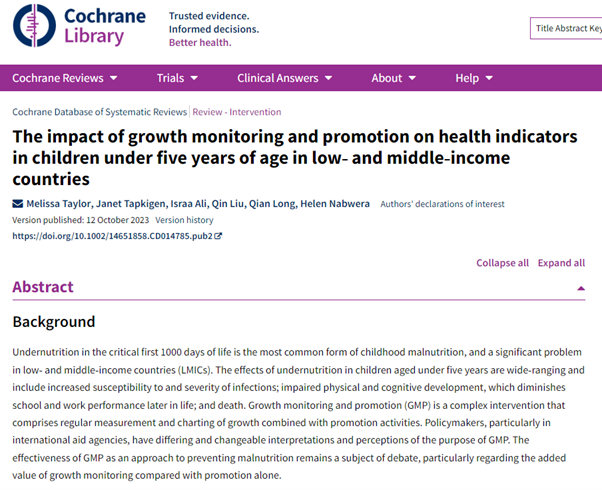
Evidence to support the use of children’s growth monitoring and promotion (GMP) is limited and uncertain, a new @Cochrane_IDG review has found.
Read more: https://t.co/8eomE4Pof0
📚New #Cochrane Review from @Cochrane_IDG published @CochraneLibrary demonstrates:
⭐️currently limited & uncertain evidence on effectiveness of #growthmonitoring & promotion to address #malnutrition in children < 5 yrs in LMICs
Full-text OA review here: https://t.co/PP9H93VNY6
This was the first review I started working on when I joined @Cochrane_IDG, and with 527 test evaluations included, it was quite the task!
Grateful to have worked with such a hard-working team on this project, especially @jacdinnes. Thanks everyone! 😊
(3/3)
Simple interventions can be effective in preventing malaria 🦟 🦟 🏠 🏠
Our @Cochrane_IDG review update demonstrates that screens on windows, doors and eaves reduces parasite prevalence and anaemia by 30%.
https://t.co/OyU1N4TJzi
@JFurnivalAdams@eveolanga@MartyChaplin
Mass drug administration for #filariasis. Communities frightened of adverse effects, suspicious of programmes, and don’t respect community distributors. #WHO Guidelines need to consider history and politics. #CIDG#qualitative#evidencesynthesis https://t.co/uSsqWiEQzZ
A bit late to the party with retweeting this but hopefully the delay increases visibility. Very interesting review and as always each one has been a learning experience for me 1/4