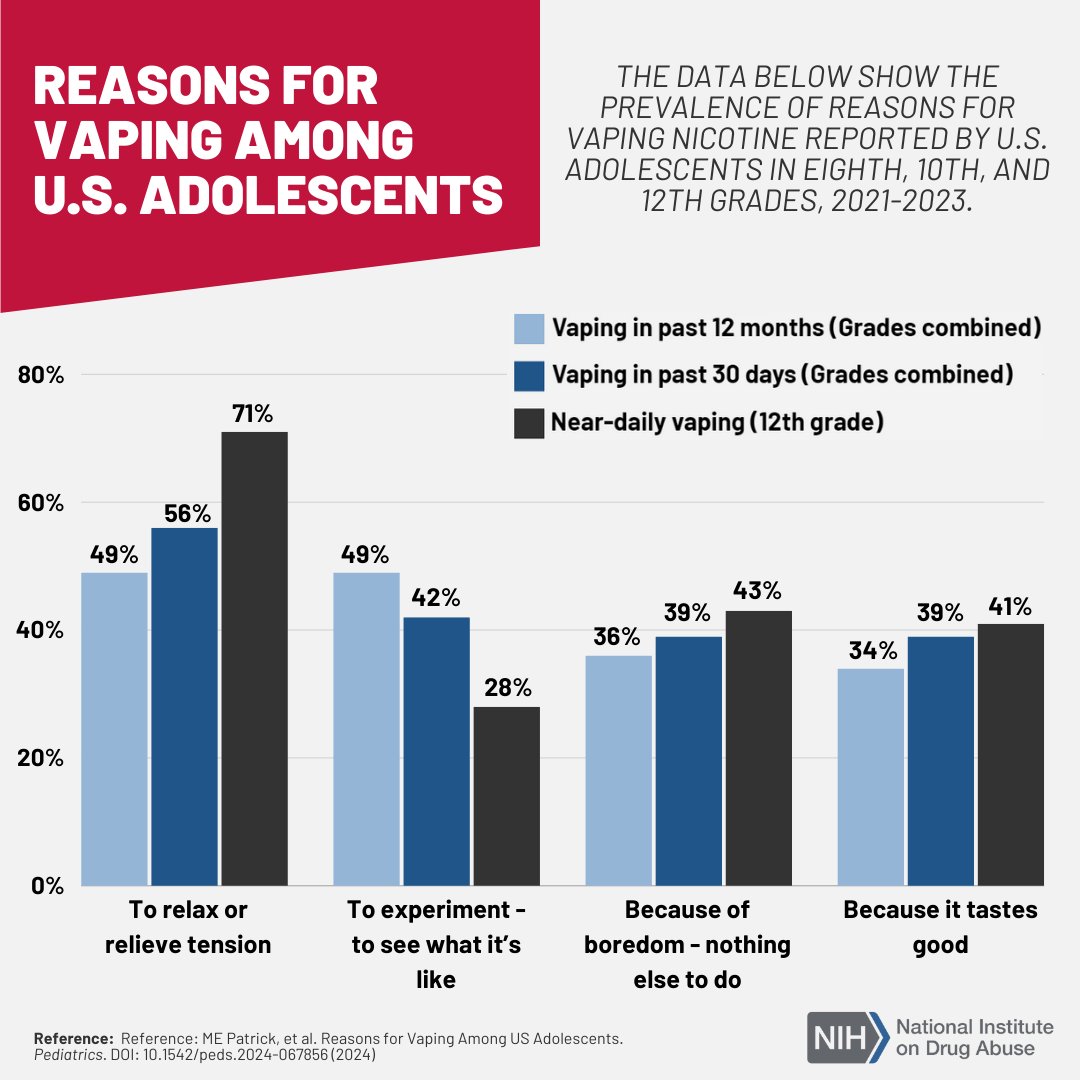
#NIDA-supported research using #MonitoringTheFuture data in 𝘗𝘦𝘥𝘪𝘢𝘵𝘳𝘪𝘤𝘴 reports reasons for vaping among U.S. adolescents. More information in the publication: https://t.co/lH6JfqdNK9
@UMich @aap_peds #MTF
Patterns of daily or near-daily use of alcohol and cannabis among adults in the United States have been changing. @MeganPatrickPhD used @MTF_study to measure how these shifts have occurred across developmental periods of adulthood https://t.co/2bNxdgHLe6
Richard Miech, @AdamMLeventhal, @MeganPatrickPhD, @ncrodrigueza report on trends in cigarette & Ecigarette use among young adults who smoked as teens, finding a drop in cigarette use coinciding w/a rise in use of Ecigarettes to quit combustibles https://t.co/RpVldLfWbD @MTF_study
Are you a @Umich social science grad student, postdoc/jr faculty interested in using #MonitoringtheFuture data? @umisr has a fellowship for you! The Bachman Fellowship provides support to analyze MTF data on a wide variety of social issues. Apply by 2/11 https://t.co/3XxpdoI24C
The latest #MonitoringtheFuture report on HIV-related risk and protective factors among young adults in the U.S., 2004-2023 is now available for download: https://t.co/5ocB1jBbZ5
New #data alert! The @NIDAnews 1976-2021 Monitoring the Future base year (12th grade) & follow-up core panel data (ages 18-30) are now available through the @ICPSR@NAHDAP1 data portal: https://t.co/eACD51y40p #MonitoringtheFuture
"Miech noted that a lot of teens who experiment with e-cigarettes or drugs start in the 9th grade, sometimes because older children are doing it. But the children who were 9th graders during the lockdowns never picked up the activity."
Via @VOANews : https://t.co/ufcs2V7gwa
Is daily use of alcohol or cannabis more prevalent in the US? It varies by age.
Daily (or near-daily) cannabis use is more prevalent than daily alcohol use among young adults, but the opposite is true among late midlife adults. @MTF_study@UM_SRC@umisr https://t.co/HmrGYLVTsM
Michael Parks, Brooke Arterberry & @MeganPatrickPhD used daily data from the #MonitoringTheFuture Vaping Supplement to examine vaping-specific nicotine dependence across days among a national sample of US young adults who vape https://t.co/SNTpuDrCv5
🆕 Results from the latest #NIDA-funded #MonitoringtheFuture survey: Reported use of most drugs among adolescents remained low in 2024. #MTF@UMich https://t.co/NNNPaUXMYc (1/2)
Are you a @Umich social science grad student, postdoc/jr faculty interested in using #MonitoringtheFuture data? @umisr has a fellowship for you! The Bachman Fellowship provides support to analyze MTF data on a wide variety of social issues. Apply by 2/11 https://t.co/3XxpdoI24C
In honor of our @umisr@UM_SRC & #MonitoringtheFuture colleague John Schulenberg, from @SRAdolescence - Celebrating the Legacy and Work of John Schulenberg: Taking the Long View of Adolescence
https://t.co/BRETUABe3Z
Overall binge drinking rates are now equivalent among young adults & those in midlife. That’s because young people are bingeing less - while middle-aged adults are drinking more alcohol in a single session than they previously did. #MonitoringtheFuture
https://t.co/Xk3OawMrpa
🆕 #NIDA-supported research using #MonitoringTheFuture data in 𝘗𝘦𝘥𝘪𝘢𝘵𝘳𝘪𝘤𝘴 reports reasons for vaping among U.S. adolescents. @UMich @aap_peds #MTF https://t.co/GyEn4J10zx
Are you bored? Boredom, relaxation & experimentation are among the top reasons teens vape. "Vaping has become the primary way that adolescents use nicotine," said @umisr researcher Megan Patrick.
HERE: https://t.co/yed3KQoIQu
New U-M Research on Teen Vaping
Curiosity, stress relief, and boredom top the list of reasons why U.S. teens turn to vaping, according to @UMich’s latest study in @AmerAcadPed. The #MonitoringTheFuture study reveals that nearly half of teens who vape do so to relax, with experimentation and boredom also cited as major motivators.
"Understanding why teens vape is essential for effective prevention," says lead author @MeganPatrickPhD of @umisr. The findings highlight the need for mental health support in anti-vaping programs, as stress and anxiety are significant factors driving these behaviors.
Key findings:
70% of near-daily vapers cite relaxation as a reason.
Only a small percentage of teens vape to quit smoking.
Some teens even vape to manage weight—a concerning trend.
The research was funded by the @NIAAAnews and the @NIDAnews.
Learn more about how U-M researchers are tracking these changing behaviors and the implications for adolescent health: https://t.co/aysUhwvAGL