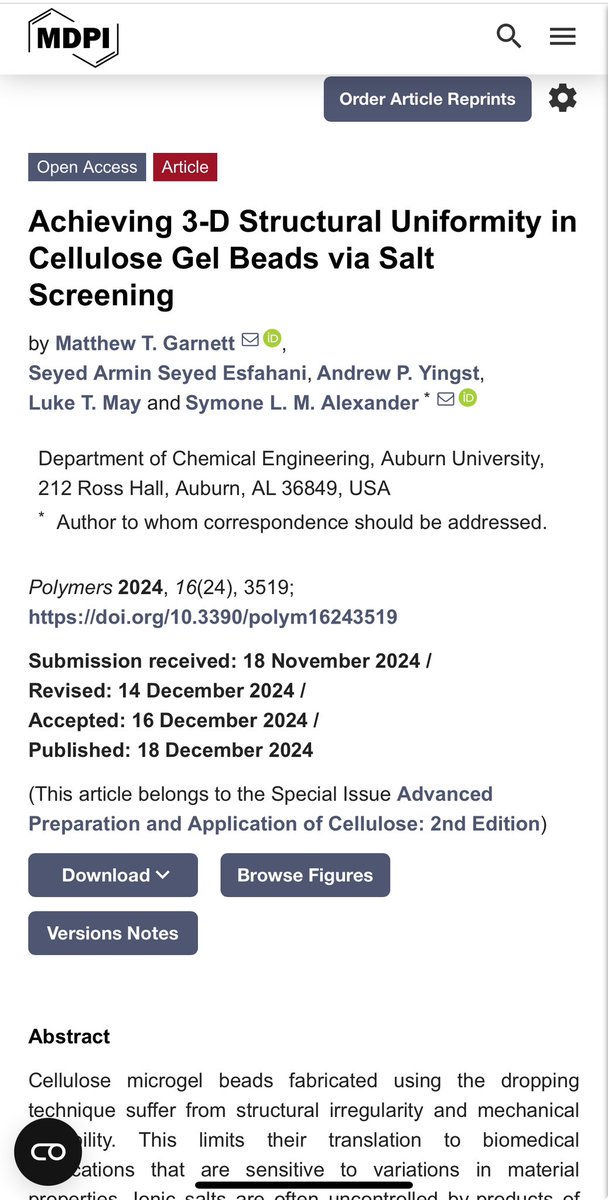
Exciting News out of the Alexander Research Team! Our manuscript has just been published in MDPI Polymers in the Special Issue Advanced Preparation and Application of Cellulose: 2nd Edition! Check it out here: https://t.co/aPXM3WSnFU
@SymoneAlexander
AUSome Science in 60 Seconds, a research-based competition in its 2nd year presented by the Council of Engineering Graduate Students, tasked students to create videos explaining their projects in a minute or less. Winners were recently announced.
https://t.co/l33EtLDxfw
New #OpenAccess paper by Matthew T. Garnett et al. presents extraction of cellulose from restaurant food waste in #RSCSustainability. Read it here: https://t.co/yfMy3ozTQG
Mario Eden’s journey to become the dean of Auburn University’s Samuel Ginn College of Engineering has been a long one... 22 years and 4,677 miles, to be exact.
Enjoy the cover feature of the latest issue of Auburn Engineer.
https://t.co/rwq0oEtCb3
My first peer-reviewed manuscript titled "Extraction of cellulose from restaurant food waste" is now published. Check out the open access manuscript here: https://t.co/fEgnGKxyAm. I would like to thank my advisor, @SymoneAlexander , for all the help with my research!
Can you recover cellulose from restaurant food waste with no control over the menu or waste composition?
We took the first step towards using real-world food waste to recover valuable biopolymers. Check out the open access manuscript here: https://t.co/9HVeAejB63.
@mtgchenref
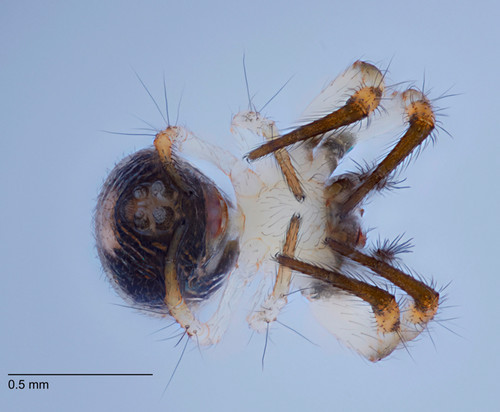
Our bioinspiration isn't limited to food - complex assemblies are everywhere! Excited to work with the Smithsonian @NMNH to uncover more fundamental physics, materials, & engineering concepts behind the slingshot spider's unique prey capture strategy.🕷 https://t.co/5jONbimIH0
The itsy, bitsy spider... helped identify biomechanical systems capable of withstanding large loads w/ sub-millisecond response times, and inspired new micromechanical systems and responsive actuators.
Incredible work by @AuburnU's @SymoneAlexander
https://t.co/Dw2G9vDbAn
Our bioinspiration isn't limited to food - complex assemblies are everywhere! Excited to work with the Smithsonian @NMNH to uncover more fundamental physics, materials, & engineering concepts behind the slingshot spider's unique prey capture strategy.🕷 https://t.co/5jONbimIH0
Can you recover cellulose from restaurant food waste with no control over the menu or waste composition?
We took the first step towards using real-world food waste to recover valuable biopolymers. Check out the open access manuscript here: https://t.co/9HVeAejB63.
@mtgchenref
Are you ready to be a part of our family?
Auburn Chemical Engineering is searching for applications to fill multiple tenure-track faculty positions with an anticipated start date of August 2024.
Apply TODAY!
https://t.co/EBB09AXAMv
When it comes to dialysis, chemical engineering doctoral student and Jordan-Hare Stadium play clock operator Matt Garnett definitely wants to delay the game.
Find out what makes Garnett tick on the latest episode of the award-winning #GINNing Podcast.
https://t.co/TxqMqMjFwN
Congrats to @mtgchenref, a graduate researcher in the Alexander Research Team at Auburn University, for being featured on the award-winning #GINNing Podcast! Matthew's work in the lab and on the football field is truly impressive. Well done! https://t.co/mPwNLQ2BtD
Michael Howard, asst. professor in chemical engineering, is developing computer models to help scientists understand and design soft materials, from industrial fluids and consumer products to nanoparticles delivered to complex environments like the body.
https://t.co/IbNntdazTg
Thanks to @NSF EPSCoR Track 2 for funding our goal of understanding the effects of micro plastics on coastal communities in Alabama and Mississippi, reimagining thermoset materials, and using self-assembly as a tool to aid recycling efforts!
https://t.co/R3R8rUITk4