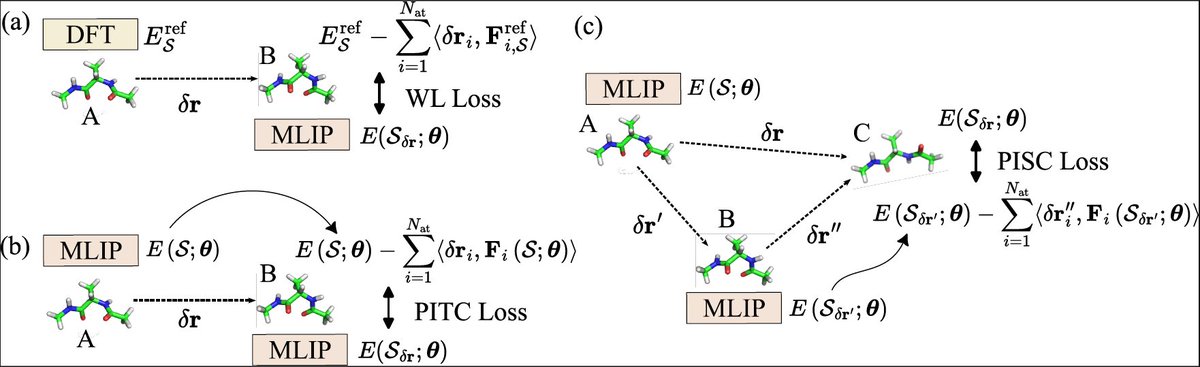
We also show that our approach facilitates MLIPs' training in a setting where the computation of forces is infeasible at the reference level, such as those employing complete-basis-set extrapolation.
Our new work has appeared on arXiv: https://t.co/n9XyKRUwvl, which addresses a challenge in #Machinelearning interatomic potentials by introducing a #physics-informed, #weakly supervised approach.
Our approach improves the accuracy of MLIPs applied to training tasks with sparse training data sets and reduces the need for pre-training computationally demanding models with large data sets.
Watch NEC Research Scientist @federico_errica explain why nearest-neighbor #graphs are not a good solution in fully supervised #machinelearning scenarios. https://t.co/ApIAfPYiaY. #NECLabs#NeurIPS23
Online LoG conference 27th – 30th Nov!
All the talks will be live-streamed on Zoom and YouTube with poster sessions and sponsor sessions on GatherTown:
Schedule Zoom: https://t.co/sGxhPHYHJS
Youtube: https://t.co/kL1qHBt7cU
GatherTown: https://t.co/HpV8gl77LJ
neural networks cannot magically solve difficult combinatorial optimization problems. a short🧵on the work of Gamarnik https://t.co/9bUBetPonS describing the performance barriers of GNNs. 1/n
If want to learn and contribute in this area, we have an opening: https://t.co/AUeZP9fqov https://t.co/6kHmmlQ8Zx
The mix of skills in the team is quite rare: machine learning, chemistry, physics and computational methods. A lot of potential for fun (...and impactful science)
It's an exciting time where #NLProc research is moving closer & closer to applications🗨🙋🗨🤖My experienced NLP team is looking for support on the applied side to make a real world impact together🚀🌎
Apply here: https://t.co/6zubbuLR8B #hiring#LLMs#SoftwareEngineering
📢#AI4Science Talk on 28.08 at 15:00 (CEST) / 09:00 (EDT) on “PDE-Refiner: Achieving Accurate Long Rollouts with Neural PDE Solvers” by @phillip_lippe from MSR/UvA.
Please join us on Zoom if you're interested!
Details: https://t.co/xE6NUTJgVX
#ML4science#CFD#PDEs#AI4Science
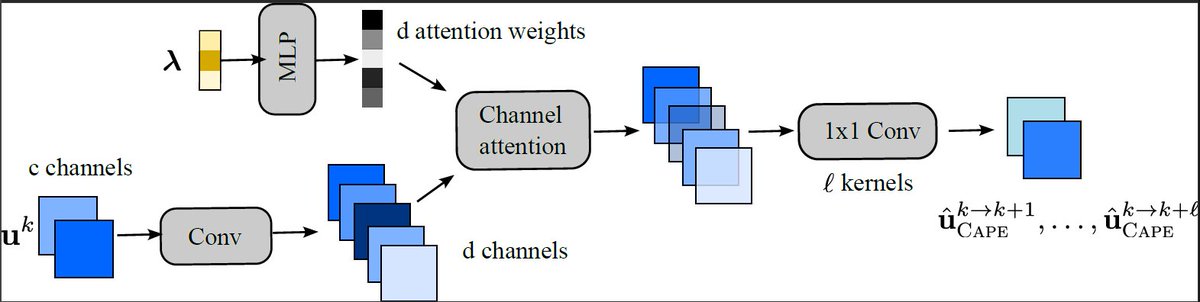
We are thrilled to announce that our new paper ”Learning Neural PDE Solvers with Parameter-Guided Channel Attention” has been accepted by #ICML2023 !! Draft will be appeared soon.
Excited to share our latest survey paper: "Artificial Intelligence for Science in Quantum, Atomistic, and Continuum Systems"! 🚀 ArXiv: https://t.co/EgMPbflFBT.
We are thrilled to announce that our new paper ”Learning Neural PDE Solvers with Parameter-Guided Channel Attention” has been accepted by #ICML2023 !! Draft will be appeared soon.
We are happy to introduce you to our first MLSS^S speaker: @Mniepert, Professor at @Uni_Stuttgart!
👉 Make sure to register to MLSS^S: the applications are open until 8th April: https://t.co/4kU4v2pDuL
We are kick starting 2023 with a new invited talk series on #AI4Science#ML4Science
As a first talk, we're excited to have @simonbatzner from @Harvard who will give a presentation about his recent work on molecular dynamics simulations, specific. NequIP (https://t.co/sBkNP9u8A5)
Now that #ICML is asking area chairs to make a statement of “why they think peer review helps science?” It is time to debate whether that is actually true. I personally align with what is said in the article below that I recommend. TLDR: Peer review is an experiment that failed!
PDEBench will be presented in today’ morning poster session at #NeurIPS2022 . Please feel free to visit our poster at Hall J #1030, and ask any questions and have a discussion with us!!