Backcountry skier with a history problem, scholar of mountain warfare, author of Ski, Climb, Fight: The 10th Mountain Division and the Rise of Mountain Warfare.
The requirement for mountain warfare, the national direction to send the time, effort, and money to train and equip forces for mountain operations is something that has increasingly come to mind, in both the past and present.
The original identification of the need for mountain warfare, to conduct mountain operations where the mountains are a means to maneuver, not an obstacle to maneuver, came amongst the alpine nations of mid-19th century Europe. Mountains, while at the physical edges of the nation, increasingly resided at the center of the mental concept of the nation, thus had to be defended.
In Italy, during the final national consolidation of the 1860s, it became clear that it would take longer to mobilize an army than it could take for any enemy to cross the Alps. The solution for this, beginning in 1872, was the raising of Alpini companies from the alpine villages in independent companies at first, to serve as a defense force to delay any enemy crossing. These companies would soon become battalions and regiments intending to hold the mountains, not just slow down any advance.
In response to the growing numbers and capability of the Alpini, the French converted 12 light infantry battalions into Chasseurs Alpins. Operating in battalion task forces with artillery, engineers, and signals, and soon backed by alpine infantry regiments, the alpins were intended to hold any advancing Italian force in the high mountain valleys to allow a reinforcing French army to climb the mountains and defeat the invaders.
In 1906 the Austro-Hungarian Empire, considering an Italian attack on unredeemed Italian-speaking parts of the Tyrol, assigned two Landesschützen regiments of the Austrian Landwehr (State Army), along with a third infantry regiment, to the border protection mission. These were to operate in nearly independent companies, patrolling, conducting reconnaissance, and gathering intelligence along 152 identified mountain routes.
So, the original requirement for mountain warfare amongst alpine nations was the need to defend mountainous borders. This primary defensive focus has long obscured the requirement for mountain warfare for other nations.
#mountainwarfare
The battles for Monte Cristallo d’Ampezzo in the Dolomites are another chapter absent from most English language books about WW1 in Italy. In late October 1915, the Alpini belayed 120 wounded and frostbitten men down Costabella Ridge using a frozen corpse as an anchor. #TiTM
Tune in to see multiple SWWRGNA historians--Rob Citino, Mike Neiberg, Jadwiga Biskupska, Cameron Zinsou--in #WorldWarIITomHanks premiering Memorial Day 2026 at 8/7c @HISTORY. Over 20 hours, the series captures the full arc of the war for a new generation @Nutopia_tv@HISTORYUK
Anyone who’s followed along here knows I have a strong interest in military skiing.
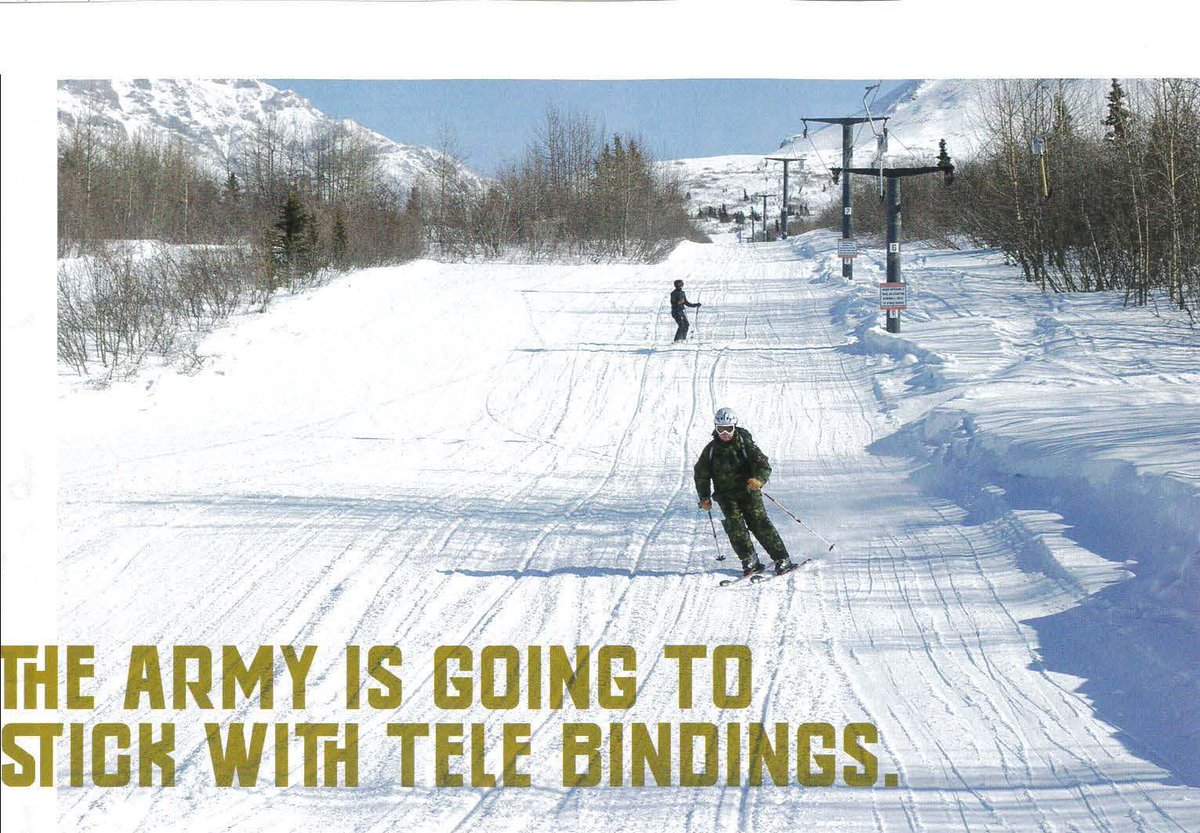
Backcountry Magazine 165 (2026) published short article, “Arctic Angels,” by Gregory Scruggs on that subject looking at skiing in the 11 ABN and NWTC in Alaska.
My response to a few key points is summarized here but encourage everyone to get a copy of the article.
#1 Military skiing is back and came from the bottom up.
A PL decided to train his platoon to ski w/assistance of the NWTC in 2022. This led to experimentation energized by the Army’s Arctic Strategy. Going and doing is the best way to move forward.
#2 11 ABN procured 2,200 pairs of skis in 2024 and they’re DPS!
DPS makes an Assault ski—153cm long, 100mm wide—snow-trekker but better than snow shoes, with fish-scales or fixed skins for low skill level, a Distance ski—87 or 82 underfoot—again with fish-scales or fixed skins for medium level skills, and a Military Alpine Tour ski—this is the Pagoda 100 Tour, my personal favorite—with the standard race base for experience skiers.
#3 For Arctic ops the Army determined that a cable binding, the old NATO 120, was the best.
AT bindings and hard boots were considered, but as the troops were not expecting to operate in steep mountains, the cable binding was preferred for the Assault and Distance skis as it can fit many different types of boots and is optimized for cross-country travel.
However, my historical evidence suggests that a battalion should mount at least one platoon of its best skiers on touring skis with AT bindings to serve as scouts or guides in steeper terrain.
#4 Ski training for the 11 ABN will focus on techniques for low-angle terrain below 25º.
Ski (and mountaineering) techniques have to be adapted to military usage and the terrain, so this strikes me as very sensible, but, as above, don’t make the steep terrain off-limits, train and equip some troops to operate there.
Tags: @dpsskis
Photos: US Army and DPS via Backcountry Magazine
Today marks 68 years that #NORAD has conducted the distinct missions of aerospace warning and aerospace control, as well as maritime warning since 2006. The images below show some of the past and current homes of the 🇨🇦 & 🇺🇸 bi-national command, as well as the various NORAD missions conducted 24/7/365.
#WeHaveTheWatch #HappyBirthdayNORAD
Setting the objective in mountain warfare, continued . . .
In March 1944 the French Expeditionary Corps (FEC) or Corps Expéditionnaire Français, (CEF), under the command of General Alphonse Juin, moved to a new section of the front line along the Garigliano River in Italy.
On 15 May, having ruptured the Gustav Line two days prior, General Juin deployed a ‘corps de montagne’ (mountain corps) comprised of the 4e division marocaine de montagne (4e DMM) and three regimental-sized Groupes de Tabors marocains (GTM), better known as goumiers, to advance through the roadless Aurunci Mountains. Juin’s objective was to cut the Itri-Pico Road which ran laterally behind the German fallback Hitler Line. Taking this objective would inhibit targeted the German capacity to supply their defenses and move their counterattack forces.
The CEF planned to supply the corps de montagne using over 4,000 mules and pre-planned airdrops for supplies. Water, for the mules, was a critical item. American staff officers in the Fifth Army HQ doubted that the maneuver could be done.
The mountain corps advanced up into the Auruncis in a southern group led by mounted goumiers and a northern group preceded by ‘rock scouts,’ trained at a mountain school in the Atlas Mountains of Morrocco, who seized Mount Fammera by climbing up narrow rock chimneys. So limited were the paths, the rear elements of the mountain corps did not begin their ascent up the massif until the next day.
For two days the Moroccan goumiers and tirailleurs walked, day and night, accompanied by mules. On 17 May the Germans, realizing their peril, dispatched two motorized battalions to intercept the southern group on the northeastern slope of Mount Revole. Mul-packed mountain artillery halted the German attack and the goumiers swarmed along the ridges above the Germans, cutting off and annihilating them.
Two days later the goumiers cut the Itri-Pico Road, rendering the Hitler Line useless, opening the way to Rome.
Juin realized that objectives in mountain warfare are best aimed at the enemy’s ability to survive and be mobile.
#mountainwarfare
From 33 years of association with faculty around the edges of a discipline I would say they are afraid of social death.
They do not wish to have no friends, to have people talk about them behind their backs, to have no invites to social events, to have people question their intelligence, to have students steered away from them, to be disdained if not hated by everyone: adminstrators, faculty, students.
Far easier to just go along to get along.
Last time @mtn_war was on @schoolofwarpod we discussed his excellent history of the 10th Mountain Division. Today, we talk about the history NORAD (where he's the command historian) and of defending America from nuclear attack.
https://t.co/KH3zWxCdG1
@shashj Welcome (back) to 1917–the best explanation I’ve found for how a similar situation was overcome during WW1 was the learning of how to carry out heavily-supported, short intensity, limited objective attacks repeatedly.