'Seeing the Cygnus Loop in a New Way'
Image Credit: X-ray: NASA/SAO/CXC; Optical: John Stone (Astrobin); Image Processing: NASA/SAO/CXC/L. Frattre, N. Wolk
https://t.co/2EDWb2mn0K
#space#astronomy
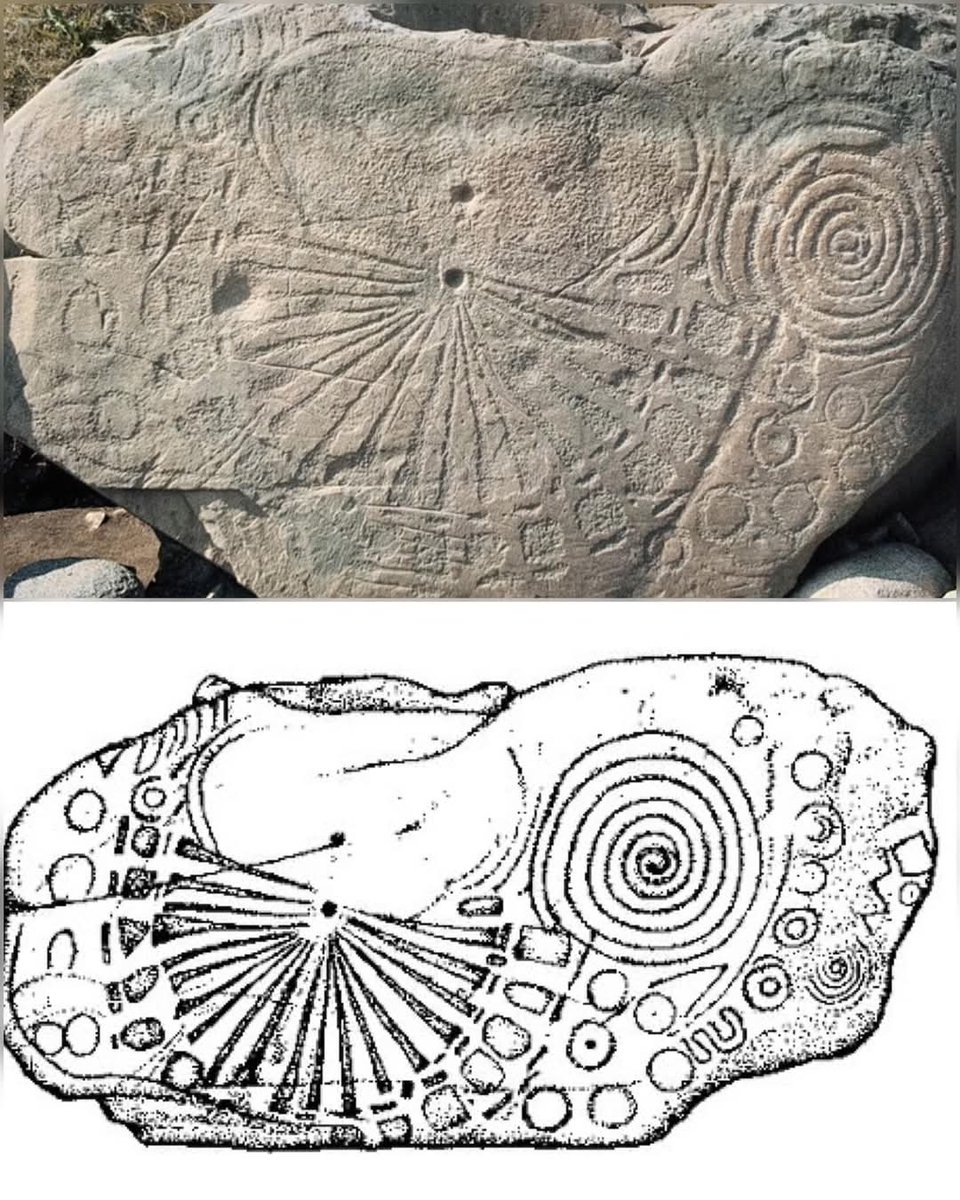
Kerbstone 15, a 5,000-year-old Neolithic artifact at the Knowth passage tomb in Ireland’s Boyne Valley, is carved with intricate designs including a central cupmark with 20 radiating lines, spirals, and U-shaped motifs.
One of 124 kerbstones surrounding the site’s main mound, it is part of the largest collection of megalithic art in Europe. While some researchers suggest it may represent an ancient calendar, the exact purpose of its carvings remains uncertain.
#drthehistories
Herbig–Haro objects are bright nebulosities with jets associated with newborn stars.
They’re formed when narrow jets of partially ionised gas ejected by stars collide with nearby clouds of gas and dust at several hundred kilometres per second.
Image: LDN 1471-HST-Judy Schmidt
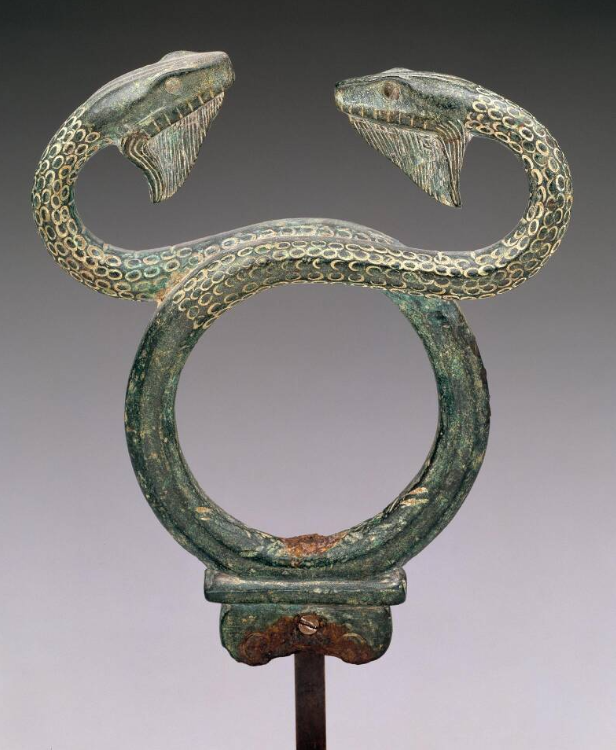
Two bearded serpents top Hermes' staff (kerykeion). The scales were created with rows of punches. Each snake once had inlaid eyes. Bronze. Greek, 5th century BCE. Dallas Museum of Art (Image courtesy Dallas Museum of Art).
A gold spiral bracelet shaped like a snake, originating from the Greek culture, dated to the 3rd century BC. It was found in the Taman Peninsula, Krasnodar Territory, Russia, within the First Middle Burial-Mound on Vasurinskaya Mountain. Currently preserved in the Hermitage Museum.
'Star Forming Region NGC 3582 without Stars'
Image Credit & Copyright: Chris Willocks
https://t.co/oMUmDsRH3c 09-20-2022
#Astrophotography#astronomy#space