Mariano Barbacid eliminated pancreatic cancer in mice.
He needs €30M for human trials.
He can't find the money.
Meanwhile, crypto raised $500M+ for dog-themed tokens last month alone.
Let that sink in.
The traditional system failed him. Governments won't fund it. Pharma won't touch it unless they own the IP.
So where is DeSci?
We have VitaDAO. Molecule. Bio Protocol. IP-NFTs. Quadratic funding.
We built the tools. We just don't use them for what matters.
€30M is a rounding error in this industry.
One DAO. One campaign. One real use case that could save millions of lives.
If DeSci can't fund a cancer cure, what exactly is it for?
Stop building toys. Start funding science.
https://t.co/MzSyX0lgxW
"Ask yourself two questions:
1. Will tomorrow be more digital than today?
2. Will fiat currency be worth less than today?
If the answer to those is yes, then carry on. BTFD and let time in the market beat timing the markets, because it always does."
Man, like so much of crypto, Asteroid Protocol was a fever dream.
I remember pitching the idea for an inscriptions protocol on Cosmos in a @delphi_labs Telegram chat. There wasn’t much response. Then, about 48 hours later, out of the blue, one of the best devs I’ve ever worked with, @donorail (who’s now building the biggest swap aggregator on Monad at @monorail_xyz), pinged me to say he’d finished building a prototype.
That prototype already had everything: an indexer, a UI, an inscriptions scanner, a fungible token framework. The whole stack.
Cosmos felt like the perfect home for inscriptions. It ran faster than bitcoin, and at the time it didn’t support permissionless smart contracts. Asteroid enabled fungible tokens and NFTs on the premier Cosmos chain for the first time ever.
Within hours of launch, millions of transactions were executed, mostly minting $ROIDS. It all happened so fast I barely had time to mint a few batches myself.
Over time, thousands of art collections and fungible tokens launched. We received grants and ran experiments with metaprotocols, games, and even a tokenized social protocol called Trollbox.
But the part I value most is the people. I met artists and builders from all over the world. The feedback I heard again and again was that Asteroid was "easy to use." It didn’t require deep knowledge of blockchain architecture. You could upload an image and mint instantly, for a fraction of a penny.
Ultimately, though, the crypto gods giveth and they taketh away. The meta shifted away from Cosmos, and now we’re here.
The infrastructure may be winding down, but the inscriptions are still embedded in the Cosmos blockchain, and they always will be.
They’re our digital footprints.
As we pass through the unknowable horizon of autonomous technology, I’ve started to think of them like hieroglyphics in a cave. We were here. We explored the boundaries. We saw what was possible, and we acted.
I want to say thank you to everyone who minted, transacted, or built on Asteroid. To the bridge operators, devs, Ark team, grant teams, marketers, space hosts, podcasters, and artists on the fringes, thank you.
I wish it had kept growing and become the canonical protocol for permanent content. The gods had different ideas. But if you asked me whether I’d do it again, in that same time and place, the answer would still be yes. We can be paralyzed and dazzled by our social feeds and billion-dollar algos, or we can roll up our sleeves and act. Asteroiders were the ones who acted.
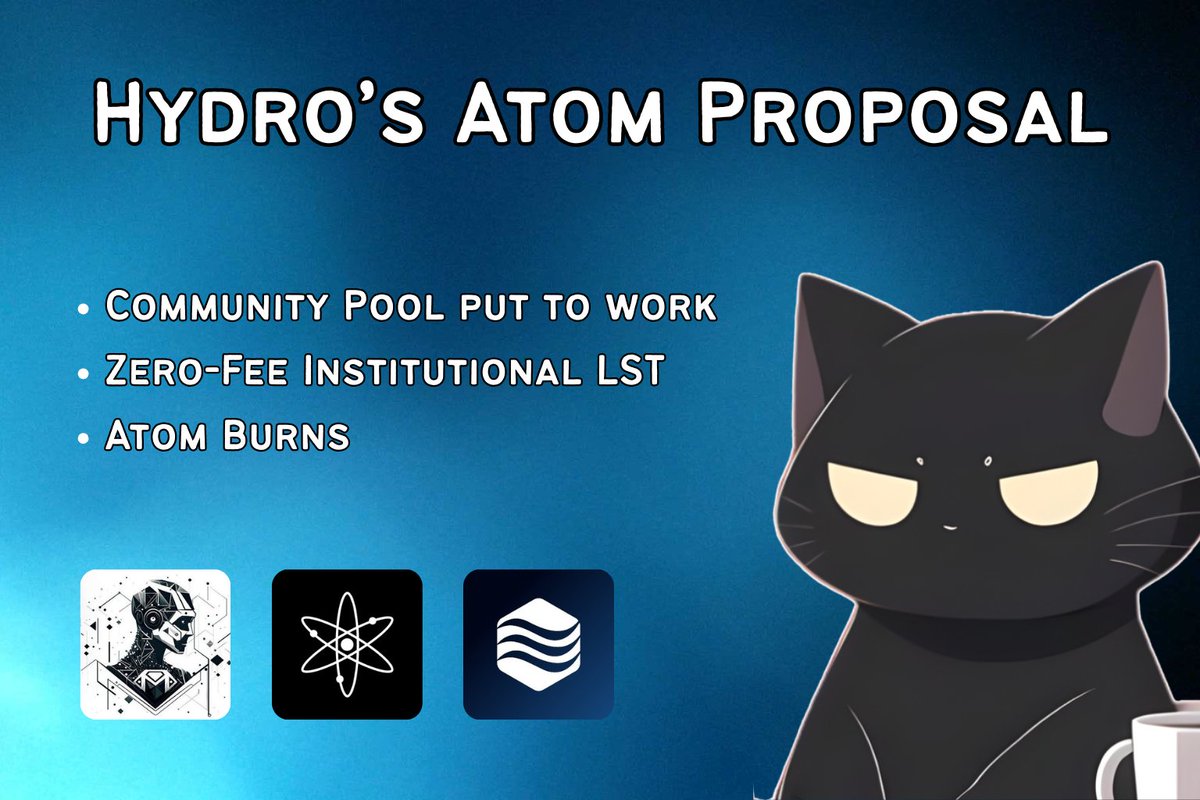
1/ Hydro's 7M ATOM Proposal 🔥
A groundbreaking proposal just dropped that could transform how the @cosmos Hub generates value.
@hydromarkets wants to put 7M $ATOM from the community pool to work in DeFi and build a zero-fee institutional LST.
A thread 🧵 👇
We received backlash for the activated circuit breaker mechanism in our protocol during yesterday’s events. However, as someone who has personally witnessed the Terra crash, the FTX collapse, and the Covid market meltdown, it has always been my deep conviction to prioritize the security of user funds over the pursuit of protocol revenue.
The circuit breaker was triggered by a steep, market-wide decline across all major assets, temporarily pausing protocol activity for about an hour and a half. During this time, the market was free-falling but later began to stabilize in a new price range.
During this period, some users, particularly short sellers, expressed frustration that they couldn’t close their perpetual positions at peak profit.
However, thanks to this anti–price manipulation safeguard, we prevented approximately $6 million in user deposits from being liquidated.
I understand that not every protocol operates under the same ethos, and that some might prefer a “profit-first” approach. But I firmly believe that protecting user funds in moments of extreme volatility is more important than enabling opportunistic gains during a market crash.
Yes, we lost users because of this decision. But in a cross-collateralized environment like @mars_protocol, even a single instance of price manipulation can cause catastrophic losses. That’s why I continue to stand by the decision to integrate and maintain the circuit breaker since the adoption of our @PythNetwork oracle.
Going forward, we’ll improve transparency by adding a clear UI indicator whenever the circuit breaker is active. Still, I am not in favor of removing this protection merely to allow individual profits at the expense of broader market stability and user safety.