August 6, 1945. A 29 year old engineer is walking to work in Hiroshima on the last day of a three month business trip.
He's packed. He's going home to his wife and baby son tomorrow.
He looks up and sees a bomber high overhead. Something small falls from it.
Then the sky turns white.
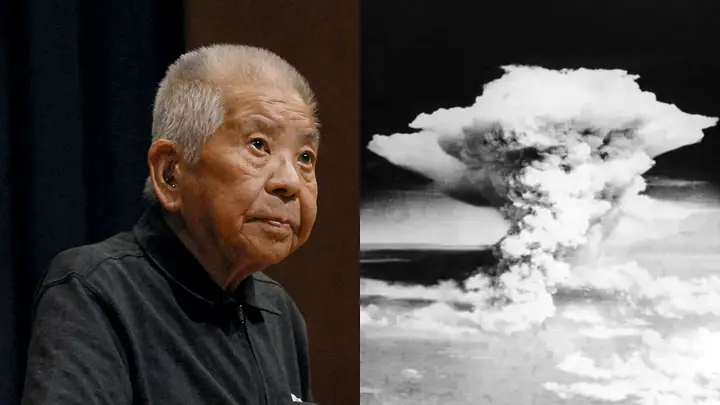
His name was Tsutomu Yamaguchi. He designed oil tankers for Mitsubishi, and he'd been sent to Hiroshima to work at the company's shipyard. He was about two miles from where the bomb exploded.
The blast threw him off his feet. It burst his eardrums. It burned the left side of his upper body, his face and arms. For a while he couldn't see.
He spent the night in an air raid shelter in a city that no longer existed.
The next morning, badly burned, he found two of his coworkers who had also survived. Together they made their way through the ruins to a train station and got on one of the few trains still running.
They were going home.
Home was Nagasaki.
He got back on August 8, covered in bandages. His family barely recognized him. Doctors treated his burns. Most people would have stayed in bed.
On August 9, Yamaguchi reported to work.
He was sitting in the Mitsubishi office in Nagasaki, telling his boss what had happened in Hiroshima. How one bomb had wiped out an entire city. According to Yamaguchi, his boss told him that was impossible. That he must be out of his mind.
And at that moment, through the window, the room filled with the same white light.
The second atomic bomb had just exploded over Nagasaki. Once again, Yamaguchi was about two miles away.
The blast tore the bandages off his burns. The office was wrecked. And somehow, again, he lived.
He rushed home terrified of what he'd find. His house was destroyed. But his wife and son had survived too. They had gone out looking for burn ointment for him and were sheltering in a tunnel when the bomb hit.
Treating his injuries from the first bomb may have saved them from the second.
He was sick for a long time. His hair fell out. He had fevers and infections. But he recovered. He went back to work, raised a family, and lived a normal life for decades. He rarely talked about it publicly.
Hundreds of people are believed to have lived through both bombings. But in 2009, the Japanese government officially recognized Yamaguchi as a survivor of both, the only person ever formally given that status.
Late in life he finally started speaking out against nuclear weapons. He even addressed the United Nations.
He died in 2010 at the age of 93.
He was hit by the only two atomic bombs ever used in war. And he outlived the century they were dropped in.