I run an AI agency. 6 of our 9 employees aren't human.
Sensei — PM. Pushes back on my plans before I ship them.
Kohai — calendar, meetings, follow-ups, client email.
Invoker — coding. Half our production projects are >50% his code.
Ronin — runs all Dojo Labs marketing.
Eshi — edits every video we post on Dojo Labs or for our clients as well. In code, not Premiere.
Meshi — Eshi's clone, running Munshi social's content. A second one cost a config file, not a hire.
Cost to run all six: ~$3k/year in Max subscriptions. Same work at API rates: ~$30k. Six US hires for these roles: $400k+.
All Claude Code, custom harness, on our own VPS. Same setup we ship to clients.
Most people fail in one of two ways: they treat an LLM as an assistant, or they give it total autonomy. One never works, the other stops being trusted. The custom harness in between is the product, the same one our AI employees run on.
What still breaks even with a good harness: the weekly limit.
70+ agent systems shipped for real businesses. I post what works, what breaks, and what it actually costs.
there’s a particular kind of 30-year-old guy who is still psychologically living in the best year of his life.
he had something happen at 24.
a startup took off. a job paid absurdly well. an investment worked. someone important noticed him. for about eleven months, the future looked completely obvious.
he was going to be somebody.
then the thing stopped working.
six years later, he’s still negotiating with the version of himself who thought he had already figured life out.
i think early success can do something genuinely cruel to a person if it arrives before they’ve learned how to be ordinary.
it teaches you to associate your identity with acceleration.
you’re the promising one.
the guy who figured it out young.
the one relatives ask about at thanksgiving because apparently something exciting is always happening with you.
until it isn't.
now you're 31, your income is inconsistent, your friends are buying houses, and you're explaining another business idea to your parents over dinner.
your dad asks whether you've considered getting a regular job.
you hear it as a request to identify the exact moment your life went wrong.
the complicated part is that you probably could get a decent job.
you have a degree. you know how to speak professionally. you have contacts. you understand enough corporate language to survive a meeting about absolutely nothing.
but somewhere along the way, a normal salary became psychologically associated with surrender.
you spent so many years imagining yourself escaping the system that participating in it now feels humiliating.
meanwhile the person who accepted a boring job at 25 has been promoted twice, developed useful relationships, saved money, and learned how to operate inside an actual organization.
you have seventeen tabs open about starting an AI company.
one of them is a youtube video called "why 2026 will create more millionaires than ever."
it's 1:38 am.
this is the part i find genuinely sad.
sometimes family money gives people just enough protection from consequences to keep an identity crisis running for years.
there's no spectacular collapse.
just a long, quiet decline in options.
the ambition stays enormous while the evidence gets smaller.
you start avoiding old friends because their perfectly normal questions require increasingly elaborate answers.
"what are you working on these days?"
god.
you used to love that question.
eventually you become more committed to preserving the possibility of an extraordinary future than doing the fairly unimpressive things that might actually produce one.
and nobody wants to talk about how addictive potential can be.
potential is wonderful because it never has to submit quarterly results.
you can be brilliant in theory for decades.
you can keep insisting that you're one connection, one opportunity, one launch away.
the really painful possibility is that your first success was real, your ambition is real, and you still have to start again at the bottom of something.
at 31.
with people younger than you.
without making a speech about how you used to be ahead.
some guys would genuinely rather spend another five years being a future millionaire than spend six months being a beginner.
and the worst part is they know exactly what they're doing.
they just can't bear to have anyone watch them start over.
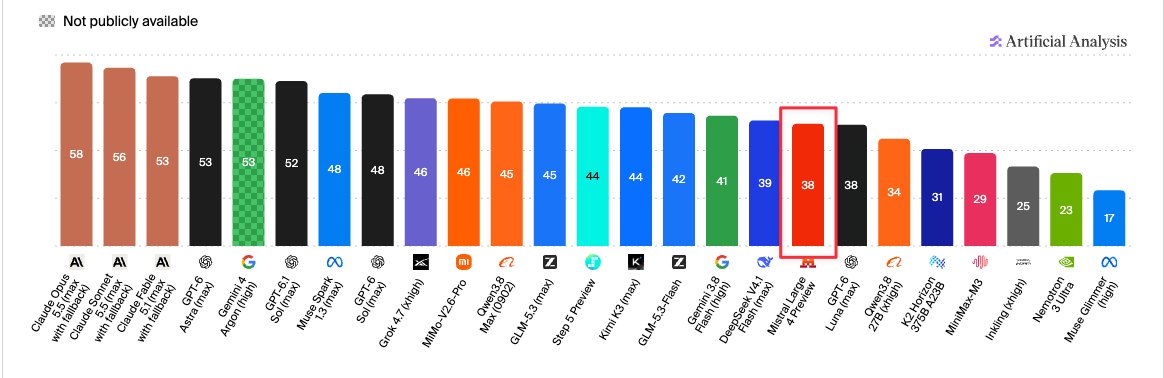
Meet Mistral Large 4, aka Le Chonk.
• 1T parameters, natively multimodal. 49B active.
It is the best open weights model from US or Europe on aggregated benchmarks.
• State-of-the-art on critical workloads, including cyber defense, manufacturing and finance and it surpasses closed frontier models on visual grounding.
• Forged in Europe end-to-end and is deployable from Europe via our own Mistral Cloud infrastructure.
• Available to all via API today. Working with cybersecurity partners privately.
Open weights release end of October.
Its 2026, @HBLPak Incase if you guys are confused.
Sometimes I think about Pakistani banking systems and I honestly just laugh.
They try to secure one thing and break three others in the process. ( HBL Give your developer Fable access please, sonnet is ruining instead of fixing it)
Just now I am trying to reset my HBL mobile banking password. Simple, right?
Heres the loop I got stuck in:
→Tap Forgot Password App tells me to stay on the screen to verify OTP comes as a phone call,
→Not an SMS Not a normal call either.
→Select your language.
→Enter a 4-digit PIN.
→To do that, I have to leave the app Come back, and the app has thrown me to the home screen Log in again, request again, get a new call Leave the app again to answer it (At this point I was pretty sure the app and the IVR were in a toxic relationship and I was the kid stuck in the middle xD)
Each piece makes sense on its own.
Kill the session when the app goes to the background?
Fine, thats anti-hijacking. Verify over a call? Fine, thats a second channel.
Put them together on one phone and the user cant finish the job at all.
So I did what any normal person does.
I called customer support.
25 minutes on hold. Twenty-five. (Writing this post while still on waiting )
Users either give up, go to a branch, or tie up a support line that already cant handle the load.
The fix isnt rocket science:
→ Keep the reset session alive for 60–90 seconds in the background
→ Offer SMS OTP, with the call as a fallback
→ Actually test the full journey on a real phone, not each feature in isolation These are some of the biggest banks in the country with massive tech budgets. How does something like this make it to production?
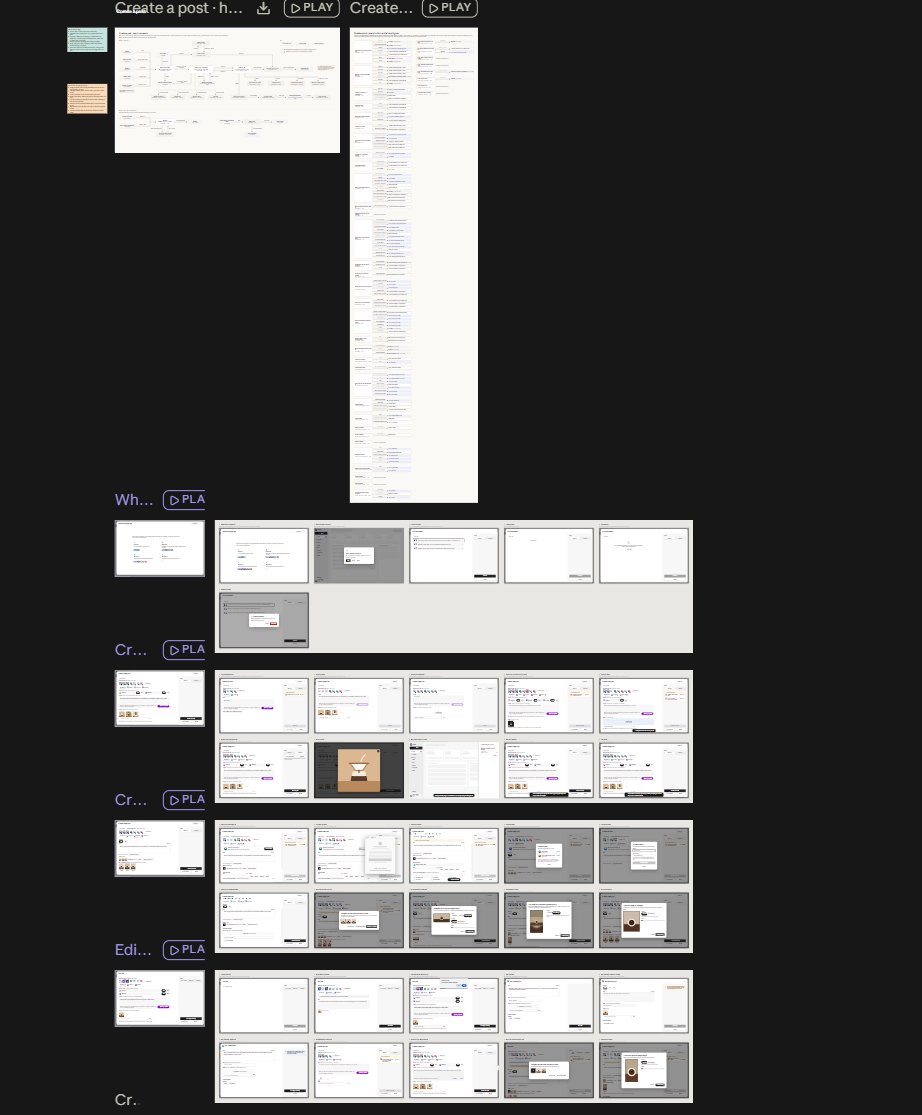
Claude is getting crazy ngl, created all the UI UX and the user journey with all possible states for @munshisocial upload upload draft. Now you can improve one by one literally each screen where it breaks and whats wrong!
Crazy times
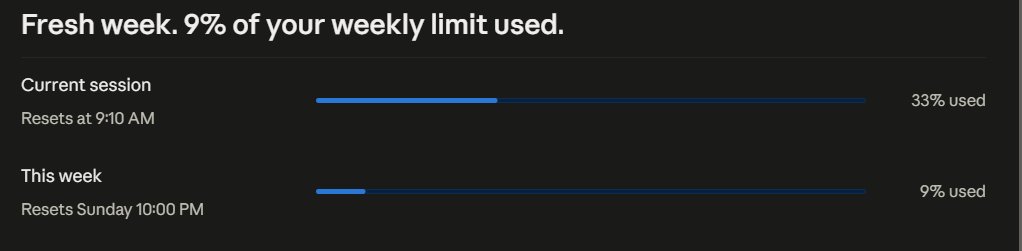
So how much useage we get on 200$ Claude 20x
Around we started from 0 Usage hourly as well as weekly, it was on opus 5.5 high
Rough math, assuming that 19.1M workflow is most of your usage since the reset:
Weekly: 19.1M ÷ 0.09 ≈ ~210M tokens/week
Session (5-hr window): 19.1M ÷ 0.33 ≈ ~58M tokens/session
One full session ≈ 27% of your week, so you get only ~3.7 maxed sessions per week.
I run an AI agency. 6 of our 9 employees aren't human.
Sensei — PM. Pushes back on my plans before I ship them.
Kohai — calendar, meetings, follow-ups, client email.
Invoker — coding. Half our production projects are >50% his code.
Ronin — runs all Dojo Labs marketing.
Eshi — edits every video we post on Dojo Labs or for our clients as well. In code, not Premiere.
Meshi — Eshi's clone, running Munshi social's content. A second one cost a config file, not a hire.
Cost to run all six: ~$3k/year in Max subscriptions. Same work at API rates: ~$30k. Six US hires for these roles: $400k+.
All Claude Code, custom harness, on our own VPS. Same setup we ship to clients.
Most people fail in one of two ways: they treat an LLM as an assistant, or they give it total autonomy. One never works, the other stops being trusted. The custom harness in between is the product, the same one our AI employees run on.
What still breaks even with a good harness: the weekly limit.
70+ agent systems shipped for real businesses. I post what works, what breaks, and what it actually costs.
Summary of the event is that
OpenAI just shipped 25 updates across chatgpt, codex and the API.
> dots (Grokbot killer)
> gpt-6.1 sol
> ultrafast
> private intelligence
> codex in the cloud
> refreshed codex CLI
> code review in the desktop app
> codex security cloud
> decisions API
> agents API with computer use
> bedrock managed agents
> plugin extensions
> improved plugin creation and discovery
> plugins in Sites
> MCP events for automations
> chatgpt Space
> Pages
> collaborative slides
> teams and shared tasks
> ChatGPT in Slack and Microsoft Teams
> Meetings plugin
> shareable profiles
> sign in with ChatGPT
> Pro 500 plan
> OpenAI Marketplace
What a time to be alive
I run an AI agency. 6 of our 9 employees aren't human.
Sensei — PM. Pushes back on my plans before I ship them.
Kohai — calendar, meetings, follow-ups, client email.
Invoker — coding. Half our production projects are >50% his code.
Ronin — runs all Dojo Labs marketing.
Eshi — edits every video we post on Dojo Labs or for our clients as well. In code, not Premiere.
Meshi — Eshi's clone, running Munshi social's content. A second one cost a config file, not a hire.
Cost to run all six: ~$3k/year in Max subscriptions. Same work at API rates: ~$30k. Six US hires for these roles: $400k+.
All Claude Code, custom harness, on our own VPS. Same setup we ship to clients.
Most people fail in one of two ways: they treat an LLM as an assistant, or they give it total autonomy. One never works, the other stops being trusted. The custom harness in between is the product, the same one our AI employees run on.
What still breaks even with a good harness: the weekly limit.
70+ agent systems shipped for real businesses. I post what works, what breaks, and what it actually costs.