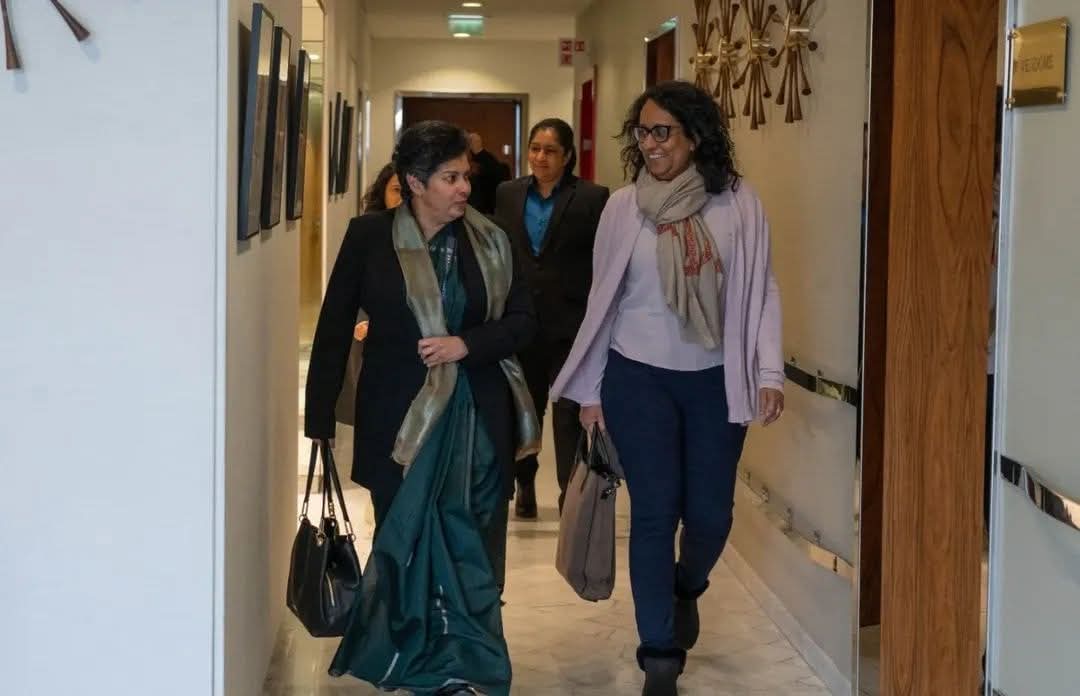
She doesn’t need a saree, a husband, or children to lead—just vision, integrity, and courage.
It’s not culture she defies, but the narrow roles forced on women.
Leadership can come in different styles. Adapt as a nation.
#SriLanka#SystemChange
Great question!😆 Both "出来る" (できる) and "出来上がる" (できあがる) can be used to describe something being completed or finished, but they have different nuances.
✅出来る(できる)
This verb is often used to indicate that something has been completed or is ready. It focuses more on the state of completion or the ability to do something.
ex)晩ご飯が出来た。(ばんごはんができた)
"Dinner is ready."
This sentence simply states that dinner is ready to be eaten.
✅出来上がる (できあがる)
This verb emphasizes the process and finalization of making or preparing something.
It has a slightly stronger nuance of "being finished" or "being done" after some effort or process.
ex)論文(ろんぶん)が出来上がった。
"Thesis is all done."
This sentence suggests that the thesis is not only finished but has gone through a complete process to reach its finished state.
So, while both can be used to indicate that dinner & thesis is finished, "出来上がる" adds a sense of completion of the process, whereas "出来る" is more straightforward about the readiness.☺️
Beware of these Japanese words!
Japanese borrows a lot from English.
And most of the time it's great - it's just free vocab.
But sometimes they change the meaning completely.
Here's a list to save you some pain.
————————————————
マンション ("mansion")
In Japan, a mansion is not a massive house. It's a usually quite modestly sized flat or apartment.
アパート (from "apartment")
This is not just any apartment. It's a apartment in a building made from lighter materials. Think just light enough so that you can hear your neighbours.
コンセント (from "consent"?)
This doesn't mean consent, it means a power socket or electrical outlet. The spot in the wall you can plug in your electric devices.
ホーム (sounds like "home")
It sounds like home, but actually it comes from "form" in the word "platform". It means a platform at a train station.
タレント ("talent")
This doesn't mean talent as in what separated Mozart from his peers. It means a media personality, for example a TV show host, comedian or idol.
スマート ("smart")
It doesn't mean smart as in clever or sharply dressed. It means "slim". That's why smart cars are tiny.
パンツ ("pants")
If you're American you might assume this means trousers, but Japan agrees with the British English where it means underwear.
サイン ("sign")
This isn't a sign that would give you a warning or directions. It's actually a person's signature.
ドライバー ("driver")
No, this isn't a driver of a car or vehicle. It's a screwdriver.
バイキング ("Viking")
Chances are if you see this word in Japan, it doesn't mean Viking or even something to do with bikes. It means a buffet meal.
サービス ("service")
Service in Japan doesn't mean the same as in English. It means that something is free of charge. For example if the restaurant gives you a free bottle of wine, it's サービス.
テンション ("tension")
It doesn't refer to stress, it means the energy or spiritedness of a situation. You can say ハイテンション ("high tension") or テンションが上がる (this means something like "to get exciting and high energy").
シャープペンシル ("sharp pencil")
This isn't a well sharpened pencil. It's a mechanical pencil (i.e. a pencil you can pump out more graphite from when it gets worn down).
トランプ ("trump")
This refers to (a set of) playing cards. If you add 氏 (shi) on the end then it will be referring to the person.
イメージ ("image")
You'll often see on packaging "写真はイメージです" ("the picture is an image"). When I first came to Japan this was amusing to me because... of course the photo is an image. All photos are images. But it means more like "the photo is just a depiction of the product, not the exact thing."
サイダー ("cider")
It's not the alcoholic beverage we love in Europe. It's basically a kind of fizzy soda. Not a fan of it myself.
ホットケーキ ("hot cake")
It's not a hot cake. It's a pancake. Quite delicious.
シーチキン ("sea chicken")
Let's end on a funny one. You probably won't encounter this much, but if you do, just know it's not chicken. It's the chicken of the sea, aka tuna.
————————————————
As you can see, Japan takes some creative liberties.
Do you know any others? Let me know them in the comments!
Cheers
Matt
#langtwt #nihongo