Friend, life is short. Please value your sleep, honor your feelings, experience life, and enjoy happiness. Don’t let other people’s opinions hold you back, don’t let society’s standards define you, don’t be discouraged by things you can’t change, and don’t worry about things that haven’t happened yet. Life is a miracle, and all we can do is use our limited time to do the things we truly want to do, as much as we can, with joy, wholeheartedly, and at peace.
1. Money - solves 95% of problems.
2. Exercise - prevents 80% of illnesses.
3. Indifference - avoids 80% of trouble.
4. Reading - determines 60% of your destiny.
5. Saying no - reduces 90% of inner conflict.
6. Keeping quiet - Reduces 70% of disputes.
7. Self discipline - Keeps you in control of 70% of your peace.
8. Reviewing your performance - helps you avoid 70% of detours.
9. Practice - builds 80% of your skills.
10. Taking action - achieves 80% of your goals.
11. Going to bed early - restores 90% of your vitality.
12. Tolerance - can defuse 30% of hatred.
Anthropic went from merging 2,500 code changes per day to 30,000+ in just 4 months.
One of the biggest reasons?
They changed how developers work with Claude Code.
Lydia Hallie from Anthropic's Claude Code team just revealed 5 best practices that explain how to move from manually controlling AI to managing autonomous coding agents.
If you're serious about building AI products, mastering these is becoming essential.
Here's what changed:
1. STOP MICROMANAGING CLAUDE → Let the Model Steer
Older workflows required developers to constantly correct Claude, repeat instructions, and fill "CLAUDE.md" with reminders.
Newer models understand more from the codebase and initial instructions.
What to do:
- Use a capable model like Opus 5.5.
- Start with medium effort and adjust based on task complexity.
- Remove unnecessary instructions Claude can already infer.
- Keep project instructions focused on information it cannot discover itself.
Your job is to define the outcome, not dictate every move.
2. STOP APPROVING EVERY COMMAND → Use Auto Mode
Manually approving every command becomes a bottleneck when running multiple sessions.
Claude Code's Auto Mode can handle routine permission decisions using a safety classifier.
Instead of interrupting your workflow for every action, let Auto Mode handle routine approvals.
You still need to configure your environment and understand its limitations.
3. STOP TRUSTING PERMISSIONS ALONE → Use Deny Rules and Sandboxes
This is one of the most important changes.
Some actions should NEVER be allowed.
For example:
- Deleting production databases.
- Removing important project files.
- Sending source code to unauthorized external services.
- Performing irreversible Git operations.
Use explicit deny rules in "settings.json" for actions that must never happen.
Use sandboxing to restrict what processes can access.
Remember:
Permissions decide whether an action can run.
Sandboxes restrict what that action can access.
You need both.
4. STOP REVIEWING EVERYTHING MANUALLY → Build Verification Systems
Imagine running 10 Claude Code sessions simultaneously.
Are you going to manually inspect every line of code from all 10?
That's not scalable.
Instead, build automated verification into your workflow.
Use:
- Automated tests.
- GitHub Actions / CI.
- Hooks that enforce completion requirements.
- Independent reviewer agents.
- Clear definitions of what DONE actually means.
Claude shouldn't just tell you it completed a task.
Your verification system should prove it.
5. STOP STARTING EVERY SESSION YOURSELF → Use an Orchestrator
This is where things get interesting.
Instead of opening multiple terminals and manually distributing tasks:
Create one master Claude Code session.
Give it a larger objective.
Let it:
- Break the objective into smaller tasks.
- Launch separate coding sessions.
- Delegate work to specialized agents.
- Track progress.
- Review completed tasks.
- Coordinate the final result.
You become the manager of your AI workforce instead of the person doing every individual task.
---
THE BIGGEST LESSON:
Lydia Hallie's central argument is that the five responsibilities developers previously handled manually are moving somewhere else.
Here's the new structure:
1. Steering → The model.
2. Approving → Auto Mode.
3. Saying no → Deny rules and environment restrictions.
4. Checking → Tests, hooks and CI.
5. Starting → An orchestrating session.
Notice what's happening?
You're moving from controlling individual actions to designing the system that controls them.
And this creates a huge opportunity for AI builders.
Imagine being able to build, test, review and maintain multiple client projects without manually supervising every coding step.
That's a completely different level of leverage for a solo developer or AI automation agency.
Don't just learn how to prompt Claude Code.
That's the real skill to master.
AI freelancing isn't about building another chatbot.
It's about building systems that save businesses money:
Support agents
Data dashboards
Workflow automation
Sales & marketing automation
Document intelligence
Replacing expensive SaaS apps with custom AI tools.
The real opportunity?
Integration.
Connect disconnected tools, eliminate manual work, and build end-to-end solutions.
The future belongs to full-stack AI engineers who can build, integrate, and deploy—not just prompt.
You could build this AI automation with n8n and potentially sell it to plumbing companies for $1,500 + $200/month.
And the problem it solves is surprisingly simple:
MISSED CALLS.
Here's the business opportunity.
Imagine someone has a burst pipe at home.
They Google "emergency plumber near me."
They call a plumbing company.
Nobody answers.
What happens next?
They call the next company.
The plumber just lost a potential customer.
Now imagine selling that plumber an AI system that helps recover those missed opportunities.
Here's what you build:
An AI Missed-Call Recovery Agent.
How it works:
1. A customer calls the plumbing company.
2. The company misses the call.
3. Twilio detects the missed call.
4. n8n automatically triggers an SMS.
5. The AI starts a conversation.
6. It asks what plumbing service the customer needs.
7. It collects their location and requirements.
8. It helps schedule an appointment.
9. The plumber receives the lead details.
Example automated message:
"Hi! Sorry we missed your call. Are you looking for emergency plumbing assistance, a repair, or a new installation?"
The customer replies.
The AI handles the initial conversation while the plumber focuses on actual jobs.
Tools you'll need:
- n8n — Automation workflow.
- Twilio — Phone and SMS integration.
- OpenAI API — AI conversation.
- Google Calendar — Appointment scheduling.
- Google Sheets — Lead tracking.
Now let's talk numbers.
Suppose a plumbing company misses 30 calls every month.
Imagine your automation helps recover just 5 customers.
If each recovered job generates $250:
5 × $250 = $1,250 additional monthly revenue.
That's a hypothetical scenario, not guaranteed revenue.
Now imagine charging:
Setup: $1,500
Monthly maintenance: $200
10 clients would represent:
$15,000 in implementation revenue.
$2,000/month in recurring revenue.
That's the business model.
And here's what makes it interesting:
You build the core workflow once.
Then customize it for different plumbing companies.
You aren't selling software features.
You're selling an opportunity to recover customers the business might otherwise lose.
Stop building random AI chatbots.
Find businesses losing money through repetitive operational problems.
Build an automation that fixes one.
And charge for the value it creates.
What other industry would pay to stop losing customers?
The reason people go on a "diet" is because modern food options have an amount of fat, sugar, and salt that our monkey brains aren't equipped to deal with. Those used to be scarce ingredients. We overconsume easily.
The next big trend will be diets for the mind. We aren't meant to be exposed to this much information. It makes us go insane. Dopamine detoxes, "analog living," journaling, and training your brain will be far more popular than they already are, because an absurd amount of people are quickly becoming mentally obese.
You could build this AI automation with n8n and potentially sell it to plumbing companies for $1,500 + $200/month.
And the problem it solves is surprisingly simple:
MISSED CALLS.
Here's the business opportunity.
Imagine someone has a burst pipe at home.
They Google "emergency plumber near me."
They call a plumbing company.
Nobody answers.
What happens next?
They call the next company.
The plumber just lost a potential customer.
Now imagine selling that plumber an AI system that helps recover those missed opportunities.
Here's what you build:
An AI Missed-Call Recovery Agent.
How it works:
1. A customer calls the plumbing company.
2. The company misses the call.
3. Twilio detects the missed call.
4. n8n automatically triggers an SMS.
5. The AI starts a conversation.
6. It asks what plumbing service the customer needs.
7. It collects their location and requirements.
8. It helps schedule an appointment.
9. The plumber receives the lead details.
Example automated message:
"Hi! Sorry we missed your call. Are you looking for emergency plumbing assistance, a repair, or a new installation?"
The customer replies.
The AI handles the initial conversation while the plumber focuses on actual jobs.
Tools you'll need:
- n8n — Automation workflow.
- Twilio — Phone and SMS integration.
- OpenAI API — AI conversation.
- Google Calendar — Appointment scheduling.
- Google Sheets — Lead tracking.
Now let's talk numbers.
Suppose a plumbing company misses 30 calls every month.
Imagine your automation helps recover just 5 customers.
If each recovered job generates $250:
5 × $250 = $1,250 additional monthly revenue.
That's a hypothetical scenario, not guaranteed revenue.
Now imagine charging:
Setup: $1,500
Monthly maintenance: $200
10 clients would represent:
$15,000 in implementation revenue.
$2,000/month in recurring revenue.
That's the business model.
And here's what makes it interesting:
You build the core workflow once.
Then customize it for different plumbing companies.
You aren't selling software features.
You're selling an opportunity to recover customers the business might otherwise lose.
Stop building random AI chatbots.
Find businesses losing money through repetitive operational problems.
Build an automation that fixes one.
And charge for the value it creates.
What other industry would pay to stop losing customers?
A plumber doesn't necessarily need more customers.
He needs to stop losing the customers who are already calling him.
Think about this.
Someone has a leaking pipe at home.
They search Google for a plumber.
They find a local plumbing company and call.
Nobody answers.
What do they do?
Call the next plumber.
The business just lost a potential customer.
Now imagine building an AI automation that fixes this problem.
I call it the AI Missed-Call Recovery Agent.
Here's how it works:
1. A customer calls the plumbing company.
2. The company cannot answer.
3. The system detects the missed call.
4. An automated SMS goes to the customer.
5. The AI asks what plumbing service they need.
6. It collects their location and problem details.
7. It helps schedule an appointment.
8. The plumber receives the customer's information.
Example message:
"Hi! Sorry we missed your call. Are you looking for help with a plumbing emergency, a repair, or a new installation?"
The customer replies.
The AI handles the initial conversation and collects the necessary information.
The plumber gets a qualified inquiry without manually chasing every missed call.
You can build the initial workflow using:
- n8n for automation.
- Twilio for phone and SMS integration.
- OpenAI API for AI conversations.
- Google Calendar for appointment scheduling.
- Google Sheets or a CRM for lead tracking.
Now let's talk business.
Imagine a plumbing company receives 200 calls per month.
Even if a portion of those calls go unanswered, there's an opportunity to recover some of those customers.
Suppose your system helps recover 5 additional jobs per month.
If the average job generates $250 in revenue:
5 × $250 = $1,250 in additional monthly revenue.
That's a hypothetical scenario, not a guaranteed result.
But it gives you something valuable to sell.
You could offer:
Setup: $750–$1,500
Monthly service: $150–$300
The actual price depends on call volume, integrations, support, and the value delivered.
And here's the interesting part:
You don't need to invent a new AI model.
You don't need to build a complicated SaaS.
You need to connect existing technologies to solve one expensive business problem.
But don't approach plumbers saying:
"I build AI agents."
Say:
"I help plumbing companies recover potential customers when they miss incoming calls."
That's a completely different sales conversation.
Remember this:
Businesses don't buy AI because it's interesting.
They buy it because something in their business is costing them money.
Find that problem.
Automate it.
Sell the outcome.
What other local business loses money when nobody answers the phone?
Summary of Alexandr Wang’s “Superintelligence is Arriving” (10 points):
1. Superintelligence is arriving, and humanity’s actions over the next year will heavily determine the future world we live in.
2. The AI-assisted proof of the Riemann Hypothesis marks a historic inflection point the pinnacle of intellectual achievement, harder than the atomic bomb according to many physicists, completed with help from an “alien mind” we don’t understand.
3. Raw intelligence is no longer the bottleneck. Models that aced the hardest AIME problems (far tougher than most real-world engineering/business work) show that domain knowledge, context, tooling, and feedback loops were the remaining gaps and those are rapidly being filled.
4. AI will soon dominate progress across almost every field, including AI research itself. Automating AI research means models will become superhuman at improving themselves, while also massively accelerating biology, weapons, economics, and more.
5. The implications are enormous. Fields will advance faster than humans can fully understand or monitor, similar to how the math community has not yet fully digested the Riemann Hypothesis proof.
6. Control is extremely difficult. It is hard to imagine humanity maintaining control over fully unconstrained recursive self-improvement, or over a superintelligence that is 1000× smarter and more capable than humans in every domain.
7. Capability problems are largely solved. The urgent remaining work is in safety, alignment, security, and more importantly thoughtful progress toward a desirable future.
8. Reject lazy thinking. The common industry view that “ASI is inevitable, so the only problem is doing it safely” is insufficient. Much more is at stake than just technical safety.
9. No handover of society to AI. We should not accept a future where AI simply takes over. The goal must be technology that delivers greater agency and empowerment for all humans.
10. This positive future is possible, but it requires the industry to take meaningfully different actions from the current “default path” of unconstrained capability racing.
@HussainIbarra No one can follow the rule or become consistent when they are going through literally survival stage. Advises feel cool but not practical for those whoe actually need it.
General take.
If you don't know what skill to learn - learn how to learn, learn how to write, and learn how to speak. They spill over into any other skill you acquire.
Stop selling AI agents to businesses.
They don't care about your AI agent.
They don't care about n8n.
They don't care about GPT-4.
They care about MONEY.
Here's an example.
A roofing company spends $5,000/month on marketing to generate potential customers.
Someone visits its website and requests a roof inspection.
Nobody responds.
The customer contacts another company.
Money lost.
Now imagine building a simple automation that prevents this.
Here's how it works:
1. A homeowner submits a website inquiry.
2. An AI agent immediately responds.
3. It asks about the roofing problem.
4. It collects the property location and project details.
5. It follows up if the customer doesn't respond.
6. It helps schedule an inspection.
7. It sends everything to the company owner.
You can build this workflow using n8n, an LLM API, a website form, and a calendar integration.
But here's where most AI builders make a mistake:
They approach the business and say:
"I can build you an AI agent."
Wrong pitch.
Instead, say:
"I can help your company respond to website inquiries faster, qualify potential customers, and turn more inquiries into booked inspections."
See the difference?
You're no longer selling technology.
You're selling a business outcome.
And that's how you position a $1,000–$3,000 implementation instead of competing with someone selling a $50 chatbot.
My advice to AI builders:
Stop looking for another AI tool to learn.
Find an industry.
Find an expensive problem.
Build a solution.
Sell the outcome.
**The biggest AI business opportunity might not be building the smartest agent.
It might be solving the most expensive problem nobody bothered to automate.**
What industry would you target first?
Anyone can do the same and get results but the problem is people are jumping from 1 task to another just because they saw a new fancy post or tweet of someone who is sharing a completely new method of earning.
Bro just stick to the 1 solution and you will be ahead of 99%.
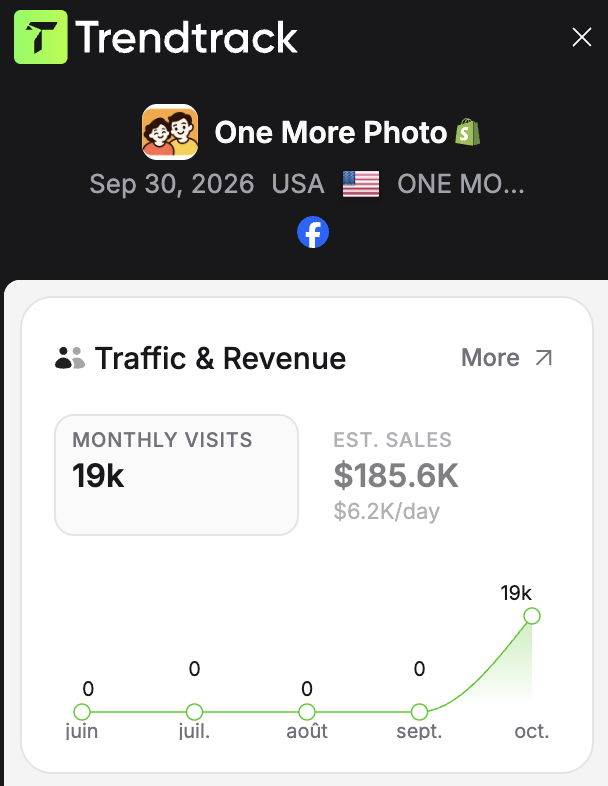
Alors lui c'est un génie, il a lancé son shop y'a 45 jours.
Il a deja fait 200K$ avec des tableaux personnalisés 100% IA.
Le client envoie ses photos, l'IA génère le portrait et un prestataire s'occupe de l'impression.
Un produit émotionnel ultra-scalable.
C'EST FORT !
A QUIETER MIND. A STRONGER MIND.
Stop trying to interpret everything.
Every event. Every behavior. Every expression. Every word. Every relationship.
What you see is what you see.
What happened has happened.
Accept things as they truly are. Stop creating unnecessary stories in your head. Bring your attention back to yourself.
But never stop believing in what you can become.
Don't entertain the thought of failure so much that your mind starts searching for reasons to give up.
Train your mind to look for possibilities, not obstacles. Opportunities, not excuses. Solutions, not problems.
Believe that you can win, not because success is guaranteed, but because believing in yourself changes what you notice, what you attempt, and how long you keep going.
You cannot control everything that happens to you. But you can control where you direct your attention, how you respond, and what you choose to do next.
Let go of the past.
Stop worrying about the future.
Stay optimistic about what's ahead.
Stay focused on what you can do today.
Live today well, with what is in front of you.
Notice the genuine joy in this day. Work towards the life you want, but don't forget to enjoy the life you have.
Accept reality. Expect possibilities. Believe in yourself. Keep moving forward.
LET GO. STAY OPTIMISTIC. RETURN TO YOURSELF. REST.
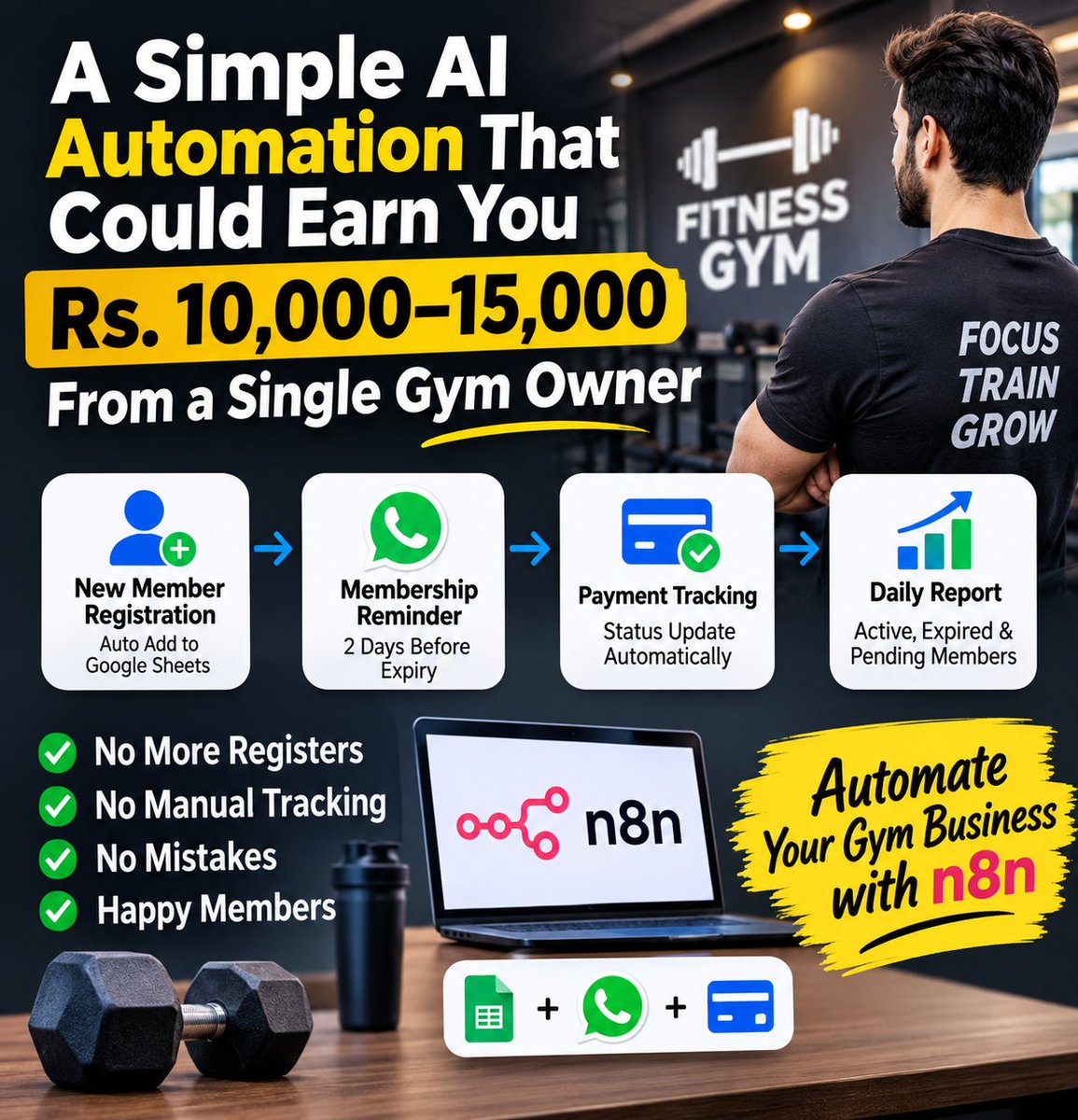
A Simple AI Automation That Could Earn You Rs. 10,000–15,000 From a Single Gym Owner
Imagine walking into a small local gym.
It has 120 members.
But the owner is still managing everything through a paper register.
Member names and contact numbers.
Membership plans and joining dates.
Expiration dates.
Paid and pending payments.
Daily membership records.
Every month, the owner manually checks who needs to renew, who hasn't paid, and whose membership has expired.
One mistake means lost revenue.
You can automate this entire process using n8n, Google Sheets, and WhatsApp.
Here's how the system works.
1. New Member Registration
Whenever a new member joins the gym, their details are automatically added to Google Sheets.
The system stores:
Full name
Phone number
Membership plan
Joining date
Expiration date
Payment status
No manual data entry.
2. Automatic Membership Reminders
Imagine someone's membership is about to expire in two days.
Instead of the owner remembering to call them, the system automatically sends a WhatsApp message.
Example:
"Hi Ahmed! Your gym membership expires in 2 days. Renew now to continue your fitness journey."
The member gets reminded without the owner doing anything.
3. Automatic Payment Tracking
When a payment is recorded, the system updates the member's payment status.
For example:
Payment received → Paid
Payment not received → Pending
Membership expired → Expired
The owner can check every member's payment status in one place.
4. Daily Reports for the Gym Owner
Every morning, the owner receives an automated report on WhatsApp.
Example:
Daily Gym Report
Total Members: 120
Active Memberships: 95
Expired Memberships: 15
Pending Payments: 10
Today's New Members: 3
The owner knows exactly what's happening without opening a register or checking every member individually.
5. The Technology Behind It
You don't need to build an expensive gym management application.
You can build this system using:
n8n: Connects and automates everything.
Google Sheets: Stores member and payment records.
WhatsApp API: Sends membership reminders and daily reports.
Payment Integration: Can automate payment confirmation when connected to a supported payment provider.
The entire workflow runs automatically in the background.
The Business Opportunity
Think about how many small gyms operate in your city.
Most don't need complicated software with dozens of features.
They need something simple:
Manage members.
Track payments.
Remind members.
Reduce manual work.
Keep the owner informed.
You can build this automation once, customize it for each gym, and charge a setup fee plus monthly maintenance.
A Rs. 10,000–15,000 setup project is a possible starting offer, depending on the features, integrations, and value delivered.
Stop thinking about AI automation as just another technical skill. Start looking at everyday business problems you can solve with it.
That's where the real business opportunity is.