Thrilled to share a report I co-authored while at The Quantum Hub (TQH), in collaboration with Zoom India: "Navigating the Future of Work".
From AI to gig work to green jobs — the shifts are real, and the policy path forward matters more than ever.
The way we work is undergoing a seismic shift - driven by AI, the rise of gig economies, sustainability imperatives, and evolving workplace models. At TQH, we’re glad to present our latest report, in collaboration with @Zoom India - “Navigating the Future of Work: Trends and Policy Insights” - authored by @swathirrao, @mudgil_shubham, and Kaushik Thanugonda under the guidance of @GuhaDeepro.
Why This Matters -
🔹Technology & AI are redefining jobs, demanding new skills and human-machine collaboration.
🔹Gig work is booming, but worker protections remain fragmented.
🔹Sustainability is no longer optional - green jobs and skills are the future.
🔹Flexibility is here to stay, but equitable access and security risks must be addressed.
Some Key Takeaways from our Recommendations -
🔹Policy must prioritize upskilling to complement AI, not compete with it.
🔹Gig workers need formal safeguards - fair wages, social security, and safety.
🔹Green jobs require targeted training and public-private partnerships.
🔹Flexible work models can unlock productivity - if digital divides are bridged.
India’s young workforce stands at a crossroads. With the right policies, we can shape an inclusive, resilient, and sustainable future of work. The time to act is now!
Read the full report here: https://t.co/bmgsgxse9S
@swathirrao | @mudgil_shubham | @GuhaDeepro | @rohitkr_RK
#FutureOfWork #AI #GigEconomy #GreenJobs #FlexibleWork
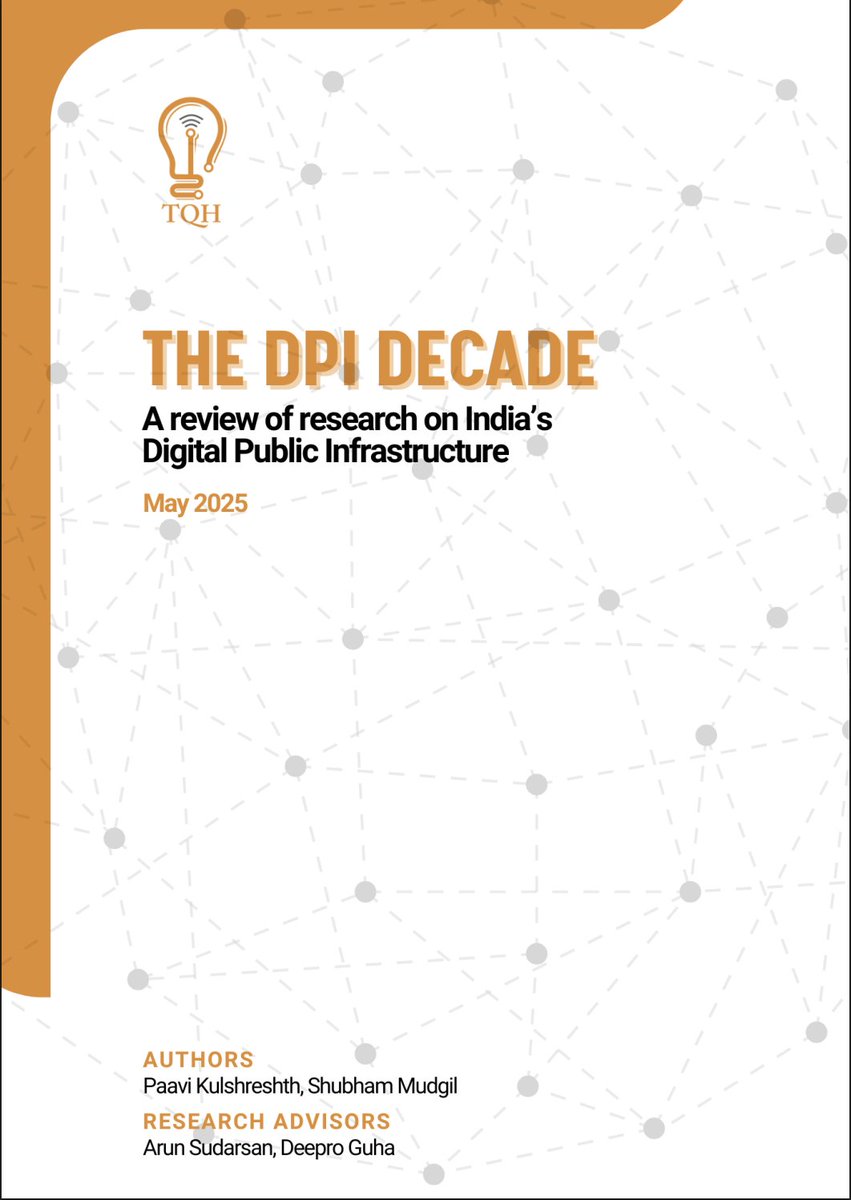
Co-authored this new report on India’s DPI journey — a first step in mapping the evidence gaps in DPI impact. As adoption scales, so must our efforts to ensure access to granular, disaggregated data that can drive meaningful evaluation and informed policymaking around DPIs.
The DPI Decade: An attempt to map the evidence gap in DPI impact — what we know, what’s missing, and why open access to granular data is essential.
We are pleased to announce the launch of a new report that takes a deep dive into India’s Digital Public Infrastructure (DPI) journey.
India is widely regarded as a global leader in DPI. Its national digital ID, Aadhaar, has achieved near-universal coverage (with over 1.42 billion IDs issued), while the Unified Payments Interface (UPI) now accounts for nearly 50% of real-time payment volumes (as of FY2025). India’s DPI ecosystem also continues to evolve, with sector-specific services being built on top of foundational digital protocols to enhance governance, accessibility, and economic growth.
While the scale of adoption is remarkable, its real-world impact remains under-evaluated. DPI systems enable real-time verification, transactions, and for the first time, the possibility of tracking real-time outcomes. However, this potential can only be unlocked if we collect, monitor, and evaluate data that offers meaningful insight into DPI’s impact on people’s lives.
Grounded in conversations with researchers, our report reveals a lack of granular and disaggregated data on DPIs that can facilitate the estimation of its overall impact on society. The report provides an overview of existing research, outlines the data currently available, and highlights critical gaps in access. With this work, we advocate for greater public access to open, disaggregated data that can help realize the full potential of DPI domestically and drive adoption and investment globally.
A big thank you to everyone who supported the research with their inputs!
Read the report here: https://t.co/LvtolxViVJ
#DigitalPublicInfrastructure #IndiaStack #DPI #UPI #Aadhaar #DataForDevelopment #DigitalInclusion #EvidenceBasedPolicy #ImpactAssessment #OpenData #Data4Good #Tech4Good
After prolonged search for this "elusive study," I can confirm that such a study by Ajay Sonkar does not exist. Has any media got the link or copy to this? Indian media behaving like Nazi media, feeding lies to public to keep sentiments alive instead of protecting public health.
Our Call for Abstracts is now open!
In this hybrid symposium to be held on 28 May, 2025 at @Cambridge_Uni, we aim to bring together scholars who engage in the ethnographic method for a collective conversation around movement and method.
#CFA
https://t.co/zsq0ftoe7B
Hello @vijayshekhar ,
Great talking to you at the OpenAI event! As a Paytm fan, I’m really excited about my Paytm Insights idea. A year-end spending trends analysis would be brilliant—I’d be its loudest advocate!
1/ Everyone censors AI - they just won't admit it. Proof: 🧵
I recently tested China’s AI model, @DeepSeek, by asking it about crimes committed by China and crimes committed by the US
In a significant ruling last Friday, the Supreme Court issued comprehensive directions to eradicate child marriage and reinforce the Prohibition of Child Marriage Act (PCMA). While this ruling addresses procedural and accountability measures, Shubham Mudgil (@mudgil_shubham) and Swathi Rao (@swathirrao), in their 2023 article for @Ideas4India, argue that the issue extends beyond legal enforcement. Their data-driven analysis shows that despite the legal marriage age being set at 18 for over four decades, child marriage persists, with 23.3% of females still marrying before turning 18, according to the latest National Family Health Survey (NFHS-5).
Mudgil and Rao highlight that the problem is deeply rooted in socio-economic factors such as poverty, lack of education, and social norms. They argue that legal action should be paired with programs promoting education and economic empowerment, citing successful initiatives like West Bengal's Kanyashree Prakalpa and Karnataka's Sphoorthi Project, which offer incentives to delay marriage and keep girls in school.
Furthermore, regional disparities persist, with states like Bihar and West Bengal having high child marriage rates, while Rajasthan and Madhya Pradesh have seen progress. While the Supreme Court’s decision is a pivotal step in strengthening legal frameworks, a comprehensive approach, integrating both legal and socio-economic reforms, is necessary to fully eliminate child marriage in India.
You can read the article here: https://t.co/ZR9FLEIpXi
VIDEO | Here's what Indian athlete Dutee Chand said on Imene Khelif vs Angela Carini controversy.
"In 2014, I challenged the IOC's rule that a person with a higher testosterone level should not participate in the Court of Arbitration for Sport in Switzerland. It was noted that hormonal level cannot increase athletic performance... I suffered a lot at that time. I faced a lot of controversy regarding my gender. Yesterday, during the Olympic match, (Angela) Carini gave up and now she is complaining about the Algerian boxer because of high testosterone levels. When you play in the Olympics, you undergo several tests. I don't think it is right to create controversy about this social media."
On the occasion of World Population Day, we revisit an article our team wrote for Dainik Jagran (@JagranNews) last year. On World Population Day 2024, the focus is on collecting inclusive data – counting everyone, everywhere, as they are. In an unpredictable world, with rapid population growth, ageing populations, and challenges like climate change and conflicts, reliable population data is crucial for addressing the needs of those left behind.
Shubham Mudgil and Rohit Kumar from The Quantum Hub (TQH) team discuss the need to view India's development through the lens of its growing population. In the article, the authors use data from the Economic Survey 2018-19 and the National Family Health Survey (NFHS) 2019-21 to analyse access to basic services such as water, electricity, and adequate nutrition in India. While most of the population now has access to electricity and drinking water, challenges remain in areas like clean cooking fuel, adequate nutrition for infants, and education for women. @mudgil_shubham@rohitkr_RK
You can read the full article here: https://t.co/ZoktjPKMtE
#WorldPopulationDay
Are you a public policy enthusiast eager to shape the discourse on rapidly evolving policy issues? Do you keep track of tech policy or social sector policy, particularly in areas like gender, accessibility, and financial inclusion? If yes, we're looking for someone like you!
The Quantum Hub (TQH) is expanding its team and hiring for several positions, including Associate, Public Policy.
If you have a degree in economics, law, public policy, political science, or related fields, along with 1-2 years of experience in policy research, policy communications, journalism, or advocacy, we encourage you to apply.
You can see other openings on our website here: https://t.co/mmHavgpHlU
Apply now!
#Hiring #PublicPolicyJobs