How do we make computers give a damn about us? We can’t design responsible AI models, but we could evolve them through artificial selection, as I argue in this piece in September’s @Epoche_Magazine issue. https://t.co/yQa6uh8fdn
@_beyondwithin_@DrTomFroese I’d encourage you to work it up and get it out there! This came from a paper last semester in my MA. The process of reworking it was very rewarding. And as you say, there’s not a lot of attention being paid to this aspect of the gap between AI and recognizable intelligence.
@_beyondwithin_@DrTomFroese That’s exactly the problem. Next-gen models are getting beyond needing advanced knowledge of specific objects and contexts, but they still don’t care. We can’t rely on unless they (somehow) start to care like we do.
@DrTomFroese Thanks! The evolution part is definitely speculative. Difficult even to think how you’d program in survival instincts like more rudimentary animals have. The related argument would just be that design is a total non-starter: it’s evolution or nothing (so maybe nothing).
How do we make computers give a damn about us? We can’t design responsible AI models, but we could evolve them through artificial selection, as I argue in this piece in September’s @Epoche_Magazine issue. https://t.co/yQa6uh8fdn
“The magic of automation leads us to believe that the world’s resources are endless. Death can be indefinitely delayed, it seems. Nature cannot hold us back. We start to think like our models.” Indeed, over-estimation of AI can lead to under-estimation of the human being.
@TuomasPernu @DebiecJacek There is a growing philosophy community on bsky, including a lot of philosophers of science. I have an invite if you’d like to try it out!
I recommend Kant’s metaphysics for children as young as 10. It has this salutary effect:
My 10 yo: Dad, I’m boooooored.
Me: You can sit with me and read the Critique of Pure Reason!
My 10 yo: Boring! *goes to find something to do, because I am hopeless*
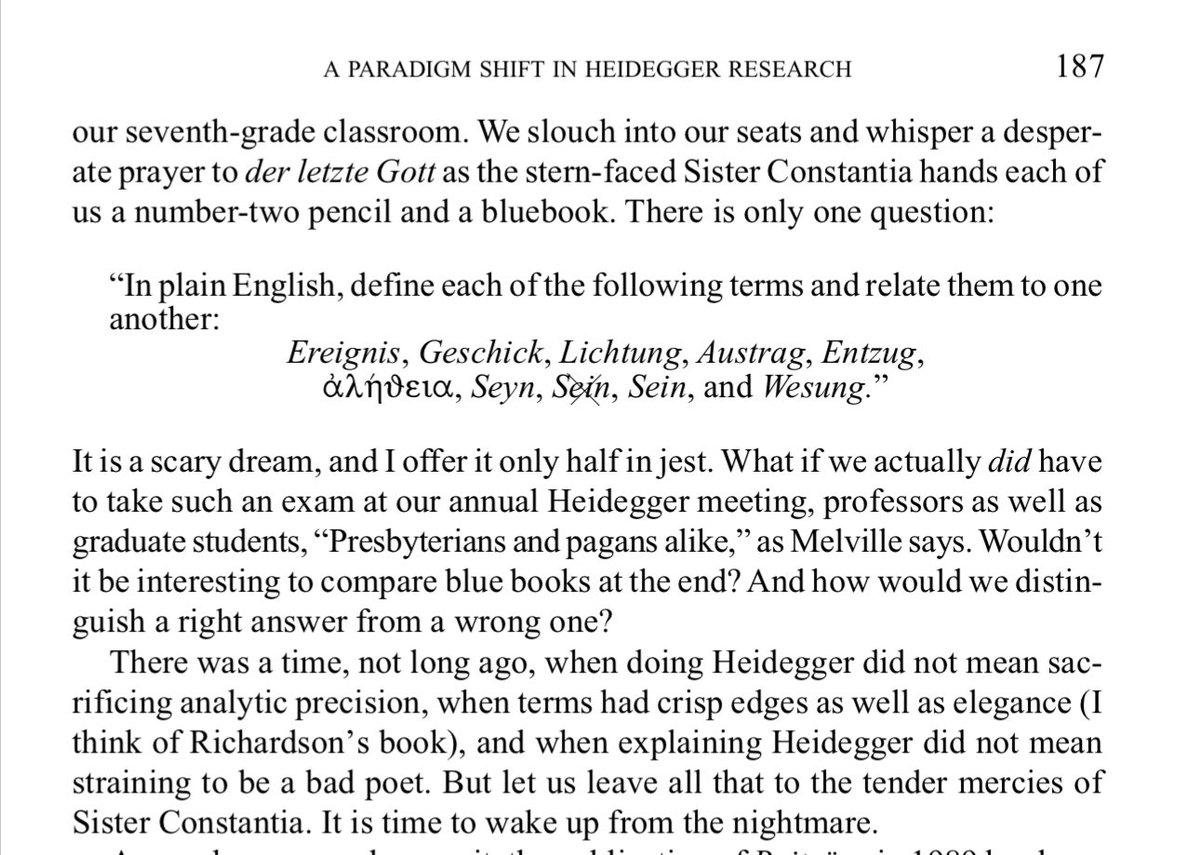
Thomas Sheehan describes the state of Heidegger scholarship ca. 2001 through a lively classroom nightmare and a fictional Sister Constantia at the head of the class (with a ruler, surely).
I don’t (yet?) have a dog in this almost 20 year old fight, but it’s entertaining.
Are you into #complexity science? Have you been considering checking out the other platform? 🟦
We’re building up a community of complexity researchers over there. There’s even a specialized feed dedicated to complexity science.
I have several invite codes. Hit me up!
#philsci
@RCarhartHarris@AmisDeBergson He is one of the few philosophers where I’d recommend just diving in without preamble, perhaps to Time and Free Will or Creative Evolution. He won the Nobel Prize for literature and is a pleasure to read!
No love for footnotes from a philosopher who wrote an entire paper on footnote eleven in “What Is It Like to Be a Bat?” Fantastic advice on writing and doing philosophy from Daniel Stoljar in this interview. https://t.co/W8dglOnuYu
@BiltoftCN @nonmarkov_field @AmisDeBergson Matyaš Moravec, “Henri Bergson and the Philosophy of Religion”. I haven’t dug in yet but it looks very good!
@SamaraJG@fidlerfm Sorry that I didn’t respond to this last week! Brian Cantwell Smith and Mathias Risse come to mind as senior scholars. Smith’s recent book on AI is exceptional. I’m still learning the lit so don’t have as many recommendations as I’d like.
@aufgehenderRest Just started, it’s entertaining so far. Reminds me of Adorno’s lectures on the first critique: clearly values Kant’s contributions, also picks a fight on page one. Strawson claims Kant’s arg is self-defeating: trying to limit reason from a point outside reason’s legitimate use.