I talking to my friends for years now - all you have to do is stick around crypto no matter market conditions.
I was curious how much have I made from airdrops so I can show them numbers.
Here’s what I dig from going trough tx history on @DeBankDeFi 👇
We are now officially on the other side of 4$ per $IMD
Pepes missing that probably 10% of supply of projects built by protocol goes to NFTs that built it.
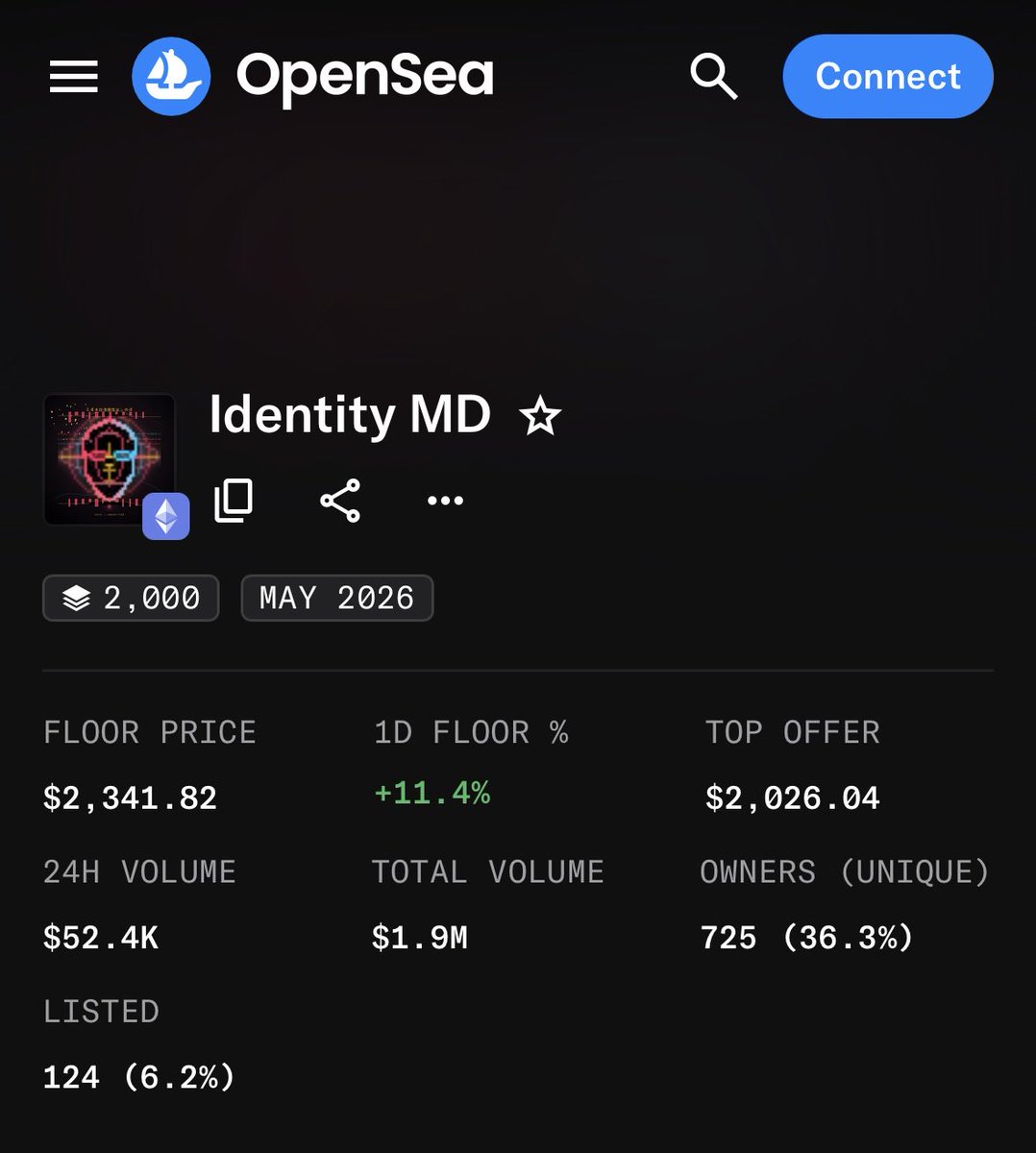
Identity MD NFTs repricing incoming
With $IMD and the NFTs hitting new ATH, I wanted to break down the project for new holders.
IdentityMD is building a system where AI creates products, NFTs identify participants in the contributor network, and the $IMD economy is meant to fund its operations.
Let’s walk through it from a potential customer’s perspective.
>> Someone comes in with an idea
Say they ask “Build me a token and a market with specific trading rules”
It is important to separate two things:
> Community Coins: a separate coin launcher that already exists. It has a form with a name, ticker and launch button.
> The core IdentityMD project: a broader concept involving an AI coordinator and a network of nodes. A simple launcher being live does not prove that this network is operational.
The system may primarily work on its own projects rather than orders from external customers.
The docs discuss launching ideas and running the lead AI coordinator, but do not yet describe a ready-to-use marketplace for services.
>> Who coordinates the work?
The docs mention a lead orchestrator, the main AI coordinator.
In simple terms, this is the central agent around which a network of other participants is planned.
It is reasonable to expect it to turn ideas into tasks and coordinate their execution.
>> Who does the work, and why do they need an NFT?
Based on Adam’s previously uncovered messages, the expected participant setup looks like this:
one Identity.md NFT > one daemon > access to Codex or Claude > an always-on computer or VPS
A daemon is a continuously running program. The operator runs and maintains it.
In this model, the NFT serves as an access pass and an identifier for a specific network participant.
The program is expected to interact with AI and carry out assigned tasks. This means the operator does not necessarily need to write code themselves.
4. How does the system check whether the AI did the work correctly?
The expected workflow:
task > code generation > independent verification > result acceptance > test deployment and an onchain record
The public test repo is designed for end-to-end testing of the contributor network.
The contract template requires reproducible builds and restricts changes to files that could let a worker tamper with verification.
The Sepolia executor and registry uncovered earlier add another piece to the picture: execution results can be recorded onchain.
>> Where does IMD fit in?
The most likely role for IMD is to become the financial backbone of IdentityMD’s AI network, helping the system accumulate resources for compute and participant rewards.
Part of this mechanism already works. POOL4 withdraws surplus IMD from the trading pool, sends the bulk of it to burn, and distributes the rest between stakers and reserves for AI and NFT nodes.
Stakers receive existing tokens, with no additional emissions.
The next planned step is bonding: selling reserve IMD for ETH at a discount with gradual vesting, to fund compute for the lead AI coordinator.
A separate reserve is earmarked for future NFT-node rewards. This connects trading activity, staking and network funding through IMD.
But mandatory IMD payments for customer orders, operator collateral and the exact payout rules remain unconfirmed.
>> How does the IMD reserve turn into compute funding?
the protocol accumulates IMD > sells part of the reserve for ETH at a discount with gradual vesting > spends the ETH on compute for the AI coordinator
The bond buyer gets tokens on specified terms, while the protocol gets funds to run the AI.
The docs say bonding will open at $4 per IMD. For now, though, the reserve is live, not the bond market itself.
>> Who benefits, and how?
An IMD staker deposits tokens and receives sIMD, representing their share of the vault. Rewards increase the amount of IMD backing that share.
An NFT-node operator is expected to participate in the network’s work. A dedicated reward reserve is already in place for these participants.
A bond buyer will eventually be able to provide ETH to the protocol in exchange for reserve IMD on specified terms.
In short:
> the NFT is meant to identify a participant in the contributor network
> IMD plays a role in its economy
> sIMD represents a share of staking rewards
> bonding is meant to turn accumulated IMD into compute funding
We are now officially on the other side of 4$ per $IMD
Pepes missing that probably 10% of supply of projects built by protocol goes to NFTs that built it.
Identity MD NFTs repricing incoming