بہت حیرت انگیز فوٹیج ۔ کس طرح پمز میں دو نرسیں آگ دیکھ کر بھاگ گئیں اور ایک مسیحی مذہب سے تعلق رکھنے والی نرس رضیہ نورین نے دلیری کے ساتھ اپنی جان خطرے میں ڈال کر ایک بچے کو سینے سے لگا کر بچا لیا
#Muhammad_Ali_Jinnah in #Kashmir, 1945.
Two photographs taken by my father, Ghulam Mohammed Kathwari, who knew Jinnah personally.
On #Pakistan_Independence_Day, I share them from our family archive—81 years after my father stood behind the camera.
Sir, thank you for sharing. You made a long journey enjoyable. I read it while traveling back from Shikarpur to Karachi after the Eid holidays . Was so engaged that I did not even notice the train arrived one and a half hours late.@steveshaw2020
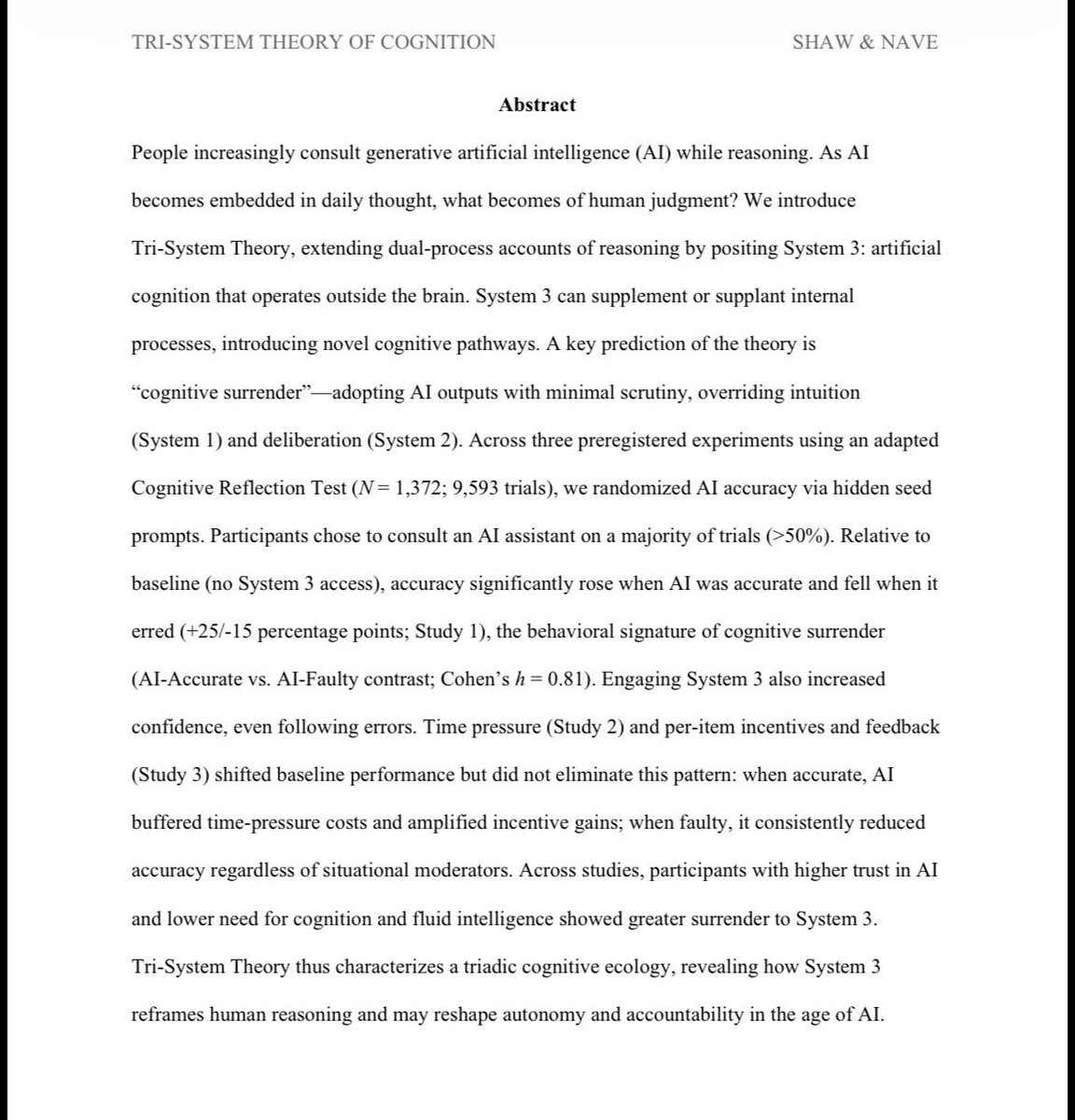
“Cognitive Surrender” - a new study argues that use of AI leads to suspension of human reasoning, not its augmentation. The implication being that over time people will lose their reasoning ability & use AI as its substitute. Download the paper for free here, excerpts & reference below:
https://t.co/ZlWbD0b6CJ
——-
“As people increasingly integrate AI into their decision-making processes, they interact and engage with a cognitive system that can reshape the functions of both intuition and deliberation. For example, System 3 can replace System 1 by offering confident, ready-made answers that preempt the need for intuitive reasoning.” (page 15 of pdf)
“As AI systems increasingly participate in human cognition, a new phenomenon emerges that cannot be explained by traditional concepts such as cognitive offloading or automation bias alone. We define cognitive surrender as the behavioral and motivational tendency to defer judgment, effort, and responsibility to System 3’s output, particularly when that output is delivered fluently, confidently, or with minimal friction. Unlike cognitive offloading, which is typically strategic and task-specific (e.g., using GPS to navigate), cognitive surrender entails a deeper transfer of agency.” (Page 17)
“Access to System 3 outputs significantly influenced accuracy, increasing correct answers when AI was correct, and decreasing accuracy when incorrect. Access to System 3 made decision-makers more confident, despite approximately half of System 3 outputs being incorrect. Finally, users who trust AI more and have lower NFC and fluid IQ were more likely to display cognitive surrender. Whether System 3 was accurate or faulty, its presence displaced internal reasoning.” (Page 27)
“Cognitive surrender was robust across studies.” (Page 42)
“Across our studies, we observe that when System 3 was available, people readily engaged it and frequently adopted its answers. This shift reflects a reallocation of cognitive control rather than mere effort saving. System 3’s fluent, confident outputs are treated as epistemically authoritative, lowering the threshold for scrutiny and attenuating the metacognitive signals that would ordinarily route a response to deliberation. In the case of cognitive surrender, there is a shift in the locus of control, with an external system (System 3) occupying the default position.” (Page 45)
“Time constraints clarify why surrender arises so readily, while incentives and feedback show that surrender is malleable. When decision time is scarce, the internal monitor detecting conflict and recruiting deliberation is less likely to trigger. Hence, the low-friction path to defer to external cognition becomes attractive.” (Page 46)
“Tri-System Theory is not a warning about AI’s dangers but a recognition of System 3’s psychological presence. We do not merely use AI; we think with it. In doing so, we must ask new questions: What happens when our judgments are shaped by minds not our own? What becomes of intuition and effort when a generative, artificial partner stands ready to answer? How do we preserve agency, reflection, and autonomy in a world where users engage in cognitive surrender?”
On Monday, December 29, I’ll be yammering on about the first quarter of the 21st century - where we at, & where we going - at the Department of History, Quaid I Azam University, Islamabad.
If you’ve really got nothing better to do, no plans with friends, no shopping, then do drop by! 😊
Details 👇 (call to register, because we’re old school & haven’t checked our emails since Obama was POTUS)
15 years ago, The Culture of Power and Governance of Pakistan, 1947-2008 was published by the Oxford University Press.
The book remains in print and is occasionally a topic of discussion.
Here is a thread of videos about the book.
If you want to learn more about how Pakistan’s governance has evolved and what long-term factors have shaped the country’s fortunes since it gained independence do get the book and/or watch the videos posted below. 1/11
https://t.co/WiSkEjrRSU
amazing piece of scholarship from @IlhanNiaz. To reform today’s institutions, we need to understand how/why they were built during the British Raj. Root of the problems run deep-colonial deep.
1. There’s no such thing as a global conscience.
2. No state accepts any authority greater than itself except when compelled to do so by other states.
3. Other states aren’t yet willing to compel Israel to stop the genocide. Not even the Arab ones.
4. The world is back to the 1930s - indiscriminate use of military force by states to exterminate civilian populations is ok again.
Sat down with Shayan Mahmoud, host of the How does it work? Podcast for a discussion about India-Pakistan, nukes & future prospects:
https://t.co/L8vo4AwJ42
While I am scheduled to have lunch at home today, I do hope to head out for dinner. 😃
Indian social media in full meltdown today for some reason.
They’ve had so many meltdowns since May 6 that it’s hard to keep track.
Will investigate this ‘new normal’ further.
India’s military confirmed for the first time that it lost an unspecified number of fighter jets in clashes with Pakistan in May.
Anil Chauhan, chief of defense staff of the Indian Armed Forces, spoke to Bloomberg TV on Saturday, while attending the Shangri-La Dialogue in Singapore: https://t.co/HVJj6NwMFW
This is the school bus India's terrorism attacked today in Khuzdar, Balochistan. Four children martyred. 44 injured, many with life-threatening injuries. This is what Modi's mad men do. This is what India stands for.
A week can be a long time in geopolitics, a lesson India has learnt the hard way, since Modi has been cut down to size within a week with a hat-trick of setbacks: Military defeat at the hands of Pakistan, a smaller neighbour; India’s bigger neighbour, China, has renamed disputed Arunachal Pradesh (previously, South Tibet) as Zangnan & renamed 27 important locations of Zangnan, including mountains, rivers & residential areas; Modi’s erstwhile ‘buddy’, President Donald Trump, is singing praises of Pakistan while actively reviving the Kashmir Issue! No wonder India has panicked, dispatching 7 Parliamentary delegations to all parts of the world for lobbying!