🚀 Applications are now open for Round 2 of the NCRIS Synthetic Biology Voucher Scheme! Access up to $75k (matched funding) to accelerate synthetic biology R&D through Australia's NCRIS infrastructure.
📅Apply by 11 Sept 2026. Learn more: https://t.co/ztZLUcePQS #NCRISImpact
New data in ESMO Real World Data provides a decisive case for the immediate adoption of universal whole genome sequencing (WGS) as the standard of care in Australian oncology. 🧬🇦🇺
The study proves the diagnostic superiority of comprehensive whole genome and transcriptome sequencing (WGTS) over traditional, piecemeal panels using routine pathology tissue. For complex cases and cancers of unknown primary (CUP), this multi-omic approach significantly accelerates tissue-of-origin resolution and identifies actionable therapeutic biomarkers at first instance.
Replacing iterative panel testing with an upfront WGTS model eliminates the diagnostic odyssey and secures equitable access to precision medicine. To deliver truly modern cancer care, Australia must transition WGTS from a specialized utility to the national standard.
Read the study: https://t.co/f0TyI3fNwm
#PrecisionOncology #ClinicalGenomics #AusHealth #GenomicMedicine
The Short Read has finally returned for its First Re-Issue- featuring an article from The Long Read where we explore the end of the The "short read vs long read" debate as it gives way to "Which technology best answers your research question"
https://t.co/iopekkwzib
Sequencing is not just a test. It is the front door to the next cancer system.
My OpEd in @australian is online today, ahead of tomorrow’s @UNSW Showcase at Parliament House.
It begins with Rosie, a staffy cross with incurable cancer, but the broader argument is about national capability: #cancer #genomics as the foundation for better treatment decisions, faster clinical trial matching, #AI-enabled interpretation, #RNA therapeutics and smarter evidence around expensive new medicines.
Australia has the proof points. The challenge now is scale: making comprehensive cancer genomics routine, equitable and connected to the infrastructure needed to act on it.
Tomorrow I’ll be at Parliament House with @PalliThordarson discussing how Australia can build this system here, rather than import it later on someone else’s terms.
🔗https://t.co/2ueCXVls2i
Are you attending @IOA_UWA's 2026 Industry Forum on July 8? Why not make the absolute most of your visit to #UWA by attending this special @CrawfordFund for Food Security WA, @RaidNetwork WA & @AgInstituteAus networking event immediately before! https://t.co/4KPfL03rLO @SAgE_UWA
I’m sure you have also wondered whether AI will replace bioinformaGicians? Until yesterday, for me the answer was obvious. But then I read this.
Gho et al. make a point that sounds simple but isn't. AI can write your favorite omics pipeline, summarise your literature, generate your methods section…but it can’t tell you if any of it is actually correct!. Whether the model fits your data, whether the result makes biological sense, whether something that looks right is actually wrong…well, that still needs a person who genuinely understands what they are looking at. The model has no idea when it is producing nonsense, and that, that IS the whole problem.
Everyone talks about model architecture, but how good the output is often comes down to the training data, and getting that right needs someone who can spot a batch effect, catch label noise, notice when a benchmark result means nothing in the real biological context. I had not thought about it this way before.
The bit in bias also makes sense. A model that works less well for certain patient populations is not an ethics conversation you have separately from the science. It is just the model being wrong, and someone needs to know enough to see it.
Not sure I have fully changed my mind. But I am thinking about it differently.
https://t.co/BnnaljfPwU
🧬 Over 94,000 completely novel lncRNAs discovered. A comprehensive study in @NatureMethods has mapped the spatial landscape of non-coding RNAs across 13 solid tumors. By integrating single-cell and spatial transcriptomics, researchers compiled the SPanC-Lnc database. 🧵
We are excited to offer a new stem cell and developmental biology grant program for researchers who are new to using the Parse Evercode technology! Register to join our information session on April 15th for application details: https://t.co/c9UAzWsseg
BREAKING: Starlink India launch just got closer.
SpaceX has just signed an MoU with Meghalaya to bring satellite internet to some of the most remote and hard-to-reach regions of the country.
SAHMRI researchers Prof David Lynn and Dr Natalie Stevens joined ABC Radio to talk microbiome - does it help or hinder vaccines? 🦠
They discussed this research, and the AVIRS study, which is seeking participants to understand more about it.
Listen 🎧 https://t.co/K9MDSwGtkh
Our newest addition, Illumina MiSeq i100 Plus🧬- an early start to the festive season @SA_genomics.
Fast, compact, powerful, and ready to deliver data in time for the holiday season. Learn more about our sequencing capabilities: https://t.co/xLmrIcw151
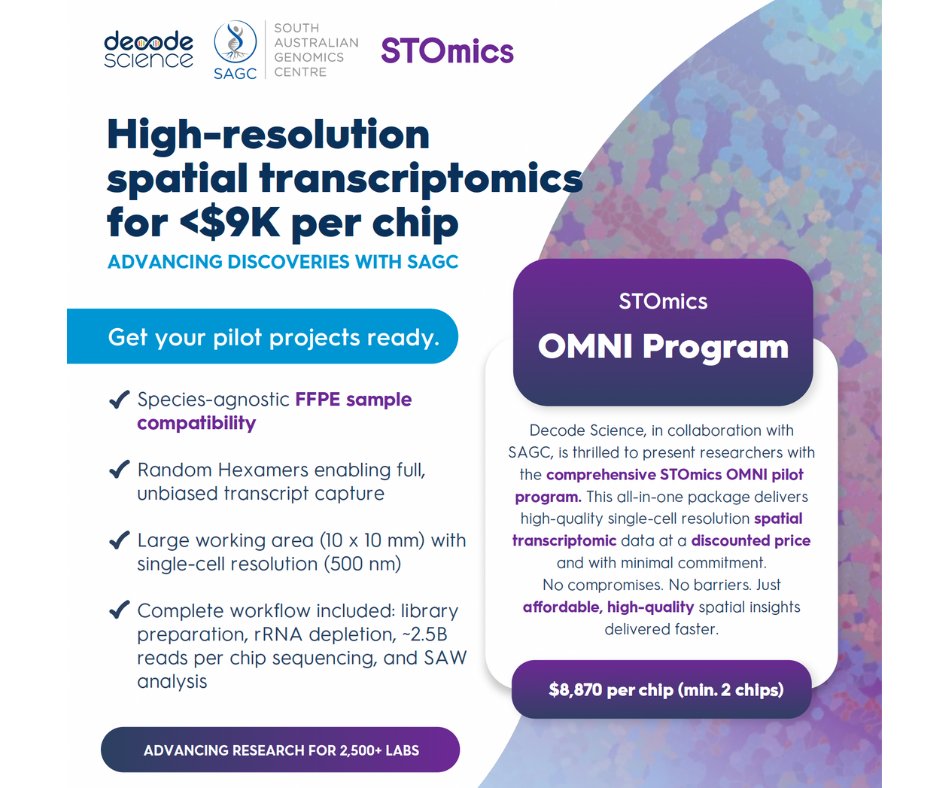
Now Open! STOmics OMNI pilot - SAGC, @Decode_Science - spatial RNA from FFPE—end-to-end service.
Why STOmics OMNI?
✅ Species-agnostic
✅ Random hexamers (total RNA)
✅ 10×10 mm area at high res (500 nm)
✅ End-to-end workflow
Get your projects ready→https://t.co/89PjKQU4Eb
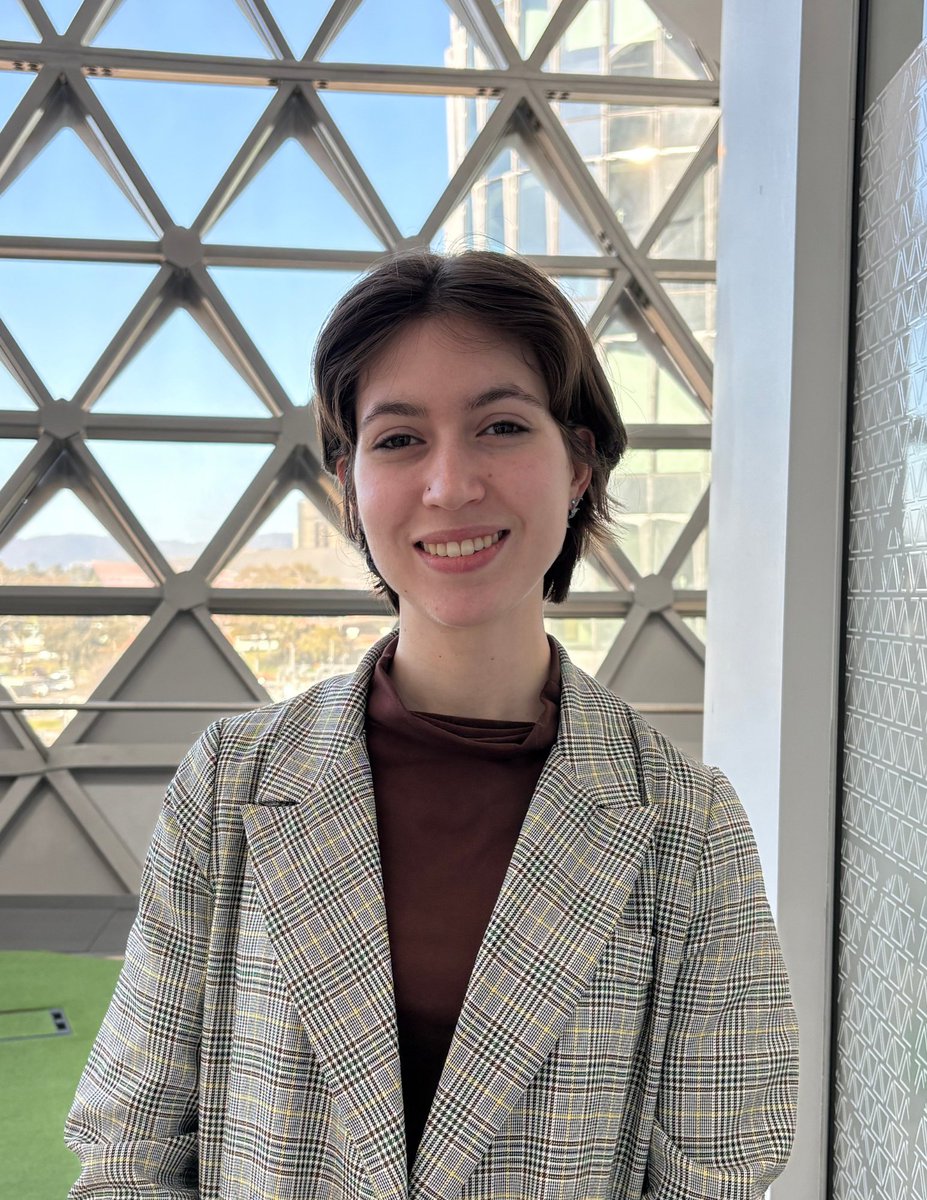
We’re thrilled to welcome Olivia Flynn to our Genomics Team.🧬Olivia recently completed her Master of Genome Analytics @MonashUni and has a passion for #rare_disease research and translating genomics into improved health outcomes. Please join us in welcoming Olivia to the Team.
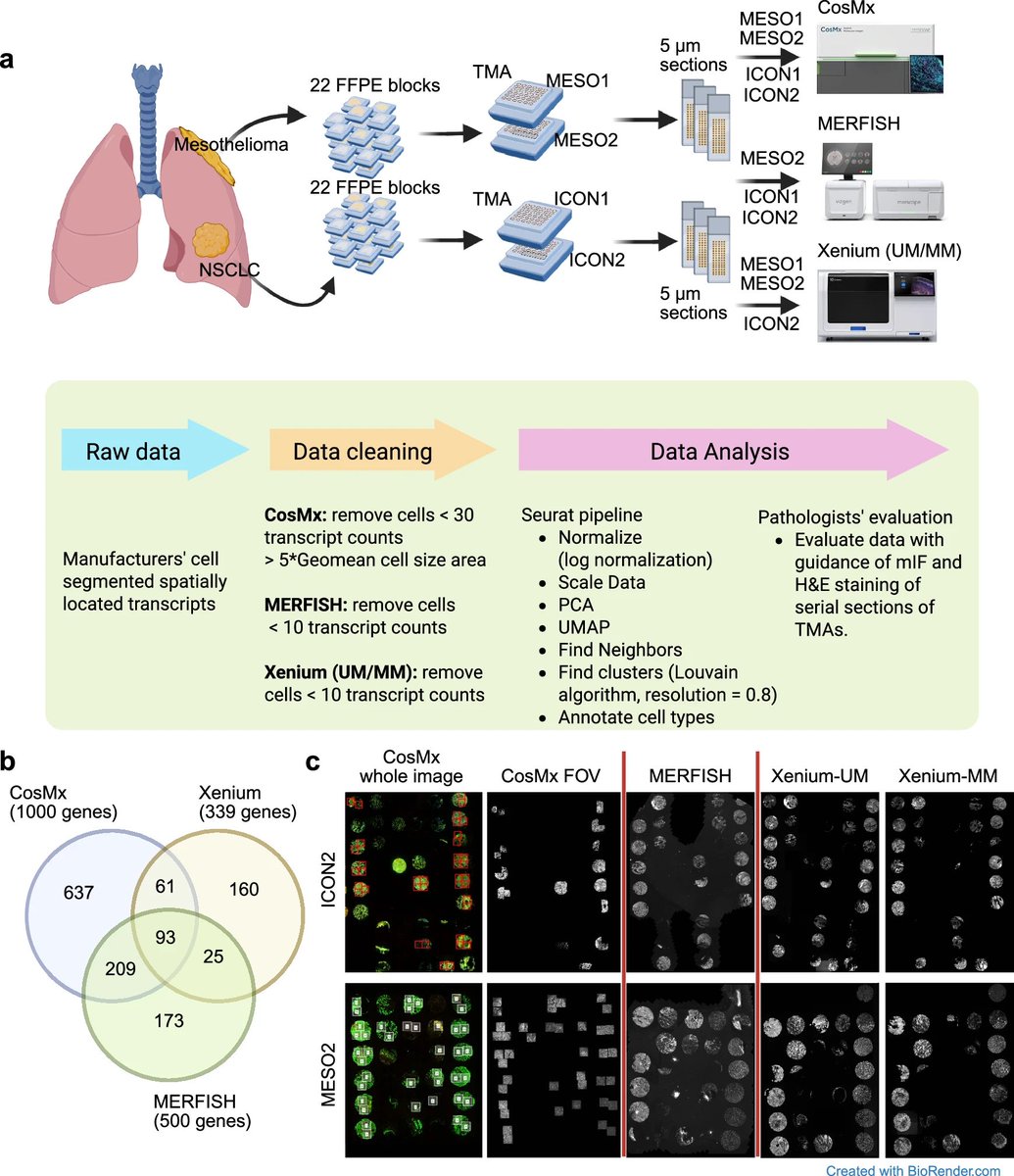
CosMX, MERFISH, Xenium… so many choices, so little time and money!
Nice study from @MDAndersonNews comparing these single cell resolution platforms in archival materials.
https://t.co/y4Xts0Y9LK
TL;DR there is no one perfect answer. Many factors including block age matter.