Self-organized criticality can occur in cellular systems, but its origins remain unclear. Now it is shown that cytoskeletal criticality is influenced by the F-actin architecture and myosin active stress.
https://t.co/C2qkhWRmZL
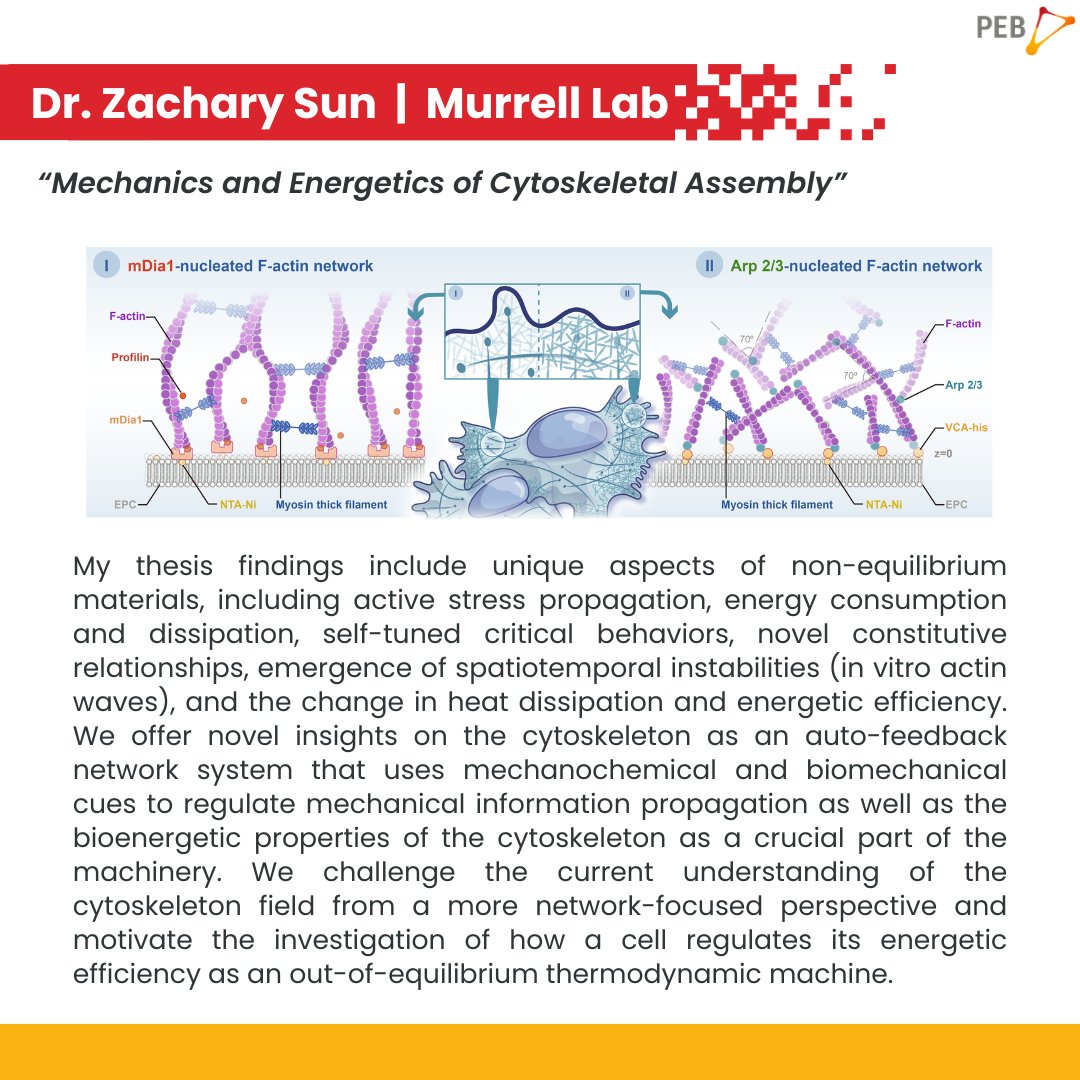
This piece of work cannot be done without the collaborative efforts with the @GareginPapoian lab at @UMD_CollegePark . We show both in vitro and in silico that actomyosin cortex exhibits criticality which can be tuned via mutual feedback between architecture and active stress.
Our latest paper in Nature Physics shows the actomyosin cortex self-organizes to a critical state via mutual feedback between dynamical F-actin structural remodeling and active stress. This further links cytoskeletal criticality to Anderson Localization. https://t.co/Vb0TVDLjqk
Congratulations to the Yale Systems Biology Institute’s Michael Murrell, who has received support from @HFSP for an has intercontinental project spanning the US, UK and South Africa to uncover the driving force in cyanobacteria https://t.co/x4c7HFuCUM
Get your hands into oobleck - a material that feels as hard as a block of cement when you slap its surface, yet is too liquid to hold in your hand! Soft matter physics and Biophysics can be so much fun!
Have you ever heard of the addition of connectivity without the penalty of an increase in rigidity of the network?
The work piece of our latest rheological study on in vitro cytoskeletal materials by our PhD student, Zachary Sun, is finally out today!
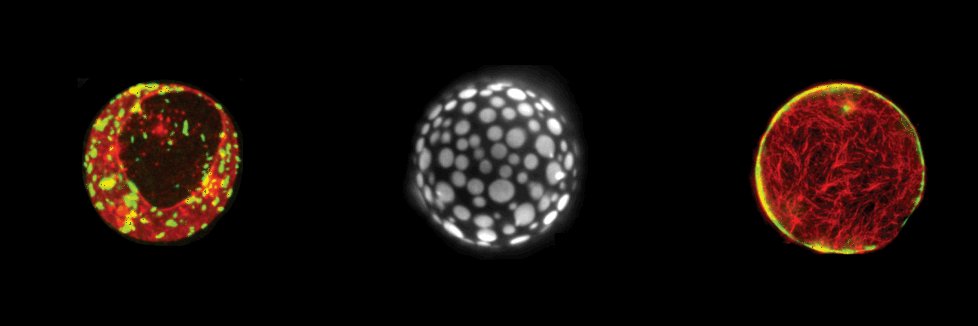
Check out our latest in vitro actomyosin cortex liposome work by Dr. Ryota Sakamoto! First paper to quantify and characterize the mechanical power and chemical energy consumption during cell division-like processes! On Nature Communications: https://t.co/8sXIfwqNhL
New Preprint! How can cells polarize in the absence of a stimulus? We suggest a surprising biophysical mechanism, protein caging!
We reveal how the complex mechanical interactions at the cell surface lead to symmetry breaking.
https://t.co/BOwbtxlago
West Campus scientists at the Systems Biology Institute have discovered the thermodynamic principles underpinning energy use in our cells - and a potential pathway to tackle diseases like cancer https://t.co/xql7cHHq2a @murrell_lab@NaturePhysics
Happy new year from LLM!
Our latest article on in vitro reconstituted systems: 'Cofilin-mediated actin filament network flexibility facilitates 2D to 3D actomyosin shape change' in EJCB special issue 'In vitro reconstitution of cytoskeletal processes'
https://t.co/Dy19xjXO8k
Visualization of f-actin within liposomes during their adhesion, spreading and rupture reveals mechanical interactions of membrane and cytoskeleton can lead to complex cellular assembly in absence of cellular biochemical regulation. @murrell_lab
https://t.co/5tJh1gFpUv
A long but rigorous and constructive review at @PhysRevX finally resulted in our latest manuscript, where we demonstrate a novel pressure-driven flow of cells out of a cell aggregate.
Observations of pressure-driven motion of cells reveal a novel type of cell migration and cooperation between cellular- and tissue-level forces, with implications for cancer cell movement and early organism development. Read https://t.co/rjTLd4g47E #PRXjustpublished#openaccess
Yale News covered our recent work on pressure-driven flows in cell aggregates that appeared recently in @PhysRevX. We thank @YaleWestCampus for their support and Jon Atherton for condensing 3 papers into this great story.
The @murrell_lab has taken a fresh look at how cells move, revealing similarities between the behavior of #cancer cell tissue and the simplest water droplets https://t.co/elOYsUSCc2 @PhysRevX @YaleSEAS
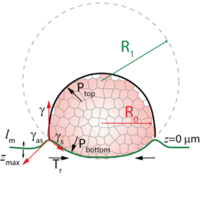
Check our latest paper in the journal Physical Review Fluids. Here we report motion in tissues that resemble Marangoni-like flows in fluids, except that it is being driven by solid-like surface tension.
https://t.co/zylW8wQ75t