Pleased to share our recent work on an NHC-catalyzed one-pot reaction to access indanone-fused pyrrole derivatives via a tandem aza-Benzoin–Michael addition–lactamization process.
Check it here: https://t.co/hUMdhTVBmH
Congratulations to @bandari25057@PrshntSinha8507
I will be back in Scotland during the first week of April, giving some talks in Glasgow and St. Andrews. The general public talk is non-technical and should be accessible to anyone who likes a little bit of science and some (hopefully) funny stories. The technical talk is about the invention of chemistry to access molecules that can be tested as medicines. If you are interested in either please come along….. and please stay to say hello at the end.
Tues April 1, 5:30pm: St Andrews University, General Public Talk. Pathways in discovery and in life; From Bellshill to the US to the Nobel Prize (see attached flyer). Open to all
Wed April 2, 2pm: St Andrews University, Technical Talk. The Development of Asymmetric Organocatalysis and Metallaphotoredox. (Booth Lecture Theatre, Medical and Biological Sciences Building). Open to all
Thurs April 3, 5:30pm: Glasgow, Royal College of Surgeons and Physicians. General Public Talk. Pathways in discovery and in life; From Bellshill to the US to the Nobel Prize. Open to all
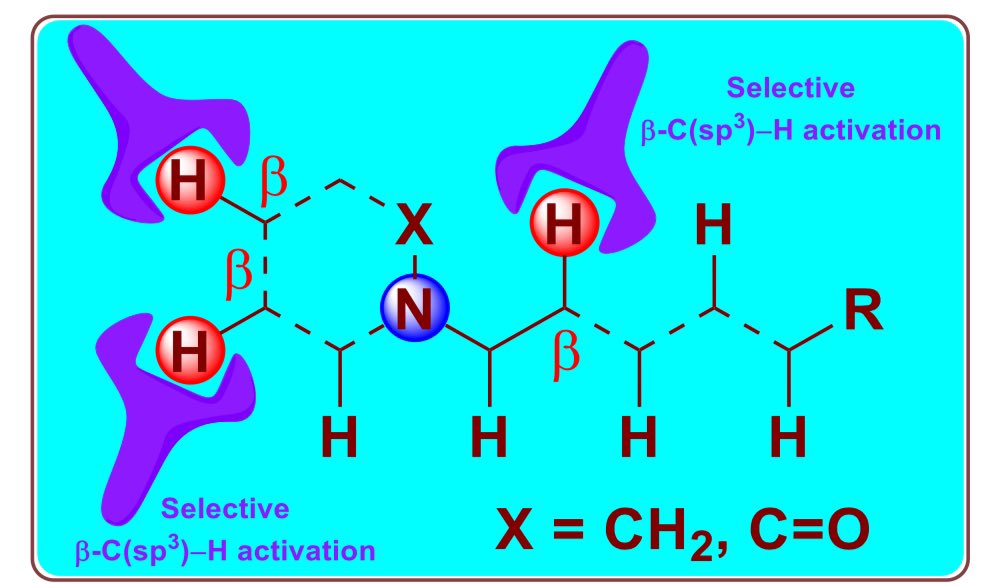
Check out the recent review on “Regio- and Stereoselective β-C(sp3)‒H Activation/ Functionalization of Saturated Nitrogen Heterocycles, Amines and Amides” in @AdvSynthCatal
Congratulations to @SANJAYY11298402@murugeshprasad1
Check it out here :- https://t.co/s4EaUY4Xbb
Our recent work on "NHC-Catalyzed Formal [4 + 2] Annulation of o‑Formyl-Tethered Michael Acceptors and Ynones to Access Highly Functionalized Naphthalene Derivatives" is now at @JOC_OL. Check it out! https://t.co/NCrFoIuUHx. Congratulations to Ramarao and Rambabu. @csiriict
3 year PostDoc position available. Collab between LAMM and @toninellisister's group. We are searching for a synthetic chemists skilled in air sensitive synthesis of metal complexes. Send me a CV!
This is how I advise my #PhD students to write research manuscripts (in case someone finds it helpful).
General points:
1. Research questions addressed by your manuscript are key and should guide you.
2. Don’t view your manuscript as an article. See it as a STORY.
3. Pick the writing style that is easily understood by a broader community. Make reading easy.
4. Most of data should get into the paper. If some doesn’t support the hypothesis, it still must be in the Suppl. Information. It must show the reproducibility limits.
5. Make the paper shorter, not longer. Cut out things that may sound like ‘bluff’ or ‘decoration’ of the story. Use well-defined terminology, don’t invent it unless clearly necessary.
6. Focus on reporting & explaining the numbers. Minimize discussions of qualitative outcomes and your imagination.
▫️
Specific steps:
1️⃣ First, formulate and polish the key questions that your study addresses. It may take hours or even days (even though you've been doing research in this area for years). A single study should address no more than 1-3 key questions. It’s your perfect start for writing.
2️⃣ Write down the structure of your STORY first: Sections and Subsections that will answer those questions. Into each subsection, put 1-2 sentences that formulate the message(s) from this subsection. It will hugely help you navigate the manuscript later and save a lot of time.
3️⃣ Write approximate messages in the conclusion section. Usually, no more than 1-4 sentences.
▫️
At this point, SHARE your [structure+questions+messages] document with your advisor for feedback. Toss it back and forth until you both converge. You can also include major collaborators if needed.
▫️
4️⃣ Write the introduction part. Put down the paragraphs that introduce a reader into the key question(s) of the manuscript and the background of your story.
5️⃣ Write the main text for each section, smoothly and firmly. Each paragraph should add a separate value and end with a message-like sentence. Follow the “First… Second… Third…” structure for paragraphs when possible, it gives rigor and readability to your story.
6️⃣ Write the conclusions. Add a broader perspective that is justified and not generic.
7️⃣ Write the abstract. It must have simple terminology and clearly explain what readers can find inside the paper. It also should contain the key conclusions.
8️⃣ Write up 4-5 different titles and spend >30 mins with your team discussing which title sounds best.
Finally, iterate on the resulting draft within your team.
The number of drafts can easily exceed 20.
▫️
❗In addition, I always emphasize that a high quality of your research paper:
- sharpen your writing and analytical skills.
- shapes your reputation.
- shows who you are as a researcher and communicator.
▫️
p.s. Everyone has a different style of advising and writing. You can adopt only some specific steps if you find them helpful.
p.p.s. Another way that we sometimes use is by starting with figures ('story in figures' style).
#AcademicTwitter #AcademicChatter
Very excited to announce a new 3 year post doc position in my lab @newgroupchem, working on the synthesis and application of responsive probes for biological systems, funded by @ARC_CIPPS. Visa sponsorship available. https://t.co/I7KnPPCudO @SydneyChemistry
Please RT.
📢 Come and join us for #OCCHA2023 - Opportunities and Challenges in C-H Activation – online symposium on 25th May 2023, featuring an incredible panel of international experts in the field. Register here: https://t.co/6evBlzLCun
#chemtwitter#CHActivation#OnlineSymposium
Happy to share our recent finding on three component regioselective aryl methylation of unsymmetrical alkynes now come in ACIE. Congratulations to @Shubham Dutta.
https://t.co/DpxbefxVRJ