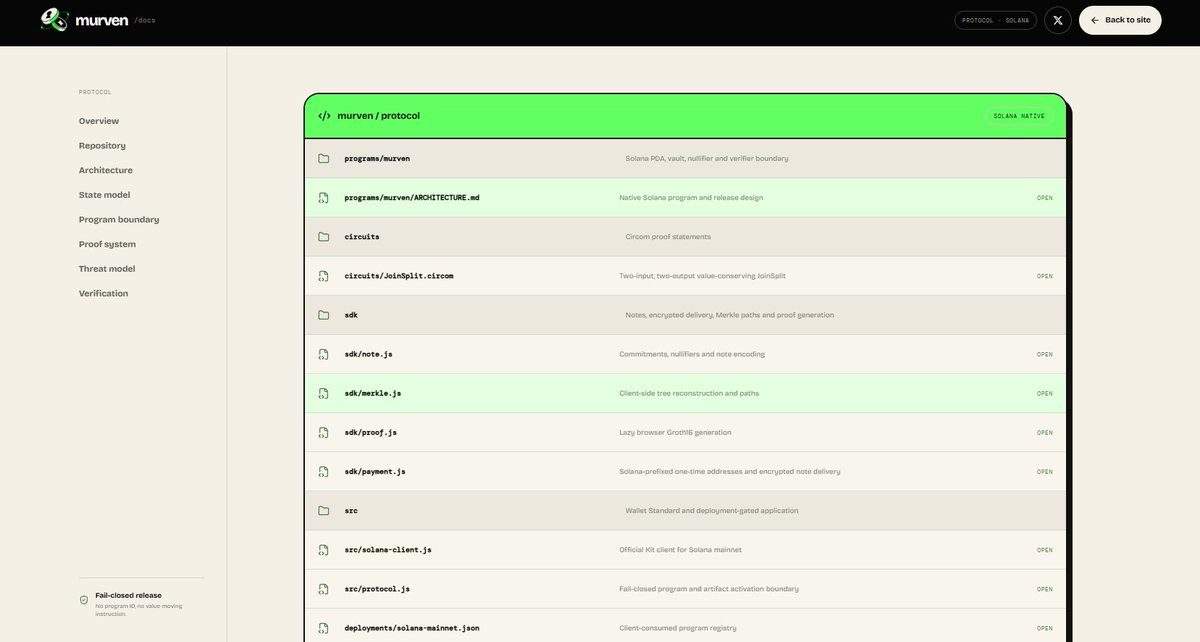
Murven’s current codebase is now fully open source.
This was something we decided on from the beginning.
For a privacy protocol, security shouldn’t depend on trusting us.
The code should be readable.
The cryptographic implementation should be inspectable.
The security assumptions should be challengeable.
And potential problems should be open for anyone to find.
We’d rather have more eyes inspecting Murven than hide security behind a black box.
Don’t trust us. Verify us.
Going live simply put Murven in front of more people.
It didn’t change what actually needs to be built.
Code, testing, private state, key management, and recovery still come next.
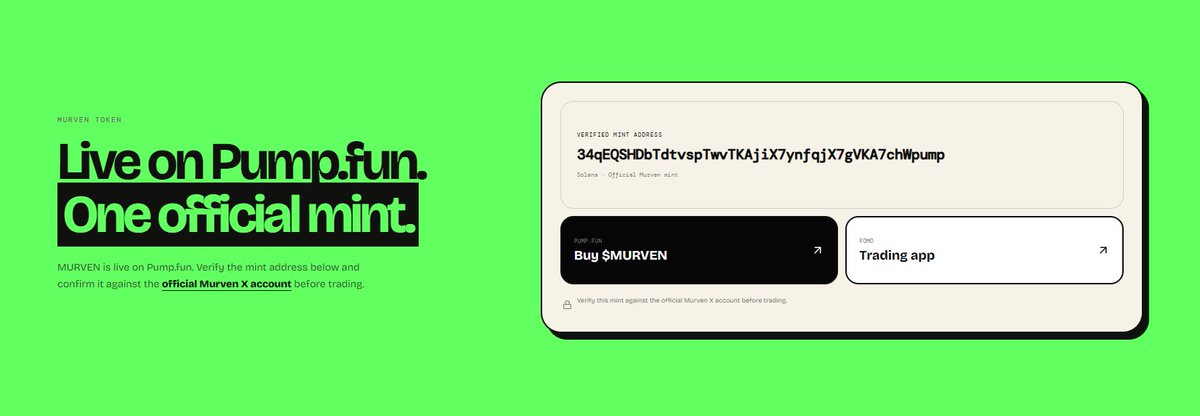
$MURVEN is live.
The protocol keeps moving.
Next, we’re updating the FOMO link.
Murven’s core frontend is fully synced, and we’re now connecting the remaining external entry points.
We’ll update here once it’s done.
The Murven frontend sync is now complete.
The official $MURVEN CA, onchain data, and protocol links have all been updated.
From here, updates go back to the product itself.
We’ll keep working on private state, client-side key management, recovery, and making more of the protocol independently verifiable.
The token is live.
Now we keep writing code.
Next, the FOMO link will be updated.
The Murven frontend sync is now complete.
The official $MURVEN CA, onchain data, and protocol links have all been updated.
From here, updates go back to the product itself.
We’ll keep working on private state, client-side key management, recovery, and making more of the protocol independently verifiable.
The token is live.
Now we keep writing code.
Next, the FOMO link will be updated.
$MURVEN is live.
We’re now syncing the official CA and related onchain data to the Murven frontend.
In the meantime, the Docs and current open-source code are already available for anyone to inspect.
We’ll post another update once the sync is complete.
From here, we keep building.
This is the first time we’ve spoken publicly as the Murven team.
There are four of us.
Over the past few years, we’ve been around the Monero ecosystem as community contributors. We’ve made some code contributions, maintained tools, helped with testing, and reported issues when we found them.
We’re not part of the Monero core team, and we’re not going to pretend our contributions were bigger than they were.
But spending that time around Monero made one thing increasingly clear to us.
Privacy shouldn’t be a feature for a small group of people. It should be part of the basic infrastructure of crypto finance.
Lately, privacy is getting attention again.
Zcash is seeing renewed interest from institutions and developers, while Monero continues to make a pretty simple point: a public ledger shouldn’t mean everyone has to put their entire financial life in public.
We think it’s time to start building something of our own.
Our original plan was to build a privacy native L2.
But building a privacy chain that people can actually trust means getting a lot of things right. Cryptography, circuits, clients, wallets, nodes, audits, and the infrastructure to keep all of it running long term.
We’re four people with limited resources. Pretending those problems don’t exist would be bullshit.
So we decided to start smaller, without changing where we ultimately want to go.
We’re building a Shielded Protocol on Solana.
Some of you probably remember Tornado Cash.
It proved there’s real demand for privacy onchain. But we’re not interested in just cloning another deposit and withdrawal mixer.
We want to start with private balances and internal transfers, then work toward hidden amounts, multi asset private state, user controlled viewing keys, private transaction intents, and eventually a programmable privacy execution layer.
Starting on Solana gives us an existing execution environment, liquidity, wallets, and users to build around while we focus our limited resources on the privacy layer itself.
We’re not going to build all of that overnight.
From here, we’ll be sharing the research, architecture, code, failures, and the technical decisions we make along the way.
And we’re not doing this just to launch a token or manufacture a short term narrative.
We also want to find people who might want to build this with us.
If you work on ZK, circuits, smart contracts, wallets, clients, or protocol security, and you genuinely care about onchain privacy, we’d like to know you.
Four people isn’t a lot.
But a lot of things that ended up mattering started with a few people deciding a problem was worth taking seriously.
$MURVEN is now live on Pumpfun.
The Murven website is now live.
https://t.co/FA3IvkWrs1
We’ve also opened the Docs section, where you can find Murven’s current technical documentation and open-source code. Anyone can read through it, inspect the implementation, and verify it for themselves.
https://t.co/fLhCwfOJWF
Murven is built on Solana.
From here, we’ll continue making the protocol architecture, code, security design, and development progress public.
Don’t trust it just because we call it a privacy protocol.
Read the code. Verify it yourself.
Your money is none of the internet’s business.
We don’t want to build another mixer.
We want to build private state people can actually keep and use on Solana.
This is how we’re approaching Murven, how the protocol works, and where we want to take it. https://t.co/jOyB4VKqBr
We don’t want to build another mixer.
We want to build private state people can actually keep and use on Solana.
This is how we’re approaching Murven, how the protocol works, and where we want to take it. https://t.co/jOyB4VKqBr
This is the first time we’ve spoken publicly as the Murven team.
There are four of us.
Over the past few years, we’ve been around the Monero ecosystem as community contributors. We’ve made some code contributions, maintained tools, helped with testing, and reported issues when we found them.
We’re not part of the Monero core team, and we’re not going to pretend our contributions were bigger than they were.
But spending that time around Monero made one thing increasingly clear to us.
Privacy shouldn’t be a feature for a small group of people. It should be part of the basic infrastructure of crypto finance.
Lately, privacy is getting attention again.
Zcash is seeing renewed interest from institutions and developers, while Monero continues to make a pretty simple point: a public ledger shouldn’t mean everyone has to put their entire financial life in public.
We think it’s time to start building something of our own.
Our original plan was to build a privacy native L2.
But building a privacy chain that people can actually trust means getting a lot of things right. Cryptography, circuits, clients, wallets, nodes, audits, and the infrastructure to keep all of it running long term.
We’re four people with limited resources. Pretending those problems don’t exist would be bullshit.
So we decided to start smaller, without changing where we ultimately want to go.
We’re building a Shielded Protocol on Solana.
Some of you probably remember Tornado Cash.
It proved there’s real demand for privacy onchain. But we’re not interested in just cloning another deposit and withdrawal mixer.
We want to start with private balances and internal transfers, then work toward hidden amounts, multi asset private state, user controlled viewing keys, private transaction intents, and eventually a programmable privacy execution layer.
Starting on Solana gives us an existing execution environment, liquidity, wallets, and users to build around while we focus our limited resources on the privacy layer itself.
We’re not going to build all of that overnight.
From here, we’ll be sharing the research, architecture, code, failures, and the technical decisions we make along the way.
And we’re not doing this just to launch a token or manufacture a short term narrative.
We also want to find people who might want to build this with us.
If you work on ZK, circuits, smart contracts, wallets, clients, or protocol security, and you genuinely care about onchain privacy, we’d like to know you.
Four people isn’t a lot.
But a lot of things that ended up mattering started with a few people deciding a problem was worth taking seriously.