The term "English" derives from the Angelcynn (Angle-kin), referring to the Germanic tribes, the Angles, Saxons, Jutes & Normans.
In Old English, the word kin (cynn) means "blood family" "race" or "kind."
When Anglo-Saxons referred to themselves as Angelcynn (Angle-kin), they were literally calling themselves the "family/ race" of the Angles.
If you are not born of English blood, then you are not English.
Living in the land of another race of people, does not change your race/ ethnicity.
How ridiculous 🙄
Mass immigration, both legal and illegal, has fundamentally changed Britain's demographic makeup.
Today in Parliament, I just demanded a full debate on our country's demographic future.
Government’s response to petition 763034 (7 September 2026) says the English, Scots, Welsh, Cornish and Manx don’t count as indigenous peoples. And @andyburnham says Britain is “for everyone, no matter who we are or where we’re born”. So which British people does Labour mean?
@UKLabour But your government’s response to petition 763034 (7 September 2026) says the English, Scots, Welsh, Cornish and Manx don’t count as indigenous peoples. And your PM says Britain is “for everyone, no matter who we are or where we’re born”. So which British people do you mean?
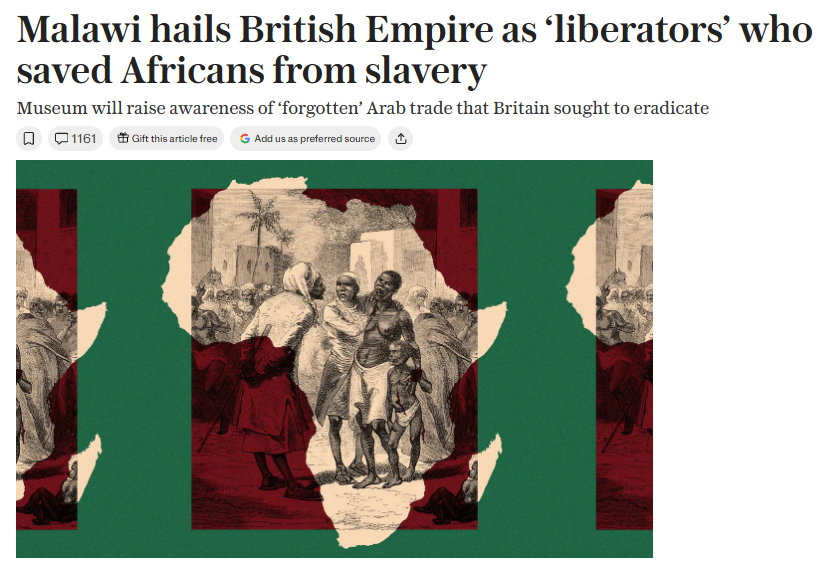
Malawi is finally saying the quiet part out loud: the British Empire ended the Arab slave trade that ravaged East and Central Africa for centuries. The modern reparations campaign, which treats only the transatlantic trade as history’s singular crime, is a selective and fruitless pipedream.
The Telegraph reports that Malawi’s government is preserving colonial forts, mosques, and markets linked to the Indian Ocean slave trade, and seeking UNESCO status for them, precisely to highlight how Britain suppressed the traffic. Officials involved state it plainly:
“Britain was not a coloniser; it was a liberator.”
The Yao and other local elites captured and sold fellow Africans (mainly Chewa) to Swahili-Arab traders for shipment to the Middle East; British forces under Harry Johnston and others dismantled the networks in the 1890s, including the brief 1896 action that ended Zanzibar’s slave trade.
Estimates put roughly 11 million people moved from the African interior to the Arab world between about 800 and 1900 via Saharan, Red Sea, and Indian Ocean routes; comparable or higher in volume to the transatlantic trade but spanning far longer and taking disproportionately more women and girls into domestic and sexual slavery. Markets and castration of males were routine features. This traffic continued into the 20th century in places; Britain spent lives and money suppressing it after abolishing its own trade and slavery in its territories. African agency was central: captives were typically taken inland by African groups and sold on, not simply “snatched by Europeans at the coast.”