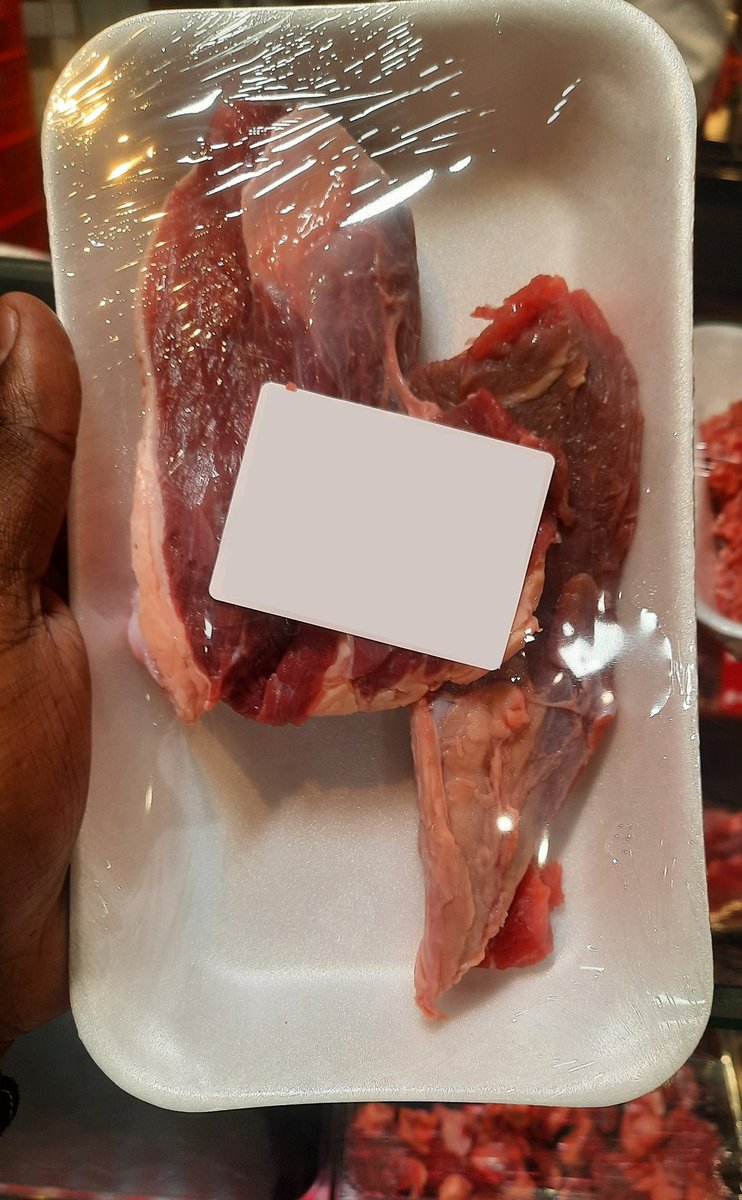
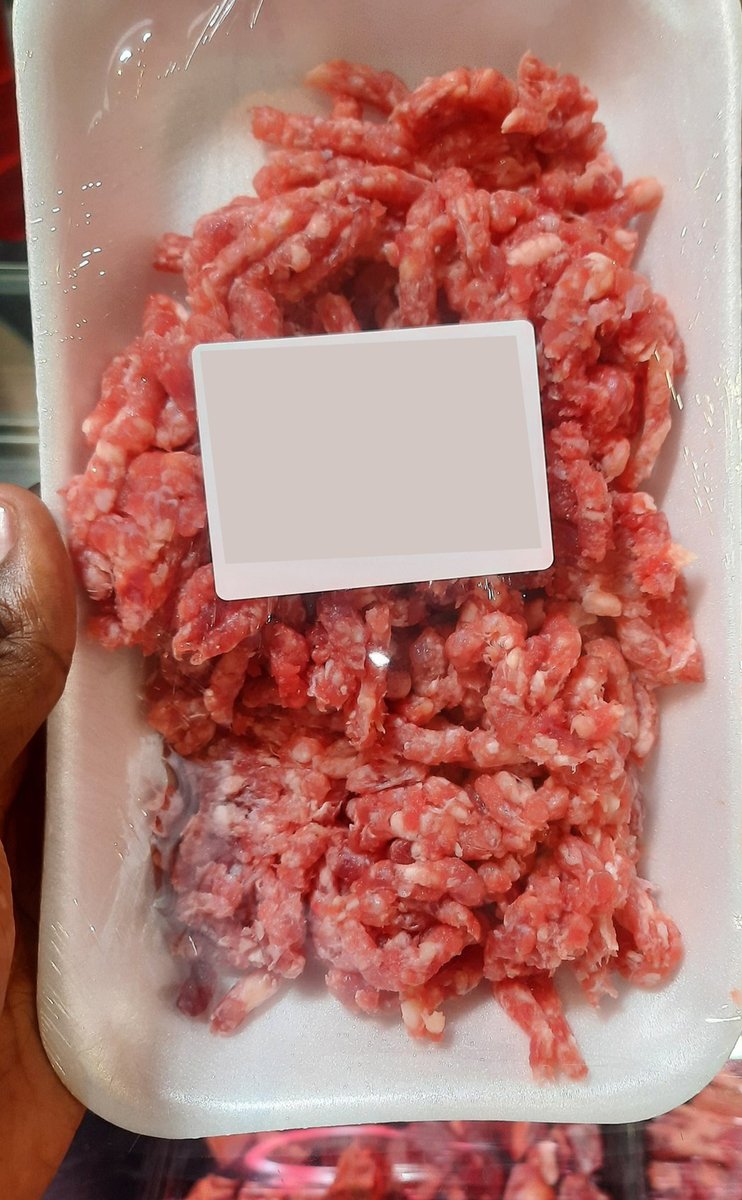
My people, as I promised, here are the long-awaited meat test results. Let me take you through everything honestly, step by step.
For the last two weeks, many of you have been asking us to look into what is really happening with the meat being sold across Kenya.
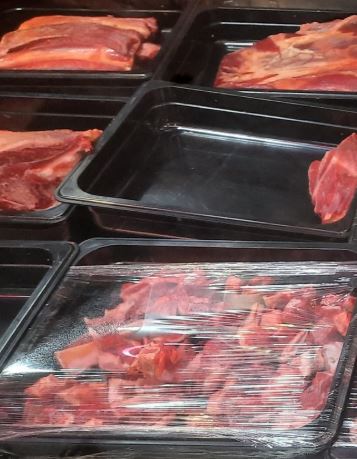
So between the 4th and 14th of this month my teams collected samples from Nairobi, Mombasa, Rongai, Ruiru, Kahawa, Juja, Eastleigh, Mukuru, Kibera, South C, Fedha, supermarkets, and a few other locations.
Some butchers were very busy places, others were small corner shops that relied on a handful of customers a day.
We did that deliberately, to see whether adulteration is a widespread issue or concentrated in certain places.
Let me take this opportunity to set the record straight on behalf of all Kenyans.
@HusseinMohamedg
With regards to inflation: 9.6 → 4.6 %
One headline says it all: Kenyans are borrowing KSH 13 billion a month, in order to be able to eat.
Prices didn’t fall because of better management. They fell because Kenyans stopped affording basic goods.
The “lower inflation” reflects economic paralysis — small businesses shut down, farmers can’t access credit, and demand has collapsed. Food inflation still hovers around 9–10%, while household incomes are shrinking.
With regards to shilling: 165 → 129 per USD
The stronger shilling isn’t from exports or productivity. It’s the result of short-term dollar borrowing — Eurobond proceeds, IMF tranches, and syndicated loans. Kenya is borrowing to look stable. When those borrowed dollars run out, the shilling will tumble again. It’s an illusion funded by future generations.
Think about this: The 18-34 years age group is the most productive age group globally. In our country, this age group faces a 67% poverty rate.
Nobody from this age group will walk into Quick Mart and trade in the "savings from shilling appreciation" for food. Kenyans need jobs, and they are not getting them.
With regards to reserves: $5.7 B → $12 B
Conveniently leaves out that those “record reserves” are borrowed dollars from new IMF loans, syndicated loans, and Eurobond proceeds — not export surpluses. Kenya is literally borrowing to look solvent, because President Ruto lacks the courage to deal with the real issues destroying the economy - such as corruption and a crushingly expensive government.
With regards to CBR: 13 → 9.25 %
Yes, the Central Bank cut its policy rate, but commercial lending rates remain 15–18%, and SMEs still can’t access credit. Why?
Because the government itself has become the biggest borrower in Kenya — tapping commercial banks for short-term domestic loans at double-digit interest. In 2023-2025, domestic debt was 51% of our sovereign debt, while interest on that portion of debt was 70% of the total interest obligation. No different than borrowing from a loan shark to take your girlfriend to Las Vegas.
This crowds out ordinary Kenyans and businesses: banks prefer lending to government (risk-free, high-yield) rather than to citizens or the productive economy.
Result: the government borrows, banks profit, citizens suffocate.
With regards to GDP: KSh 17 trillion — Growth on paper, misery in reality
The size of the economy only confirms if there is food in the kitchen, and the amount of the food.
A more important question is, WHO IS INVITED TO EAT?
Our country today is using roughly 50% of every shilling we have on salaries for less than 2% of the population.
For example, in 2023-2024, when our country earned KSH 2.5 trillion in revenue, KSH 1.2 trillion, or 48%, was devoted to salaries for one million employees of the national government.
That is less than 2% of our population.
That 2% is WHO IS EATING.
The 98% of us are mere spectators in the feast.
President Ruto has signed 8 Bills into law, including key ones that affect digital safety, crypto trade, air travel, and government operations.
Here’s a breakdown of the signed Bills.
Thread below:
Kenyans are allowed to import over-8-year-old or left-hand drive special vehicles.
But only with proof of customization, service records, and if the vehicle is under 20 years old.
Millie Odhiambo: Mr. Speaker, you must respect the court order. The court has ruled that Azimio is the majority party. You must resign as Speaker or the party leader of Ford Kenya.
Nairobi Motorists Shocked as Fuel Test Shows Standard Fuel Outperforming V-Power in Some Stations
A fuel quality test conducted by an automotive content creator across seven petrol stations in Nairobi has revealed surprising variations in performance, with some premium fuels performing worse than their standard counterparts.
The test found that Total Limuru Road recorded the highest rating at 92 PON, followed closely by Astrol Rosslyn at 91 PON.
Other stations such as Total Spring Valley and Rubis UN Avenue both registered 90 PON.
At Shell Limuru Road, the results showed a notable contrast, with V-Power scoring 87 PON while the standard fuel at the same station recorded a higher rating of 91 PON.
A similar trend appeared at Shell Lavington, where V-Power scored 87 PON, while regular fuel at the same station recorded 90 PON.
The findings suggest that consumers paying a premium for V-Power at some locations may not be getting the expected fuel quality advantage.
The test results have sparked discussion among motorists, with many questioning the consistency of premium fuel quality across different stations.
Starting this Monday, join @MariamBishar @OfficialJMbugua and I on this new journey of #FixingTheNation on @ntvkenya@NationFmKE. Also streaming online on YouTube, X, FB, TikTok, IG and available on podcasts
At exactly 6am on 20th August 2019, four people entered a brand new studio and started a journey along an uncharted path.
When I switched on the four microphones that morning I was excited at launching yet another station, but I also had butterflies in my stomach; would this work? Would the audience embrace four hours of non-stop talk during their busy morning commute?
The four of us with CT Muga, Ndu Okoh and Njeri Thorne took on the new assignment with dedication and a true belief that we could do it. Outside of that studio was our producer Brian Evusa, the Programmes Controller Brian Obara and, although he wasn’t in the studio, the Radio General Manager Tom Japanni was present.
It has been a great journey building The Situation Room to what it has become and we have very many people to thank, not least the team of producers, marketing, commercial, technical and other colleagues.
The Situation Room has become the home of Kenya’s Biggest Conversations and it continues to host many thought leaders, community influencers, different professionals and duty bearers.
The biggest part of this show has been the audience who tune in on radio, Tv or digital platforms. It’s humbling whenever people reach out on calls, text or approach us with compliments, comments and suggestions for the show.
On this 6th day of January 2025, my heart is heavy as I bid kwaheri to the brilliant team of colleagues at Spice FM and the Standard Group. I am grateful for the opportunity to once again be a part of Kenya’s oldest private media house and I am proud of the teams that I leave behind in radio, TV and print.
I love the thrill of creating and starting new things and I have been blessed to do just that. I was privileged to be there at the launch of Kenya’s first 24hr religious media house - Family FM and Family TV, the first 24hrs vernacular radio station - Kameme FM and the first 24hr news and information TV station - K24.
Is there room for something new? Of course, always, and I sure hope to be a part of it soon. Wish me luck, I will keep you posted.
I met a girl in tears today as I was strolling around Kenyatta University. I then approached the girl out of curiosity when she told me that she had gone hungry for two days and that her dad had asked her to...1/4