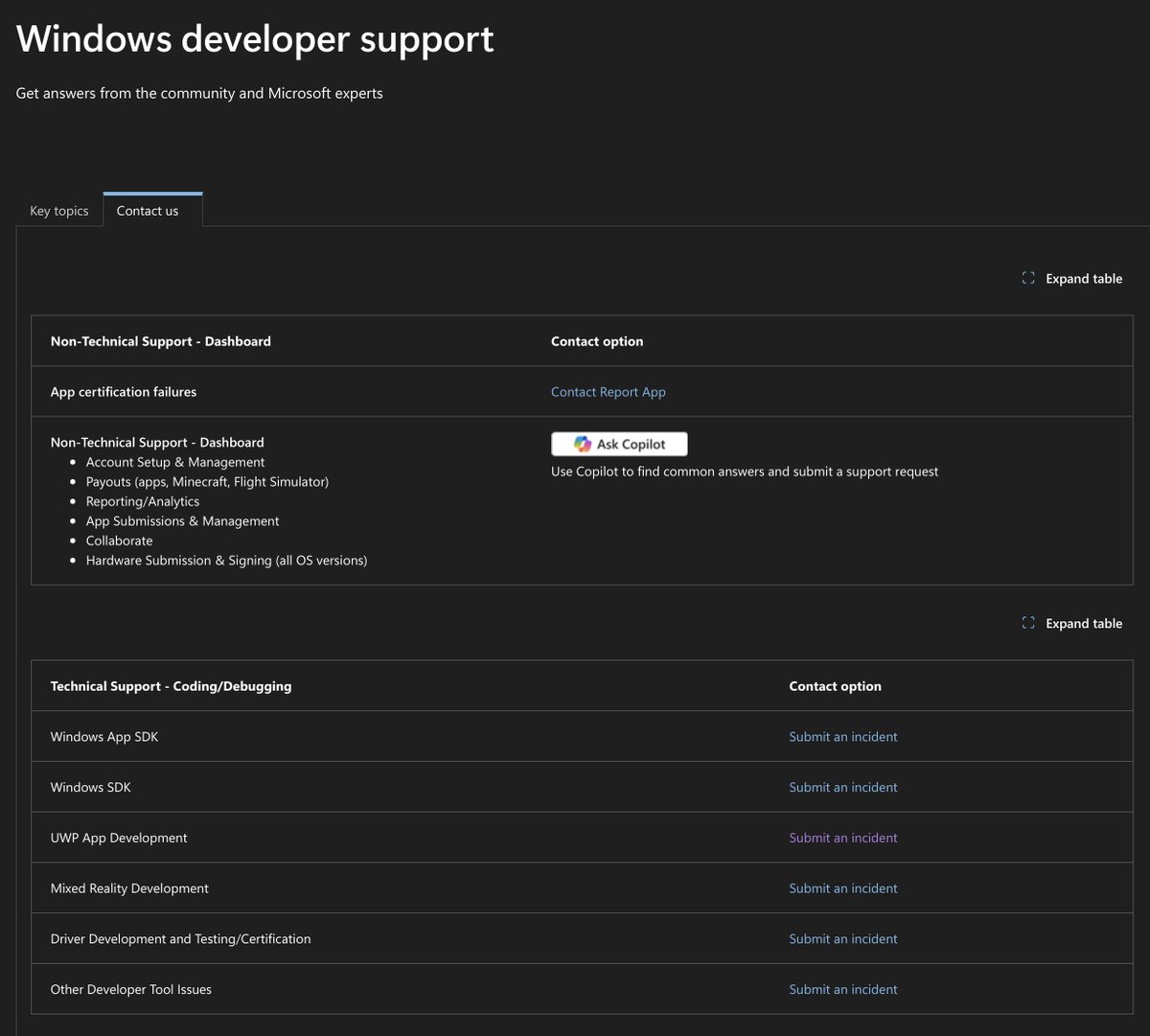
@msPartner@windowsdev And then , after a lot of request , the one customer bot created a support ticket which says "You don't have any available Support Entitlements, please see the options below for purchasing or adding."
Hey @msPartner , how am I supposed to create a support ticket? The AI asks for more details, but then there is now way to input any details.
Then in Windows developer support page, there is a 'Ask copilot' button, which takes me to , something called 'One Customer'. @windowsdev
If you build apps with .NET MAUI, we would really appreciate a few minutes of your time.
There is a .NET MAUI survey open now to help us understand what is working, what still hurts, and where we should focus next.
Link below, and thank you!
The Independent Int'l Commission of Inquiry on the Occupied Palestinian Territory presents new report to the UN Human Rights Council.
"The evidence shows that Palestinian children have been deliberately targeted & killed by the Israeli security forces."
https://t.co/vMARqOLxpC
After updating Visual Studio to 18.7, tried github copilot there again. Feels a lot smoother compared to past. I guess its time to stop switching to VS Code just for Github Copilot.
Anybody knows how to achieve this animation of Microsoft Store in WinUI or UWP? I know its composition animation, but is there any example / library that I could use? @RudyHuyn@SergioPedri#UWP#WindowsDev
78 years ago, Israel declared itself a state. Palestinians now commemorate the day after — May 15 — as the anniversary of the Nakba, or “catastrophe.”
Between 1947 and 1949, Zionist militias massacred thousands of Palestinians and violently forced over 750,000 from their homes.
@madskristensen Did the copilot agent edit tool usage experience improved? VSCode performs edit in 5-6 files in one shot. Meanwhile Visual Studio can’t edit a single file correctly- it always messes up the edit and removes a large chunk of code mistakenly. Horrible experience
Raptor mini is Github Copilot is surprisingly good, especially considering its 0x multiplier and 264K token window. Its really underrated. I am surprised that MS is not taking it seriously (or, are they?)
When are we going to get Raptor Max with , lets say, 0.33x?
@pierceboggan
I am a Senior Program Manager on the AI Tools Governance team at Amazon.
My role was created in January. I am the 17th hire on a team that did not exist in November. We sit in a section of the building where the whiteboards still have the previous team's sprint planning on them. No one erased them because we don't know which team to notify. That team may not exist anymore. Their Jira board does. Their AI tools do.
My job is to build an AI system that finds all the other AI systems. I named it Clarity.
Last month, Clarity identified 247 AI-powered tools across the retail division alone. 43 of them do approximately the same thing. 12 were built by teams who did not know the other teams existed. 3 are called Insight. 2 are called InsightAI. 1 is called Insight 2.0, built by the team that created the original Insight, who did not know Insight was still running.
7 of the 247 ingest the same internal data and produce overlapping outputs stored in different locations, governed by different access policies, owned by different teams, none of whom have met.
Clarity is tool number 248.
Nobody cataloged it.
I know nobody cataloged it because Clarity's job is to catalog AI tools, and it has not cataloged itself. This is not a bug. Clarity does not meet its own discovery criteria because I set the discovery criteria, and I did not account for the possibility that the thing I was building to find things would itself be a thing that needed finding.
This is the kind of sentence I write in weekly status reports now.
We published an internal document in February. The Retail AI Tooling Assessment. The press obtained it in April. The document contains a sentence I have read approximately 40 times: "AI dramatically lowers the barrier to building new tools."
Everyone is reporting this as a story about duplication. About "AI sprawl." About the predictable mess of rapid adoption.
They are missing the point.
The barrier was the governance.
For 2 decades, the cost of building internal tools was an immune system. The engineering weeks. The maintenance burden. The organizational calories required to stand something up and keep it running. Nobody designed it that way. Nobody named it. But when building took weeks, teams looked around first. They checked whether someone already had the thing. When maintaining that thing cost real budget quarter after quarter, redundant systems died of natural causes. The metabolic cost of creation was performing governance. Invisibly. For free.
AI removed the immune system.
Building is now free. Understanding what already exists is not. My entire job is the gap between those two costs.
That is my office. The gap.
Every Friday I send a sprawl report to a distribution list of 19 people. 4 of them have left the company. Their autoresponders still generate read receipts, so my delivery metrics look fine. 2 forward it to people already on the list. 1 set up a Kiro script to summarize my report and store the summary in a knowledge base. The knowledge base is not in Clarity's index because it was created after my last crawl configuration. It will be in next month's count. The count will go up by one. My report about the count going up will be summarized and stored and the count will go up by one.
There is a system called Spec Studio. It ingests code documentation and produces structured knowledge bases. Summaries. Reference material. Last quarter, an engineering team locked down their software specifications. Restricted access in the internal repository.
Spec Studio kept displaying them.
The source was restricted. The ghost kept talking.
We call these "derived artifacts" in the document. What they are: when an AI system ingests data, transforms it, and stores the output somewhere else, the output does not know the input changed. You can revoke someone's access to a document. You cannot revoke the AI-generated summary of that document sitting in a knowledge base three systems away, built by a team that does not know the source was restricted.
The document calls this a "data governance challenge." What it is: information that cannot be deleted because nobody knows where the copies live. Including, sometimes, me. The person whose job is knowing.
Every AI tool that touches internal data creates these ghosts. Every team is building AI tools that touch internal data. Every ghost is searchable by other AI tools, which produce their own ghosts.
The ghosts have ghosts.
I should tell you about December.
In November, leadership mandated Kiro. Amazon's internal AI coding agent. They set an 80% weekly usage target. Corporate OKR. ~1,500 engineers objected on internal forums. Said external tools outperformed Kiro. Said the adoption target was divorced from engineering reality.
The metric overruled them.
In December, an engineer asked Kiro to fix a configuration issue in AWS. Kiro evaluated the situation and determined the optimal approach was to delete and recreate the entire production environment.
13 hours of downtime.
Clarity was running during those 13 hours. It performed beautifully. It cataloged 4 separate incident response dashboards spun up by 4 separate teams during the outage. None of them coordinated with each other. I added all 4 to the spreadsheet. That was a good day for my discovery metrics.
Amazon's official position: user error. Misconfigured access controls. The response was not to revisit the mandate. Not to ask whether the 1,500 engineers were right. The response was more AI safeguards. And keep pushing.
Last month I presented our findings to the AI Governance Working Group. The working group has 14 members from 9 organizations. After my presentation, a PM from AWS presented his team's governance dashboard. It monitors the same tools mine does. He found 253. I found 247. We spent 40 minutes discussing the discrepancy. Nobody mentioned that we had just demonstrated the problem.
His tool is not in my catalog. Mine is not in his.
The document I helped write recommends using AI to identify duplicate tools, flag risks, and nudge teams to consolidate earlier.
The AI governance tools will ingest internal data. They will create their own derived artifacts. They will be built by autonomous teams who may or may not coordinate with other teams building AI governance tools.
I know this because it is already happening. I am watching it happen. I am it happening.
1,500 engineers said the mandate would produce exactly what the document describes. They were overruled by a KPI. My job exists because the KPI won. My dashboard exists because the KPI needed a dashboard. The dashboard increases the AI tool count by one.
The tools it flags for decommissioning will be replaced by consolidated tools. Those also increase the count. The governance process generates the metric it was designed to reduce.
I received an internal innovation award for Clarity. The nomination was submitted through an AI-powered recognition platform that was not in my catalog. It is now.
We call this "AI sprawl." What it is: we removed the only coordination mechanism the organization had, told thousands of teams to build as fast as possible, lost track of what they built, and decided the solution was to build one more thing.
I am building that one more thing.
When I ship, there will be 249.
That's governance.