As US–Canada trade tensions flare again, our paper on the price effects of Canada’s 2025 counter-tariffs is now out in the Journal of Monetary Economics.
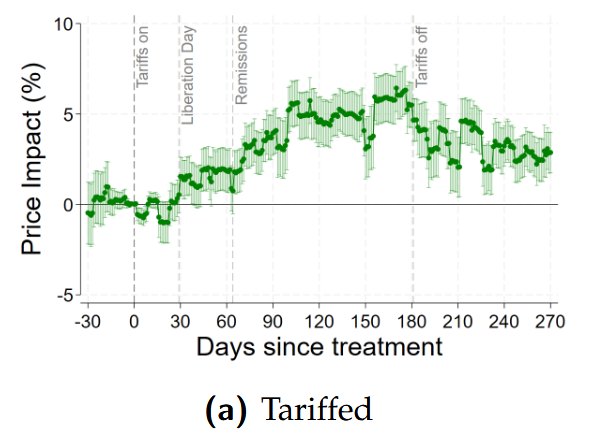
Prices of affected goods rose 6%—about ¼ pass-through within 100 days—and largely fell back after the tariffs were removed.
https://t.co/G3F6w6Me2G
Just posted a new tariff paper using Canadian retail micro data, which is a useful benchmark for today’s Supreme Court ruling striking down the US tariffs.
In Canada’s 2025 retaliation tariffs, pricing was asymmetric: retail prices rose gradually after tariffs were imposed, but fell faster once tariffs were removed, unwinding more than half of the increase within weeks.
This points to expectations and uncertainty: when removal is credible, retailers adjust quickly and disinflation can arrive sooner than the run-up suggests. Whether that happens in the US now depends on the administration’s response and how much uncertainty remains.
Much of macro-finance focuses on optimal capital regulation. A new version of "Q-Theory of Banks" is a first to look at optimal accounting rules.
https://t.co/2rkEHfF9aM
new cool results on:
- optimal accounting rules
- perils of countercyclical capital buffers
@benjaminfelix Nice calculator. Even if I modify it to set the amortization rate to 0 (to keep leverage at max), it's difficult to get the owner to come out ahead. Thanks!
@benjaminfelix Levered ETF? Margin account? Factor exposure? I'd be interested to know if any of those match the levered expected price appreciation of a house.
(Yes, leverage in the mortgage decreases over time, but amortization rate is low the first years, so not that much...)
@benjaminfelix Low return but x5. Given you're willing to tolerate the high risk, I'm not sure there's any other way to access that level of leveraged return.
I wish banks would offer an "equity mortgage": same product as mortgage, but you buy a well diversified etf instead of a house...
1/n I would like to get your thoughts on "A Q-Theory of Banks" w/ Begenau, Majerovitz, and Vieyra.
This study makes the point that the delayed accounting of losses (or zombie lending) is critical to understanding bank behavior.
Let's start with facts...
The French mathematician André Weil was imprisoned for failure to report for duty in 1940. While in jail for six months at Rouen, he proved the Riemann hypothesis for curves over finite fields.
Están buenísimos estos gráficos de Blanco @berniastarloa Drenik @economoser Trupkin acá https://t.co/46EwkIWbON
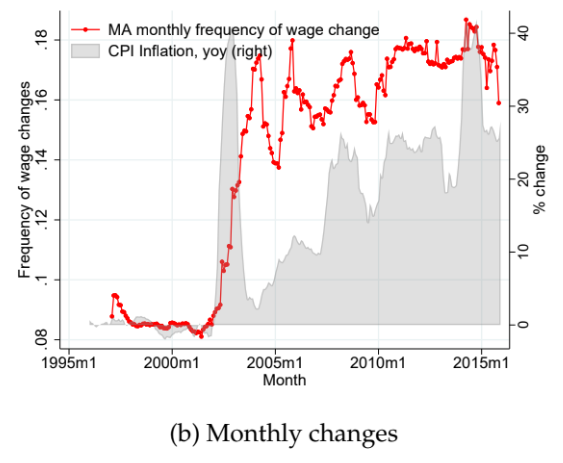
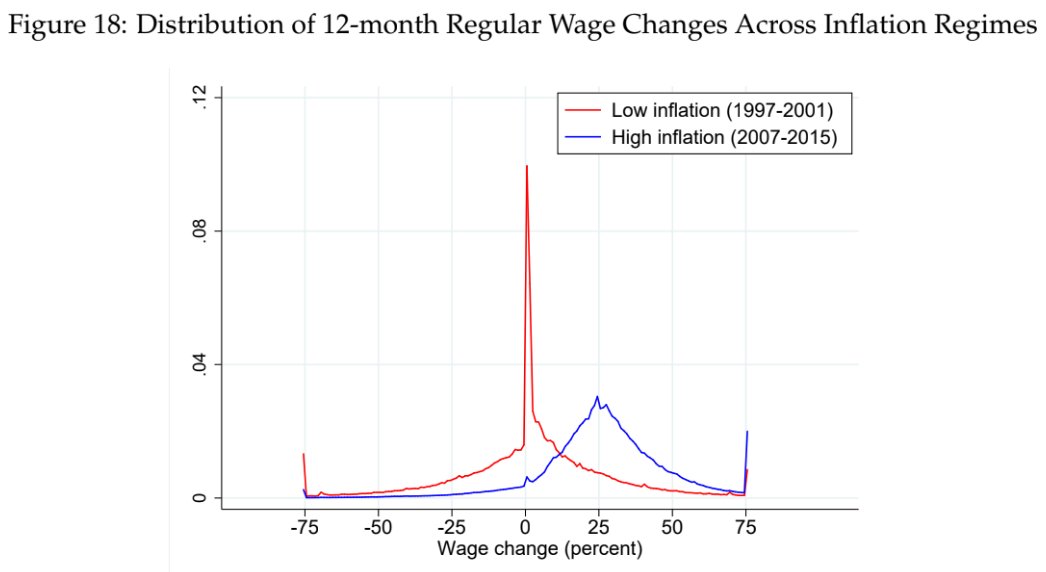
Muestran que al pasar a un régimen inflacionario, se duplica la frecuencia de salarios que cambian en un mes dado, y la masa "faltante" de cambios <0 desaparece
I have a (very 🇦🇷) proposal to help central banks lift inflation.
Every month, the CB writes off a small % of gov bonds in its balance sheet, until inflation target is reached.
I call it glider money. It's like helicopter money, but without the transfers.
@bpellerin re your last column on @OttawaCitizen, why do you think that urban sprawl is a threat to the environment? Given that cities cover just 3% of the world's land
https://t.co/aQJt2Io92V
Para la discusión en Argentina sobre si restricción externa o fiscal: la deuda pública total es mejor predictor de los spreads soberanos que la deuda externa neta
https://t.co/wvSseXDzwd
A twist on the universal basic income would be to allow future transfers to be pledged as collateral for loans. People would be able to finance liquidity needs or education and capital investments paying almost no risk premia. Argentina did this with conditional cash transfers