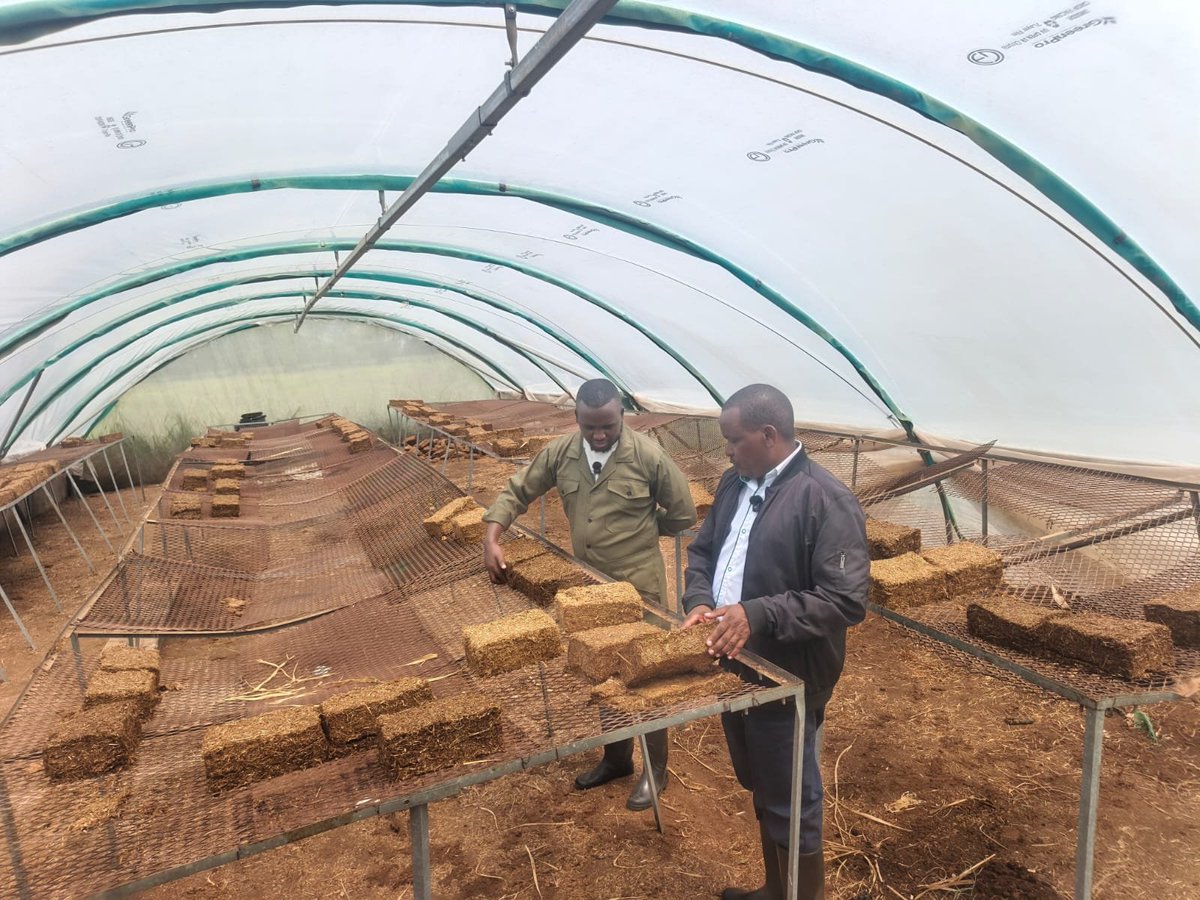
Can We Farm Like a Forest? Inside Kenya's Multi-Million-Shilling Syntropic Farm
On the latest episode of @TheOrganicPod I sit down with Sven Verwiel, CEO ForestFoods, to explore one of the most fascinating approaches to farming emerging in Kenya.
Syntropic Agroforestry
KALRO’s Beef Research Institute (BRI) is driving the transformation of Kenya’s beef sector through innovative, research-backed technologies that enhance productivity, profitability, and climate resilience.
Key innovations include feedlot production systems for efficient commercial beef finishing, climate-smart feed technologies such as improved forages and feed conservation, and genetic improvement of beef cattle to deliver faster growth, higher meat yields, disease tolerance, and adaptability to diverse production systems.
Learn more about these cutting-edge technologies on NTV’s Kilimo Almasi this Sunday, with a repeat broadcast on Friday, as KALRO showcases how research and innovation are powering sustainable beef production in Kenya.
I don't even know whether it's in the box or out of the box.
But what about whoever the president we elect:
1. Hires and lets professionals do their job.
2. Pays well for roles.
3. Adopts technology.
4. Puts emphasis on food security, education, industrialization and health.
5. Respects rule of law.
6. Go after all thieves of public funds.
Edward Zakayo shares his SAD 😔 😟 STORY
"I was born to run, and since 2015 I have carried only one dream — to change my life and my family’s life through athletics. I trained with pain, discipline, and hope. But today, I sit broken, suspended not because of doping or dishonesty, but because of something so small, so human — a lost phone — and because of powerful people who never wanted to listen to my side of the story.
It all started on November 29th, 2023, after a race in Spain. I was exhausted. I had run, finished the competition, and traveled the same day without rest. My body was so tired I could barely think. During my connection flight in Dubai, I realized too late that I had forgotten my small hand luggage bag inside the plane. Inside that bag was everything — my phone, a power bank, and the only access I had to my ADAMS account to update my whereabouts.
I begged the airline staff:
“Please, I left my bag on the plane. My phone is inside. Can I go back?”
They told me firmly:
“No, you cannot. For security reasons, once you exit you cannot re-enter. Report it to lost and found.”
I rushed there, but they said, “The flight is under cleaning process. Your bag will be brought here in four hours.”
Four hours? I had only thirty minutes before my connection flight to Nairobi. If I missed it, my manager would never forgive me. With pain in my heart, I left without the bag.
Back in Kenya, I tried to reach Emirates using someone else’s email, but no reply ever came. That phone was gone. And with it, my lifeline to ADAMS.
I explained my situation to ADAK officers who came to our camps and even those who collected my samples. One of them told me, “Just replace your Safaricom line.” But when I went to Safaricom, they said, “We cannot. That line is still active in Dubai. Come back when the phone switches off.”
So I waited. Days turned into weeks. Weeks into months.
Finally, in April 2024, I managed to replace the line. ADAK called me to meet them at Lornah Club. I went with hope, telling myself: “This nightmare is finally over.”
They looked into my account. One officer said:
“You don’t have any missed tests.”
I smiled. “Yes, I know. I have been careful,” I told them.
But after that, they refused to correct my whereabouts. They left me confused. Then, suddenly, they turned around and gave me a missed test. I asked one officer on the phone, “Did you even check my whereabouts before going to Kapsait?”
He snapped at me:
“That’s not your business!” — and he hung up.
That was the moment I realized this was no longer about rules. This was about something else.
In May 2024, during the National Trials, humiliation followed me like a shadow. I went to collect my race number at Kasarani. From morning until night, AK and ADAK officials sent me back and forth like a child. “Go to ADAK.” Then, “Go back to AK.” Seven times I moved between those tables. I was tired, hungry, but determined. At last, a white man with long hair wearing an ADAK shirt looked at me with pity and said:
“You don’t have any problem. Pick your number and go.”
But by then, it was too late. My chance was already lost.
Instead of representing my country, I went to Nigeria. I ran. I won. Then I went to Gabon. Then Istanbul. Every race I ran with tears inside me, but I told myself: “At least I can still provide for my family.”
I trained hard for the Copenhagen Half Marathon on August 9th, 2024. That race was my hope. That race was going to feed my siblings, keep my sister in school, and prepare me to welcome my unborn child.
Then, on August 6th, 2024, one call shattered everything. My agent’s voice was heavy:
“My brother… do you know you are suspended?”
I was silent. “What? How? Who told you?”
He sent me screenshots of his conversation with Athletics Kenya officials. They told him directly:
“Your athlete is suspended.”
I felt my knees go weak. I asked him, “Why now? Why after all this time? Why let me train, run, suffer, and then destroy me?”
For the best pedigree dairy breeds ,we're there for you.
Consider booking from us today .
We're located at Githunguri Kiambu and we do countrywide deliveries
Have you ever asked yourself who sponsors most of the research about the food we eat or the drinks we buy? The fact is that a significant portion of these studies are funded by the very brands selling these products. Okay let me narrow it down.
Think about it. If a soda company sponsors research on sugar consumption, how objective can the findings truly be? Are we consuming products that have been “approved” by science manipulated to favor profits over public health?
Even more alarming is the possibility that some of these brands are contributing to the very health crises they claim to address. From rising obesity rates to chronic illnesses linked to processed foods and sugary drinks. Yet, the marketing remains persuasive, and the labels look reassuring.
Should we trust research funded by corporations with a vested interest or should we demand transparency and accountability? And how much responsibility falls on consumers to question the information we're fed?
What do you think? Are we being misled, or is this just how business works? Look at the case of climate change studies. Most are done and sponsored by oil companies.