* Argentina could overtake Chile as South America’s top lithium producer by 2035, even as global supply climbs to 3.55 million tonnes of lithium carbonate equivalent (LCE), a new study shows. 🔋🇦🇷
Between 2024 and 2030, the UK’s cumulative #criticalmineral demand versus 2024 alone is projected to explode 💥
#RareEarths: 18,020 tonnes, up from 1,161 tonnes (x15)
#Lithium: 113,400 tonnes, up from 2,525 tonnes (x45)
#Graphite: 137,800 tonnes, up from 9,070 tonnes (x15)
#Cobalt: 76,610 tonnes, up from 6,089 tonnes (x13)
#Nickel: 416,100 tonnes, up from 50,430 tonnes (x8)
MPs warn the UK cannot be confident the government meets any of 10 tests to cut reliance on China.
🔗 https://t.co/NmahmlgsKU #mining #miningnews
🚨 RARE EARTHS: A TRADE TRUCE IS NOT A SECURE SUPPLY CHAIN. 🌍⚗️🧲🧵
🟨125× for yttrium.
🟠20× for dysprosium.
🟤8× for terbium.
🇨🇳Those are the overseas-versus-China price multiples reported by Bloomberg, citing Argus, ahead of the anticipated Trump–Xi meeting in Shenzhen.
My takeaway: the important question is no longer simply “What is the Chinese price?” It is “Can manufacturers outside China obtain the material they need?”
📊 A divided market
The reported comparisons are striking:
🔹 Yttrium: approximately 125× higher in Europe than in China.
🔹 Dysprosium: approximately 20× higher outside China.
🔹 Terbium: approximately 8× higher outside China.
These are reported comparisons for particular materials and markets, not a single multiplier applicable to every rare-earth product, purity or contract.
Argus itself describes export controls as splitting Chinese and Western heavy-rare-earth markets, with tighter overseas availability and widening price divergence.
An abundant domestic market and a constrained export market can exist at the same time.
🚢 The shipment figures matter
📰Bloomberg reports that China’s yttrium oxide exports are running at approximately 40% of their 2023–2024 average, with almost no shipments to Japan this year and deliveries to the US around 70% below pre-2025 levels.
🟨Yttrium’s importance extends beyond the magnet discussion: the article highlights semiconductor applications and protective coatings for gas and jet-engine turbines.
This is about access to industrial inputs, not just commodity-price volatility.
⏳ What the truce actually changes
📅China’s 9 November announcement extends the suspension of six October 2025 export-control measures through 10 January 2027.
It does not suspend the separate April 2025 controls covering samarium, gadolinium, terbium, dysprosium, lutetium, scandium and yttrium. Those elements remain subject to export licensing.
That distinction is essential: a pause on additional restrictions is not the removal of the existing licensing system.
⚗️ Build the chain, not just mines
Project Blue’s David Merriman expects limited alternative supply over the next one to two years and a substantial China/ex-China price gap to persist. That is an outlook, not a guaranteed price forecast. breathing space to build a connected industrial supply chain:
⛏️ Secure, traceable mined feedstock
♻️ Recovery from suitable secondary materials
⚗️ Separation into individual qualified oxides
🔥 Metallisation and alloy production
🧲 Magnet manufacturing and customer qualification
⚙️ Reliable reagents, specialist machinery, spare parts and technical expertise
The priority should be bankable offtake, workable pricing and dependable deliveries,not isolated announcements.
👀 Bottom Line
A scarcity premium is not the same as a bankable security premium.
Today’s extreme price gaps should not automatically be treated as tomorrow’s guaranteed project revenue.
The objective should be qualified supply under durable commercial arrangements, not business cases that require shortages to continue indefinitely.
Paying to diversify before a disruption is strategic risk management. Scrambling for material afterwards is crisis management.
Use the truce to build alternatives, not to postpone them. 🌍⚗️🧲
#RareEarths #CriticalMinerals #SupplyChainSecurity #RareEarthSeparation #Dysprosium #Terbium #MineToMagnet
For the first time in decades, America is about to start refining raw tin at scale. A first-of-its-kind plant in Henry County, Virginia, is set to begin production in 2027. A new deal secures its supply: up to 3,600 metric tons a year from the Democratic Republic of the Congo. Tin holds together the circuit boards in your phone, your car, and our defense systems. American workers will now smelt Congolese tin in the United States, creating jobs on both sides of the Atlantic. That is Pax Silica and the U.S.-DRC Strategic Partnership Agreement at work.
https://t.co/mpImeABCjU
Copper price continues on the lower side with $6.31 a pound- for record, 15 years ago while exploring for this metal in Chile, the price was down around $2.75 a pound. The price has doubled- the discoveries have not.
Statement of the #USA🇺🇸 & the #DRC🇨🇩 following the meeting this week of the Joint Steering Committee for the Strategic Partnership reaffirms the commitment to “lasting investment that creates jobs, strengthens supply chains, and brings shared prosperity.”
https://t.co/8mqlSO68zT
Democratic Republic of Congo is seeking investors to develop $12 billion of electricity projects over the next five years to combat shortages hobbling economic growth https://t.co/iQjkPfcE3w
Critical minerals companies backed by billions in US government support face a new risk: heightened scrutiny from a Democratic-controlled Congress.
Washington holds equity stakes in MP Materials, Lithium Americas and Trilogy Metals, and about 10% of USA Rare Earth under a $1.6 billion Commerce deal.
TD Cowen’s John Miller doesn’t think the intent is necessarily to break existing contracts. Marex’s Ed Meir expects a pause as earlier deals are reviewed.
Source: Bloomberg
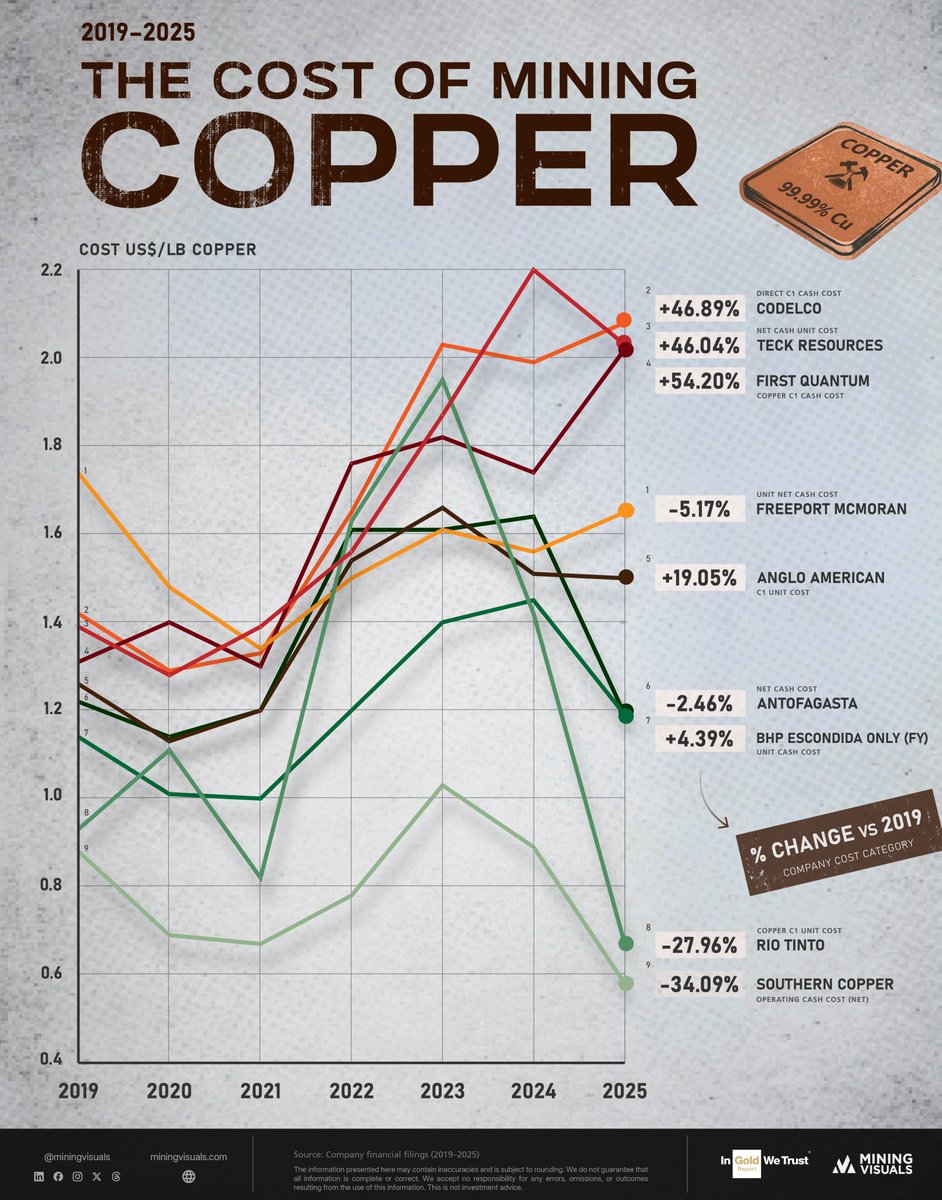
Copper costs since 2019 tell two stories.
Codelco, Teck and First Quantum are up 46–54%, while Southern Copper and Rio are down 28–34%.
In a tight market, it makes sense to closely watch the low-cost producers.
📊 @MiningVisuals $MUX $ATX $NEM
Pentagon’s China #RareEarth ban starts on Jan 1, but new supply can take 10 years 💥
So, what breaks first?
“Ultimately sources of domestic supply are unlikely to match demand for at least the next decade" — @AIAspeaks member company
https://t.co/e0YDOCbYVk #mining