Ferguson promised not to increase taxes, then signed the income tax.
He promised $2.5m in revenue for small businesses and then settled on $250k relief instead.
The legislature promised not to create an income tax by passing I-2111 into law and then created it 2 years later.
All of those broken promises tell us they won't keep their word, but looks like their lies work on some people. 🤭
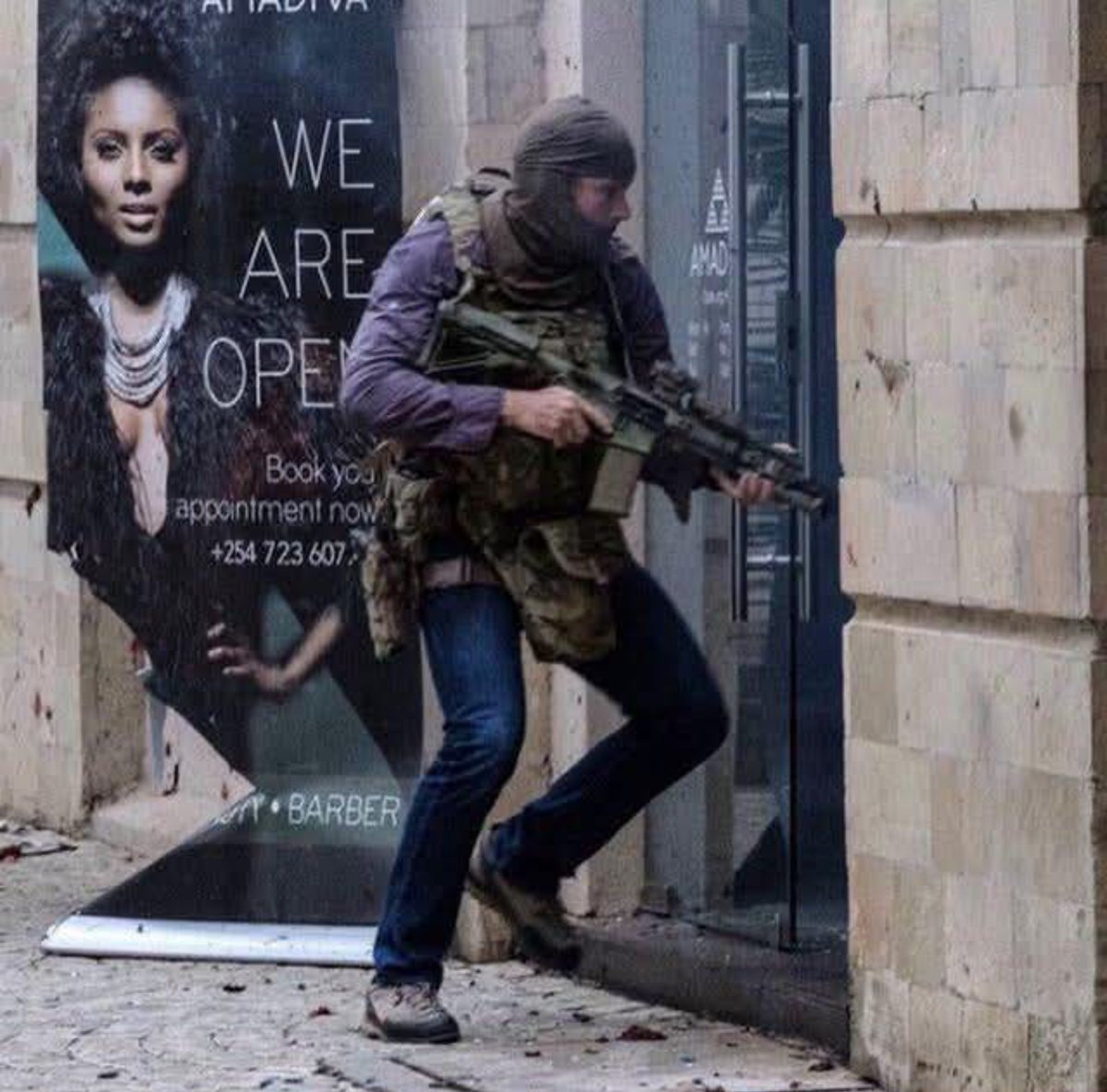
A former British SAS operator Christian Craighead responding to the January 2019 terrorist attack at the Dusit D2 hotel complex in Nairobi, Kenya 🇰🇪
On January 15, 2019, Nairobi. Craighead had just finished a morning of firearms training when the phone rang, a friend, a former British soldier, gunfire audible in the background. The address was 14 Riverside Drive, the DusitD2 hotel and office complex in Westlands. Al-Shabaab had begun a massacre. He threw his weapons case into his pickup and drove. He had never been to the complex. He didn't know how many shooters he was walking into. He went anyway.
The attack had started around 2:30pm, a suicide bomber detonating in the Secret Garden cafe, followed by four gunmen armed with AKs, grenades, and suicide vests splitting through the offices, hotel, and car park hunting civilians. Twenty-one people would die that day and overnight. Craighead arrived roughly 30 minutes later to chaos, no organized security line, body parts, screaming, sporadic fire. He wore a balaclava specifically because media were already present. In his Shawn Ryan appearance, he described the exact moment he decided to go in alone, a woman screaming, then automatic fire cutting the scream off. He understood she had just been murdered. He asked Kenyan forces if they were entering. They said no, boss. He went in without them.
He started in the restaurant, dragging terrified, wounded people toward safety, then ran alone across open ground under fire, clearing rooms and pulling together roughly 150 survivors. He picked up an improvised team along the way, Slovenian diplomatic protection officer Dan Prastalo, whose own side of this story we've also featured, and two Kenyan police officers. Together they cleared a 13-story car park, calling out to hostages with "Eagle, eagle, security forces." He thought his part was finished and went to brief the Kenyan commander, who asked him to lead his men. Craighead said yes, cleared a five-story office block from the front, and pulled out roughly 50 more people.
The remaining gunmen had moved into the eight-story hotel. Craighead linked up with a Kenyan police assault team on the seventh floor and stayed with them for the next 13 hours, no helmet, left behind in the truck, enduring grenades bouncing down marble stairwells, black smoke, and confined-space gunfire. In his book he writes about the blasts forcing the air from his lungs and repeating to himself, press on, push on, not yet knowing how many were still being killed elsewhere in the complex. Near dawn, the last pair of terrorists on that floor tried to break out. Craighead had already warned the team. They were killed the moment they left cover.
The hotel still wasn't clear. Kenyan police in the lobby said two men remained in the basement, and after a full night of fighting, few officers wanted to go back in. Craighead volunteered first. They pushed through smoke-filled storerooms and flooded service corridors, held a standoff behind a barricade for roughly an hour, and killed the final two attackers. Nineteen to twenty-two hours after the first blast, President Kenyatta announced the complex secure. All five militants were dead. Nearly 700 people were rescued.
He was awarded the Conspicuous Gallantry Cross. Who Dares Wins.
#archaeohistories
On September 11, 2001, Lieutenant Colonel Brian Birdwell was working on the second floor of the Pentagon's E-Ring (the outermost ring) when American Airlines Flight 77 struck the building. He was just 15 to 20 yards away from the exact point where the nose of the plane penetrated the structure, making him one of the closest people to the impact to survive.
Moments before the crash, Birdwell had stepped out of the restroom. When the aircraft hit at 9:37 a.m., he heard a sound louder than anything he had ever experienced. The explosion tossed him "like a rag doll" down the corridor and instantly set him ablaze. The intense heat and fuel vapor melted his polyester military uniform directly onto his skin. Trapped in pitch-black, toxic smoke, and unable to breathe due to searing air and jet fuel vapor, Birdwell collapsed. Believing he was about to die, he prayed, said a silent goodbye to his family, and "accepted his death". Suddenly, the Pentagon’s ceiling sprinkler system activated right above him, extinguishing the flames on his body. This gave him just enough strength to crawl and find help.
A group of colleagues found him in the smoke, pulling him to safety. Because the burns were so extensive across his body, a medical team at a makeshift triage station inside the Pentagon had to administer an IV and morphine directly through his feet, which were the only parts of his body left unburned. Birdwell suffered burns over 60% of his body, with nearly half of them being third-degree. His most critical injury was an intensive internal inhalation injury. The scorching air and toxic fumes had severely seared his lungs, requiring him to be placed on a respirator for several weeks.
Doctors initially gave Birdwell less than a 1% chance of survival, prompting him to say what he thought were his final goodbyes to his 12-year-old son from his hospital bed. Against all odds, he survived. He spent 92 days at the MedStar Washington Hospital Center Burn Unit and underwent 39 reconstructive surgeries over four years of agonizing rehabilitation to regain his mobility. He was awarded the Purple Heart for the wounds he received that day.”
--
Almost 25 years later, I met Brian at the Pentagon, not far from where he cheated death. That’s him, all the way on to my right, barely in the frame. The guy in the green tie with a big smile. We met in The Hall of Heroes, where I had just accepted a check for The mikeroweWORKS Foundation, on behalf of everyone at Build Freedom - including The Honorable Brian Birdwell.
“My name is Brian Birdwell,” he said. “And I just wanted to say hello and thank you for all those dirty jobs! And for what you’re doing with your foundation. I think it’s terrific!”
“Thanks,” I said. “I appreciate your support and I promise to spend the money wisely. Oh, and thank you for your service.”
It was a rather assumptive thing to say, since I didn’t know at the time that Brian Birdwell had been a Lt. Colonel in the Army, much less what he’d endured 25 years ago. But there was something about his bearing. His posture. The flag on the lapel. The scars on his hands. He seemed like a man who understood sacrifice.
“This is the greatest country in the world,” he said, “and it’s my privilege to serve it. Now keep on doing what you do, Mr. Rowe!"
There were many other hands to shake that day, and lots of other people to meet, including the fine Americans standing with Brian, all of whom have stories worth sharing. But on this day, I’ll focus on Brian Birdwell. Partly because I really appreciate what Build Freedom is doing for our country, and partly because I really am grateful for the service and the sacrifice he made for you and me. But mostly, because 25 years after those murderous swine tried their best to kill him, Brian Birdwell is still standing. Still smiling. Still serving the country he loves.
I realized all of this several minutes ago, after I boarded a United flight from LAX to San Francisco. As we waited on the tarmac, I saw a link in my newsfeed to the article I quoted above, and learned about the man who somehow survived the attack on the Pentagon 25 years ago. A man I last saw in The Hall of Heroes, wearing a green tie and a big smile. A man called Brian Birdwell, who didn’t bother to tell me about himself the day we met. Hopefully, he won’t mind too much if I tell you about him today, before wising all of you safe travels, in friendly skies.
Hang in there! It's that time of the year where I start getting lots of questions on when it'll finally cool down as patience starts to run thin.
It can only last so long & eventually intense Texas heat subsides. Here's our average high in SA through mid November.
I never met CPT McMahon, but his death shaped my time in Afghanistan and overall mindset about war.
We had just arrived in country. I had just gotten to the company from EOD school and didn’t know anyone or anything.
CPT Mac has been critically wounded while we were flying in. My whole company went to say their final goodbyes to him.
After he passed, I stood as a rifle bearer while they loaded his casket onto the plane en route back to America. It dissuaded me from any notion of invincibility many young Soldiers have.
Jason T. McMahon
KIA 5 September 2010 in Bagram, Afghanistan, of wounds sustained when insurgents attacked his unit with indirect fire in Jalalabad.
A Hero That Trusted His Intuition.
The problem wasn’t that Morgan Stanley didn’t believe him.
Rick Rescorla had already been right once. After the 1993 basement bombing of the World Trade Center, the firm’s security chief walked the towers, studied the site, and reached a conclusion most people preferred not to hear: the World Trade Center was still a target. Next time, he said, it would not be a truck. It would be an airplane.
An airplane. In a 1993 report.
Executives listened. Then they looked at the lease.
Morgan Stanley was the largest tenant in the complex—twenty-two floors of the South Tower, thousands of brokers, and a trading infrastructure that could not be packed into boxes and wheeled across the Hudson.
They literally made it a trading center.
The contract with the Port Authority ran until 2006. Walking away from premium Manhattan space of that scale would have meant penalties measured in the hundreds of millions, plus the operational chaos of relocating an entire downtown machine. So the company stayed.
Rescorla adjusted. If they could not leave the building, they would learn to escape it.
He built a protocol and treated it like doctrine. Unannounced drills. No exemptions. Brokers who billed by the minute were pulled off their desks and sent into the stairwells two by two, starting from the top floors, leaving a lane for firefighters coming the other way.
People complained. He did not care. Practice, he believed, was the only thing that would beat panic.
On the morning of September 11, 2001, American Airlines Flight 11 hit the North Tower. From the 44th floor of the South Tower, Rescorla could see the fire. Then the Port Authority came over the speakers: the South Tower was secure. Stay at your desks.
Rescorla grabbed a bullhorn and ignored them.
He started the drill his people already knew by heart. Floor by floor, two by two, down the stairs. He sang as he moved—Cornish songs from childhood, then “God Bless America”—keeping the line moving, refusing to let the stairwell become a stampede. Seventeen minutes later, the second plane struck the South Tower.
By then, most of Morgan Stanley was already on the way out.
Of the 2,687 employees in the building that morning, all but 13 survived.
It was stunning.
Rescorla could have been outside with them. He went back up instead. Colleagues told him to leave. He said he would, as soon as he was sure no one was left behind.
He was last seen around the 10th floor, heading higher.
The South Tower fell at 9:59 a.m. They never found him.
He was one of the 13.
He was a hero in every sense of the word.
Remember Rick Rescorla, he remembered for us.
@jasonrantz@nancydchurchill A scam? How about when one is built less than a 1/4 mile from your house, visible from the second floor, and your water pressure is all of a sudden shit?