Economist at heart, striving to do my bit to make the world a more efficient place. Portfolio Manager at Vestact, managing money in Johannesburg and New York
@FinanceGhost I placed an order with one of their divisions for delivery before the end of Aug. This is their reply to me
"we are nearing financial year end, and we are not shipping anything more from this supplier...There will be no more sea freight orders landing before the end of Nov 2025"
@WOOLWORTHS_SA
Come on team. What’s the point of me paying for this delivery when the bulk of my order is out of stock? This is going to be a very sad Braai!
@nickhedley "those struck later in the pandemic had smaller deficits compared with those infected with the original strain or the alpha variant,"
https://t.co/1puhSASd0m
@smalltalkdaily In my limited sample size, this was happening already to some degree.
Whenever people moved jobs, they would cash in their retirement savings, pay penalty taxes, and spend the rest.
Still a concerning trend though.
@smalltalkdaily My family does business with many of the Hudaco engineering businesses. They are poorly stocked (lost sales) and the staff who knew their industries have left.
Management only cares about spreadsheet ratios.
It is easier to blame the economy than own shortcomings.
Nice insight from @mwtreherne in yesterday's Vestact newsletter
Investing in startups and young, exciting companies is tough. Their value is based on future sales, and the current business is often very reliant on one or two key customers. A wrong step can easily mean the end of the company. That is why we have an unofficial rule in the office that we won't buy any company with a market cap of less than $10 billion.
Now it seems that we need to increase that hurdle. Byju's is an Indian multinational educational technology company, headquartered in Bengaluru, that used to be India's highest-valued startup at $22 billion. HSBC now say that it is worth zero. Byju's faces court cases, its directors and auditors have quit, and it recently failed to raise capital to keep going.
The name Byju's may sound familiar. That's because Prosus is their biggest shareholder with 10%, having contributed $500 million over various fundraising rounds. Oops.
HSBC also estimates that Prosus' stake in a number of other startups - Meesho, Pharmeasy, ElasticRun, and Stack Overflow - are not nearly as valuable as they once were; and has cut those valuations in half. These are HSBC's subjective views, but they will play a role in setting expectations when those companies need to raise capital in the future.
The frustrating thing here is that Prosus' previous management used to justify their high salaries on the basis that they were superior allocators of capital. Thankfully there is now a new management team and the money lost on these startups is still relatively small in relation to the Tencent stake.
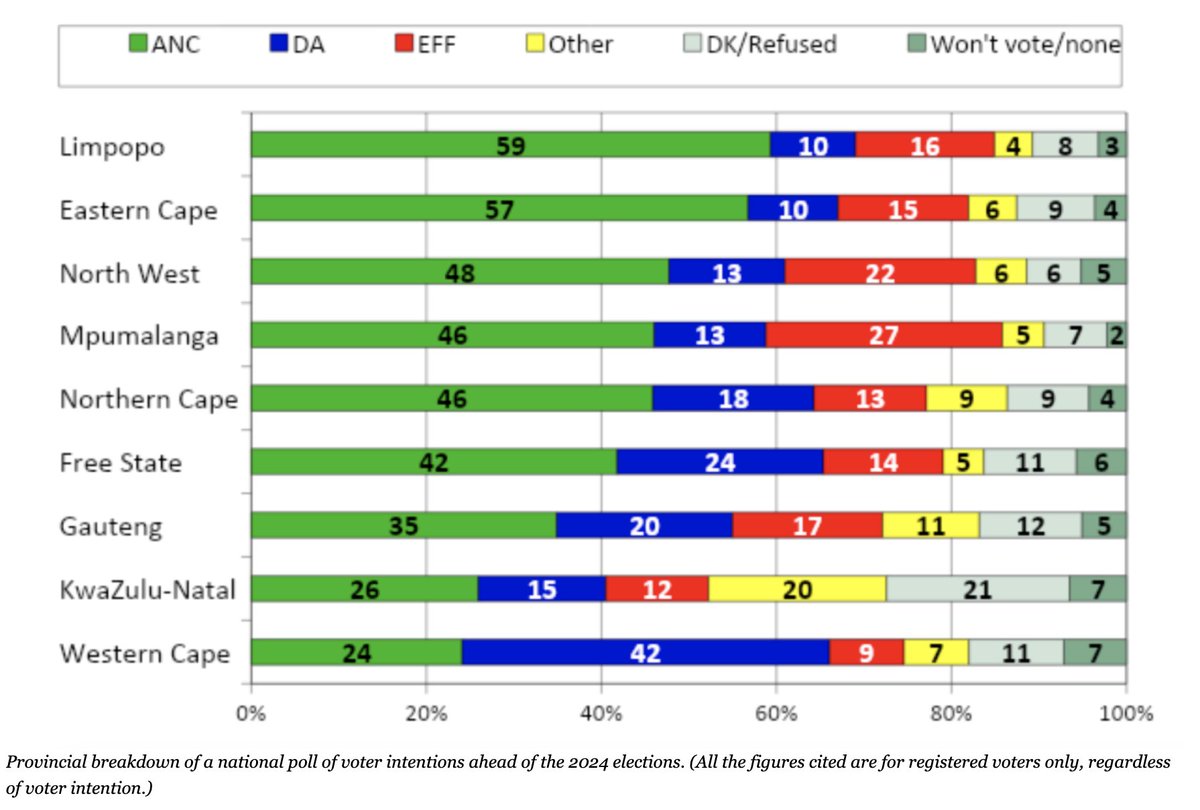
@dailymaverick These numbers are a vague guess at best. Just look at how off the "won't vote" numbers are, that will probably be closer to 30% - 40% come election day.
@iAmTPJN Precovid, GIBS was getting 3x more applications for the MBA than they had space for.
I'm not sure what it is like now, but would assume even with regular price hikes they still have enough applicants to fill seats.
Many corporates also pay for their employees to do an MBA.
@SashtonSean It kills me that the term 'Rand manipulation' is used.
It was price fixing by currency desks, around what they charged clients to trade. It didn't impact the spot price of the Rand.