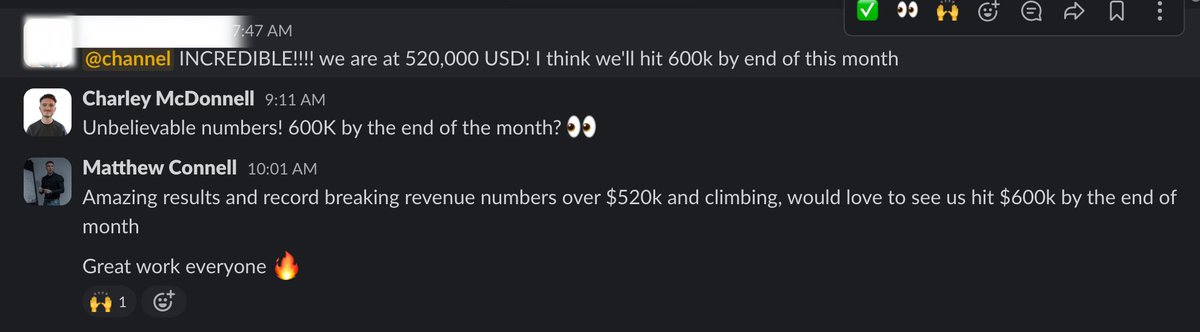
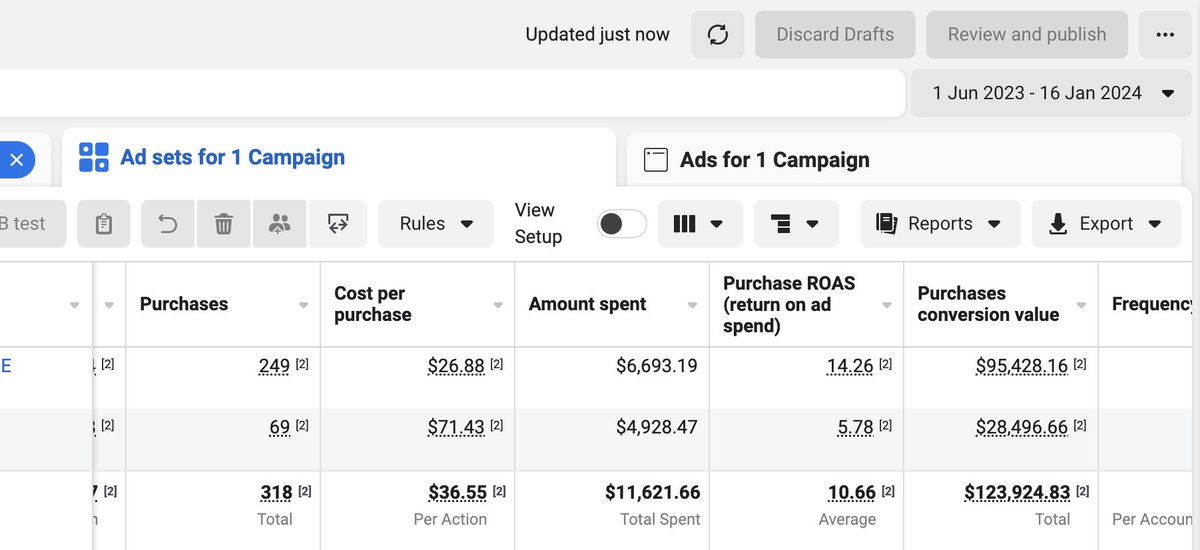
Most brands don’t fail because of bad products.
They fail because of:
– Weak offers
– Lack of creative variety
– Poor retention strategy
– Chasing ROAS instead of building MER & LTV
Ads can only amplify what already works.
Front-end ROAS ≠ profitability.
Some brands are happy to breakeven at the start — because they know repeat customers stack profit.
That’s how 1.0 ROAS turns into 5x lifetime.
LTV > short-term thinking
Example:
• Ads show 1.9x ROAS (looks bad).
• But MER = 5.4x (every $1 in ads drove $5.40 in total sales).
👉 ROAS is the platform’s story.
👉 MER is the brand’s reality.
Scale using MER, not vanity metrics.
MER is the most underrated metric in ecom.
MER = Marketing Efficiency Ratio → Total Revenue ÷ Total Ad Spend.
It tells you how efficiently your entire business is growing, not just what Meta or Google reports.
Raising AOV = instant revenue boost.
How we do it:
– Tiered bundles (1 for X, 2 for Y, 3 for Z)
– Cross-sells at checkout
– Post-purchase upsells
– Free shipping thresholds
Customers spend more, CAC stays the same.
Ads just became more profitable ✅
Ad hooks aren’t just about what you say.
They’re about what people see & feel in the first 3 seconds.
– Pattern-breaking visuals
– Emotional triggers
– Relatable scenarios
The best hook is multi-sensory. Words alone won’t stop the scroll.
Meta = Demand generation
Google = Demand capture
Meta makes people want the product.
Google scoops them up when they search for it later.
Scaling brands use both.
Ignore one, and you’re leaving money on the table.
❌ “Buy our product — it’s the best.”
✅ “Here’s why [customer type] is switching to this product.”
❌ “We have 20% off.”
✅ “Stop overpaying for [pain point], here’s a smarter option.”
Ads don’t need louder claims. They need better framing.
One of the first things I do when auditing a brand:
I read 100+ customer reviews.
Why? Because your customers already wrote your ad copy.
Pain points, desires, triggers—it’s all there.
Skip this step, and you’ll forever “guess” with your ads
Offers > Ads
No creative can fix a bad offer.
One brand was running “10% off” and wondering why nobody cared.
We reframed it → “Buy 2, Get 1 Free” + bundle positioning.
Same spend, but 40% higher AOV.
Ads amplify offers. They don’t replace them.
Here’s how I scale brands without burning cash:
1. Research customer avatar
2. Build 3–4 creative angles
3. Test broad with single-variable ads
4. Kill losers fast
5. Scale winners into Advantage+
Simple system. Boring works.
Growth doesn’t always mean more ad spend.
If your conversion rate goes from 2% → 4%, you just doubled revenue without spending a cent more.
We’ve scaled brands massively by fixing:
✅ Checkout flow
✅ PDP clarity
✅ Offer structure
Better CRO = bigger returns on the same traffic
One of my clients thought their ads weren’t working because “the algorithm is broken.”
The truth? They were testing 1 ad at a time.
We rebuilt the structure → 1 campaign, 4 angles, 3 hooks each.
Within 14 days, CPA dropped 27%.
👉 Stop blaming the algo. Feed it creative variety.
If you’re not tracking hook rate, you’re wasting budget on Meta ads.
💡 Hook rate = 3-sec views ÷ impressions
It tells you how well your ad stops the scroll.
Benchmarks (UGC/video):
< 20% = Weak
20–30% = OK
30–40% = Strong
40%+ = 🔥 Scale it
Track, Iterate, Scale 🚀
Consistency builds everything worth having.
Business. Life. eCom.
Not the brands who show up when sales are good
The ones who show up regardless.
No secret. Just:
→ Daily effort
→ Testing when it flops
→ Pushing when it’s quiet
Stay consistent. Especially when it’s hard.
Meta Ad Structure in 2025 👇
• Adv+ for scale
• ABO for testing
• 1 Concept per ad set
• Funnel-based campaigns (T/M/BOF)
• CAPI + UTM = clean data
• Scaling? Don’t touch it
Simple structure = better performance.
Stop overcomplicating. Let Meta work.