Most DeFi protocols fail for the exact same reason:
They promise astronomical APYs, attract mercenary capital, and the moment emissions taper off, that liquidity vanishes overnight.
When people first look at @potsmoney, they instinctively assume it’s playing the same game.
That assumption is usually wrong.
To see why the architecture is fundamentally different, you have to separate standard DeFi habits from permanent on-chain mechanics.
Here are 𝟯 things people consistently get wrong about POTS Money, and the bigger picture behind the protocol.
@pots_money@pots_market
🧵 🎥
Farming Pools of the Week:
The APR Is Not the Strategy: What I Look At Before Farming STON/USDT
A high APR can make a DeFi liquidity pool look impossible to ignore.
But the more time I spend around liquidity pools, the more I realize that the APR displayed on the dashboard is only the starting point—not the full strategy.
The STON/USDT pool on https://t.co/hy6LUCCRQ0 is a good example.
The numbers shown in the reference are interesting:
$722.68K TVL
$4.41K 24h volume
0.45% pool APR
26.55% boosted APR
That 26.55% boosted APR is obviously the number that grabs attention.
But I wouldn't make a liquidity decision based on that figure alone.
The first question I'd ask is:
Where is the extra yield coming from?
Boosted APRs are often tied to incentives that may only last for a certain period. If those incentives are reduced or removed, the effective return can look very different.
Then I look at the pool itself.
TVL gives me an idea of how much capital is currently providing liquidity, while trading volume helps show how much activity is actually happening.
Both matter because liquidity provision isn't simply about collecting rewards.
You're putting capital into a market where the underlying assets can move.
If STON and USDT move significantly relative to each other, impermanent loss becomes an important factor to consider.
That's why my approach to farming has changed.
Instead of asking:
"How high is the APR?"
I'd rather ask:
"What am I taking on to earn that APR?"
For me, that means looking at:
→ Pool liquidity
→ Trading activity
→ Incentive duration
→ Token volatility
→ Impermanent loss
→ Fees
→ Sustainability of the rewards
This is what makes DeFi interesting.
The goal isn't simply to chase the highest number displayed on a dashboard.
It's to understand the relationship between reward, risk, liquidity, and time.
A 26.55% boosted APR can certainly look attractive.
But whether it's actually attractive depends on what is happening underneath that number.
In DeFi, the smartest yield strategy isn't always the one offering the highest APR.
Sometimes, it's simply the one you understand best.
DYOR before providing liquidity.
#STONfi #DeFi #TON
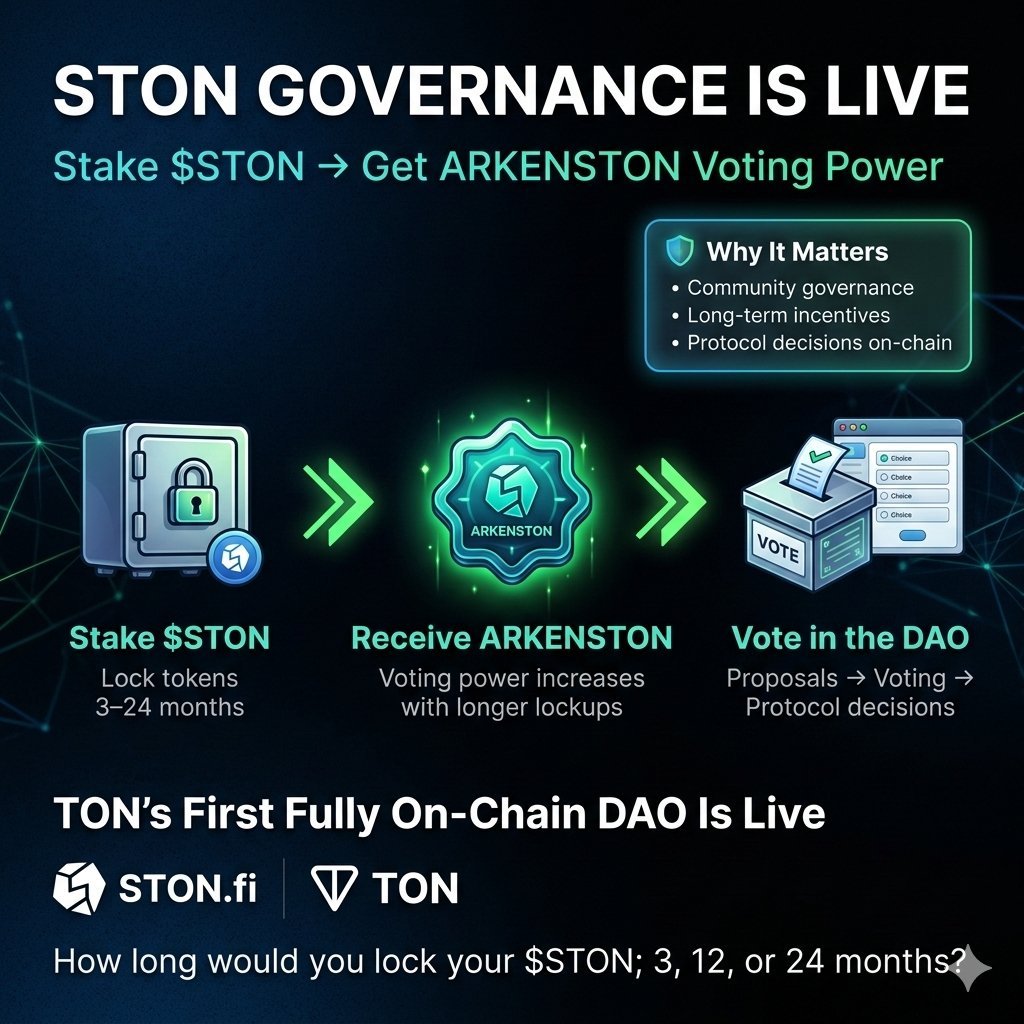
Stake $STON for 3–24 months on https://t.co/551ERWsdaN → receive ARKENSTON voting power.
Lock longer, gain more influence.
TON now has its first fully on-chain DAO live; where the community can shape protocol decisions.
Are you staking or just watching governance happen?
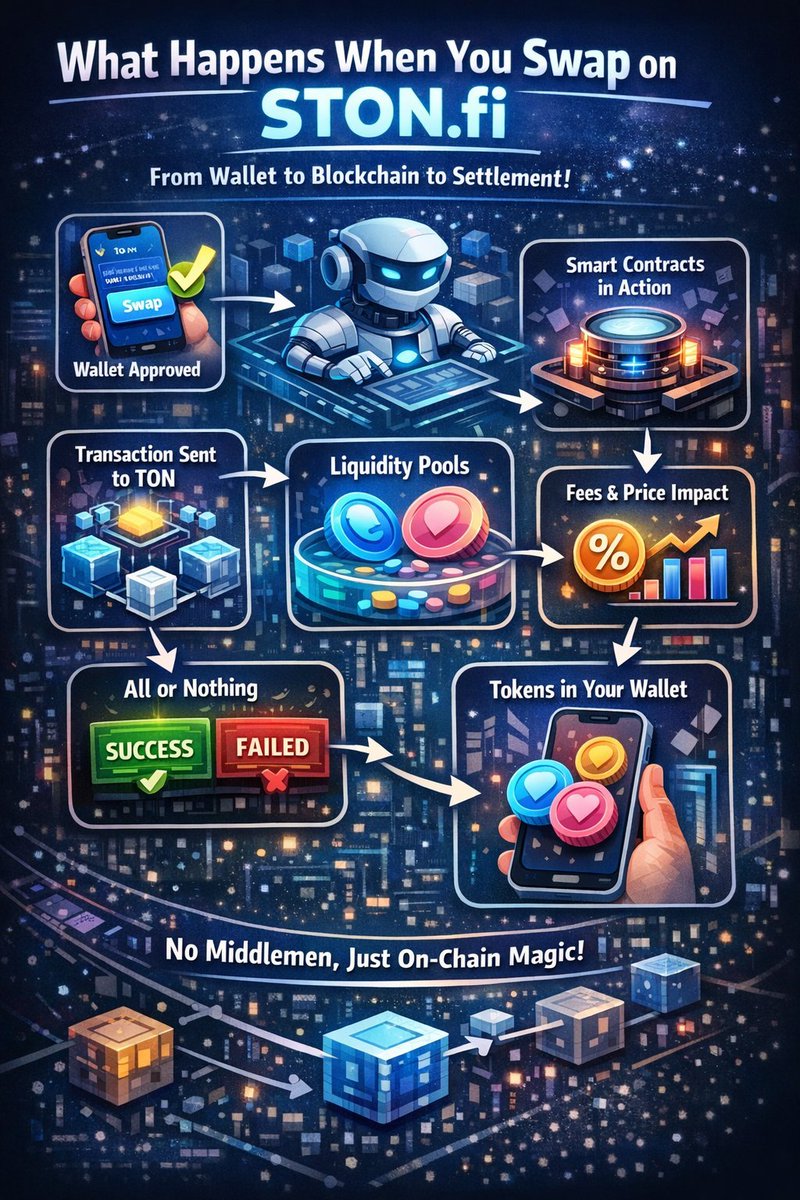
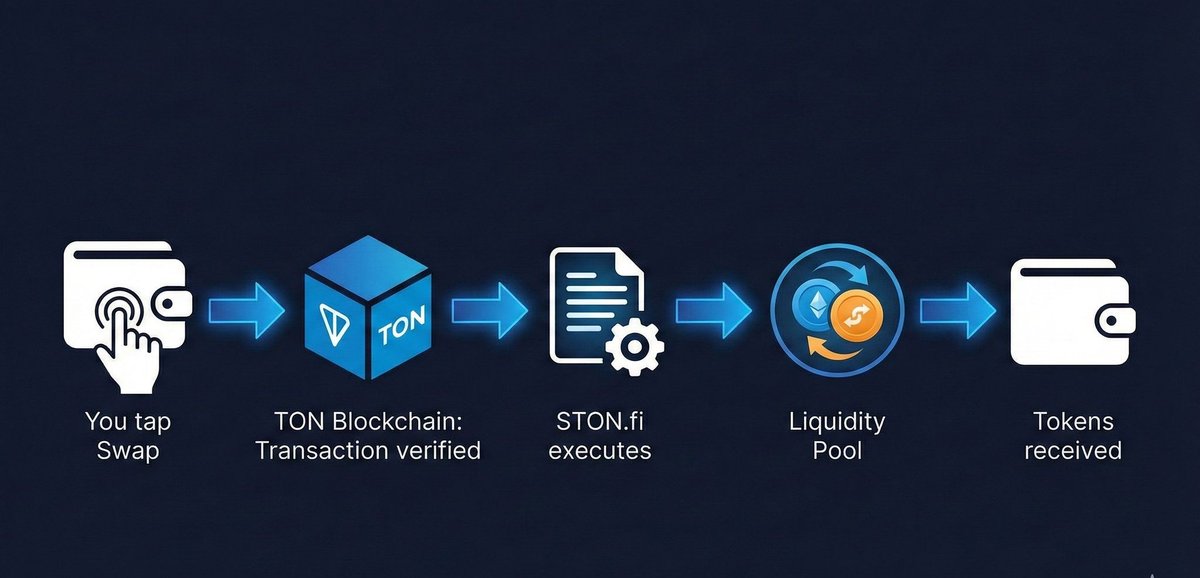
You tap “Swap.”
But on https://t.co/hy6LUCCRQ0, a LOT happens before your new tokens appear.
Let’s walk through what actually goes down from wallet → blockchain → settlement, without the boring textbook stuff.
Stage 1: Your wallet makes the first move
When you hit swap, your TON wallet signs a message. Think of it as saying, “I approve this action.”
No funds move yet; you’re just giving smart contracts permission to do their thing.
Stage 2: TON takes over
That signed transaction is sent to the TON blockchain. Validators check it’s legit; balance, rules, and all that good stuff. If it passes, it gets processed on-chain.
Stage 3: Smart contracts wake up
https://t.co/hy6LUCCRQ0 runs on smart contracts. Once your transaction lands, the contracts read your instructions; what you’re swapping, how much, and your minimum acceptable output.
Stage 4: No buyers, no sellers, just liquidity
There’s no order book here. Your swap interacts with a liquidity pool; a pool filled with two tokens supplied by liquidity providers.
The price comes from math, not from someone on the other side of the trade.
Stage 5: Fees & price impact happen quietly
Your swap slightly shifts the pool balance; that’s price impact. A small fee is also taken and routed to liquidity providers, helping keep the system running.
Stage 6: All or nothing
The swap is atomic. Either every step succeeds and you get your tokens, or something fails and the whole transaction is rolled back. No half-swaps, no weird surprises.
Stage 7: Tokens land in your wallet
If all conditions are met, the smart contract sends the new tokens straight to your wallet. The result is final and recorded on the TON blockchain.
The real magic?
No custody, no middlemen, no off-chain IOUs; just wallets, code, liquidity, and on-chain settlement.
Once you understand this flow, “Swap” stops feeling like a button and starts feeling like a process you actually control.