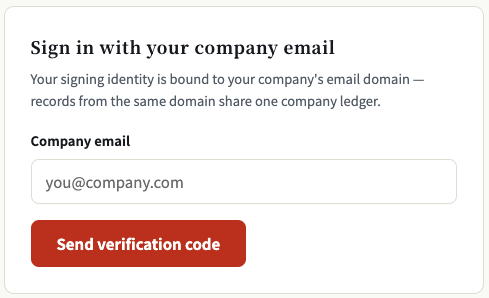
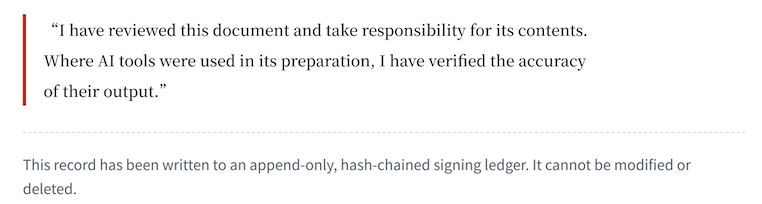
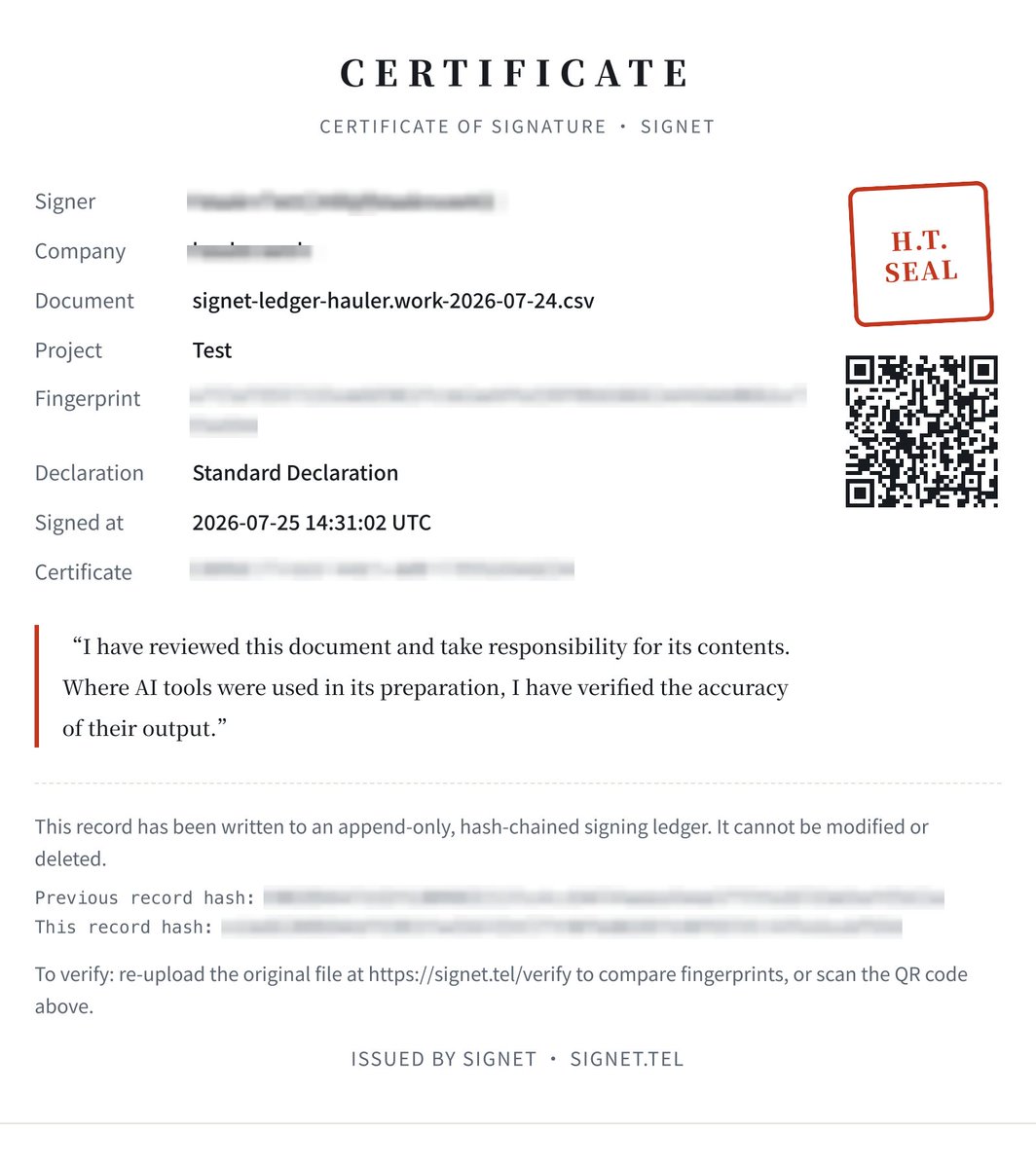
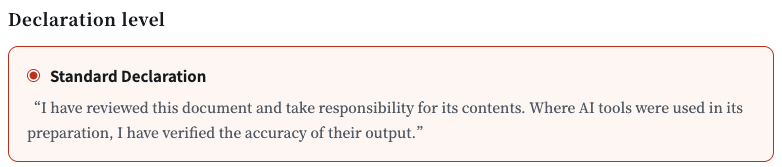
Here's the failure mode I built Signet for.
A report goes out to a client. Three weeks later they find a number that's wrong. You ask internally who approved it, and the answer is a chain of shrugs. It was drafted with AI, edited by two people, sent by a third. The file has been renamed twice. Nobody is certain which version actually went out.
Nothing was hidden. There was just never a moment where one person said: this one, I checked it, it's mine.
That moment takes about twenty seconds. Signet records it — who, when, which exact file, under which declaration — and the record can't be edited afterward.
The question I get most: why not just use DocuSign?
DocuSign proves an agreement happened between two parties. It's built for contracts — two sides, mutual consent.
Signet answers a different question: who inside your company stood behind this document before it went out. One person, one declaration, no counterparty required.
A report, a memo, a client deliverable, an AI-drafted summary — none of those have someone signing on the other side. They all still have someone responsible.
That's the gap. Twenty seconds, and the record is permanent: who, when, which exact file, under which declaration.
Free for companies → https://t.co/rnGuOLeGpl
A build decision I want on the record: verifying a signature on Signet requires no account. No login, no email, no trial. Drop the file in at https://t.co/h5NDLamnPK and you get an answer.
The reason is simple. The person who most needs to check a document is almost never the person who signed it. It's the client receiving the report. The regulator reading the filing. The journalist handed a memo.
If I made those people sign up first, most of them wouldn't. And a proof nobody can check isn't a proof.
So verification is free forever. That's not a launch promotion I'll quietly walk back — it's the part that makes the rest of it mean anything.
Free for companies → https://t.co/rnGuOLfeeT
Courts have already sanctioned lawyers for filing briefs with AI-invented citations. Not one judge asked which model wrote the brief. The name on the filing took the hit.
That's how every profession works: the AI can draft, but a person answers.
Signet just makes that moment explicit. Before the document goes out, the responsible person signs it — 20 seconds. The record is permanent: who, when, which exact file, under which declaration.
"The AI did it" was never a defense. Now there's proof of who actually stood behind the work.
Free for companies → https://t.co/rnGuOLfeeT
A question for people who manage teams using AI:
When AI-drafted work goes out under your company's name and turns out wrong — who owns it?
Not who should. Who actually does, in your team, today?
The answer that started Signet was an employee telling me: "the AI wrote it, not my responsibility." I suspect that answer is more common than anyone admits.
Curious how other teams handle this.
A question for people who manage teams using AI:
When AI-drafted work goes out under your company's name and turns out wrong — who owns it?
Not who should. Who actually does, in your team, today?
The answer that started Signet was an employee telling me: "the AI wrote it, not my responsibility." I suspect that answer is more common than anyone admits.
Curious how other teams handle this.
🤡 FUN 🤡
Apple ra “phụ kiện” $199 để giữ nắp MacBook mở he hé, cho AI agent chạy 24/7 mà màn hình không sleep 💀
Tức là giờ cái laptop thức làm việc, còn mình thì đi ngủ.
Trong khi lệnh caffeinate xài free, cục tẩy 2 nghìn kê vào cũng ra y chang kết quả.
A detail I care about in Signet: I can't edit the ledger. Nobody can.
Every record carries the hash of the one before it. Change anything — even one byte, even years later — and the chain breaks, publicly.
So when I say a signature is permanent, that's not a policy promise. It's how the thing is built.
Anyone can check: re-upload the original file at https://t.co/h5NDLamnPK and it either matches byte for byte, or it doesn't.
A detail I care about in Signet: verifying a document doesn't require an account, or trusting me.
You receive a file. You drop it on https://t.co/h5NDLamnPK. If a single byte changed since it was signed, the check fails. If it matches, you see who signed it, when, and under which declaration.
Under the hood the ledger is append-only and hash-chained — every record locks in the one before it. I couldn't quietly rewrite history if I wanted to.
That "not even me" part took the longest to build. It's also the whole point.
Last week an employee told me: "the AI wrote it, not my responsibility."
That answer can't stand. AI can produce the work — it can't go to court, face a client, or take blame. Someone has to.
So I built Signet: a signing ledger for the AI era.
Before a document goes out, the person in charge signs it — 20 seconds. The record is permanent: who, when, which exact file, under which declaration. Hash-chained, append-only, publicly auditable. Nobody can edit it. Not even me.
Anyone who receives the document can verify it's untouched, byte for byte.
"The AI did it" stops being an escape. And the people who do stand behind their work finally get proof of it.
Free for companies → https://t.co/rnGuOLfeeT
Every important document deserves a name that stands behind it.
Courts have already sanctioned lawyers for filing briefs with AI-invented citations. Not one judge asked which model wrote the brief. The name on the filing took the hit.
That's how every profession works: the AI can draft, but a person answers.
Signet just makes that moment explicit. Before the document goes out, the responsible person signs it — 20 seconds. The record is permanent: who, when, which exact file, under which declaration.
"The AI did it" was never a defense. Now there's proof of who actually stood behind the work.
Free for companies → https://t.co/rnGuOLfeeT
A detail I care about in Signet: I can't edit the ledger. Nobody can.
Every record carries the hash of the one before it. Change anything — even one byte, even years later — and the chain breaks, publicly.
So when I say a signature is permanent, that's not a policy promise. It's how the thing is built.
Anyone can check: re-upload the original file at https://t.co/h5NDLalQ0c and it either matches byte for byte, or it doesn't.
These are the apps that have grown the most over the last 6 months:
- Peptide apps
- Manifestation apps
- Alarm apps
- Meal planner apps
- Calorie tracker apps
(Screenshot from https://t.co/QHRRNDYJGa)
Claude Fable 5 is actually a beast for web design.
this guy just dropped a full guide on how to design and build interactive animated 3D websites with Claude Code + Fable 5
(complete prompts in the comments)
watch the video and read the full guidelines on the article below