If I don't reply to you, please, do not get offended. I took a holy meow never to engage in any discussion on Twitter (aka X). Just put stuff here for promotion. If you'd like to talk, please, visit the FB page. 😼 https://t.co/mIhbmZDTp6
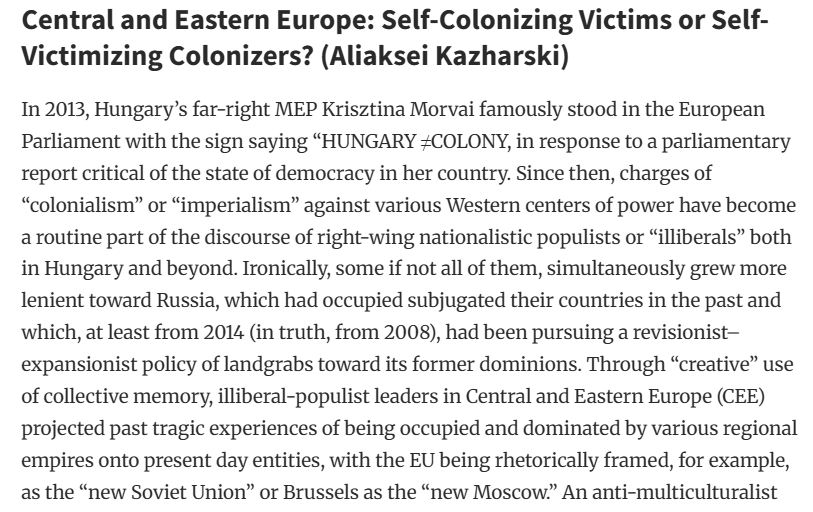
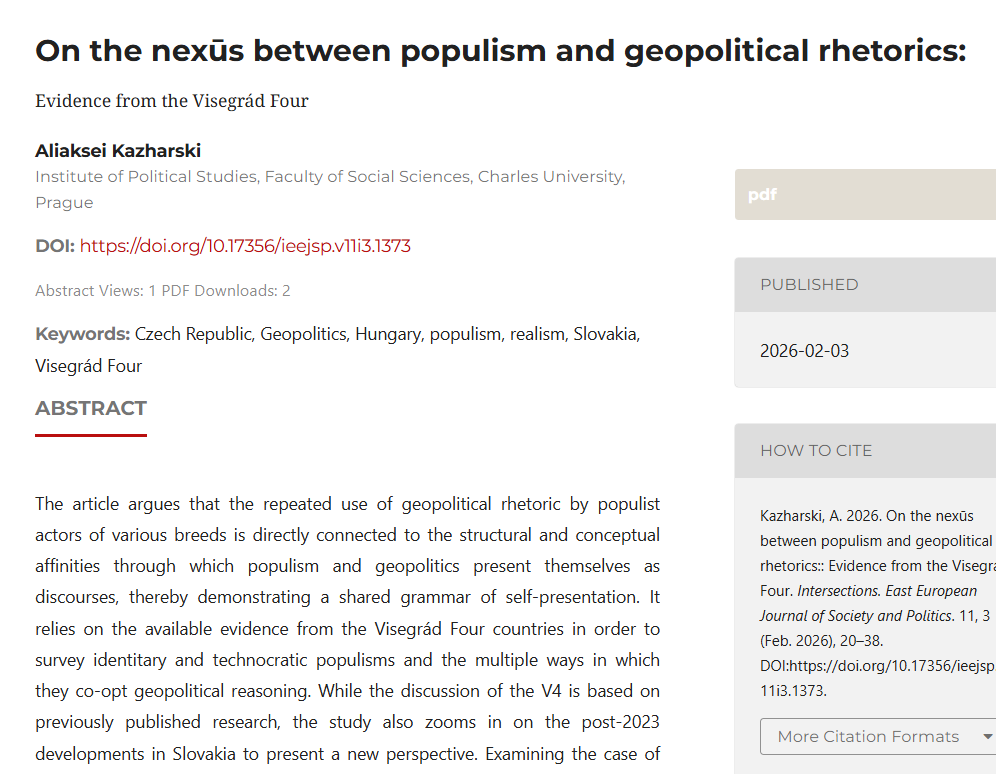
Glad to share this forum to which I also contributed. Use&abuse of 'anti-colonial' rhetoric, worldwide and in Central&Eastern Europe. @IPS_FSV_CUNI@VisegradInsight@RigaGeopolitics@GLOBSEC
https://t.co/On0J38d3Bn
Calling journalist Andrzej Poczobut a “joint Polish-Belarusian hero,” exiled Belarusian opposition leader Sviatlana Tsikhanouskaya [@Tsihanouskaya] thanked the Polish leadership and public for their support.
New text out as part of a forum in Cooperation and Conflict: "Authoritarian learning: importing the logic of war in Hungary and Slovakia."
Open access.
https://t.co/RwkKN0DDk2 @VisegradInsight@RigaGeopolitics@GLOBSEC@panyiszabolcs
In June 2020, at the height of Covid, Orbán came to Belarus on an official visit to support Lukashenka ahead of presidential election.
I was preparing briefing materials for their talks and here is a thread with my memories about that day.
Ladies and gentlemen: Hungary’s PM is now attacking and lying about an investigative journalist in the final days of his campaign—right after we exposed and corroborated his foreign minister’s collusion with Russia over EU sanctions.
He used to ignore us; now he appears rattled.
Rick Fawn's detailed account of the Visegrád Group's history - and the lessons to be learned from it for the future of the broader region, including Belarus, Ukraine and other "Eastern neighbors." Read my review in JCES https://t.co/wLNRZrNqiB
‼️Statement on the Orbán Government Accusing Me, an Investigative Journalist, of Espionage‼️
Today, the Hungarian government has filed a complaint against me for espionage. Accusing investigative journalists of espionage is virtually unprecedented in the 21st century for an EU member state. This is typical of Putin’s Russia, Belarus, and similar regimes.
I have spent over a decade documenting how Russian spies and interests have penetrated Hungarian politics, so I am probably the least surprised by this.
Despite growing signs that the Hungarian government acts as a Kremlin ally and copies the Russian model, I still trust that parts of the Hungarian state—and the judiciary—follow the Hungarian constitution, not that of the Russian Federation.
I have never engaged in espionage. I see my work as journalistic counterintelligence—from exposing the hacking of the Hungarian Foreign Ministry by Russian actors to revealing the activities of Hungarian pro-Kremlin propagandists.
Defending myself publicly would be easier if I were not bound by source protection. But that remains my top priority. I cannot reveal who provides me information or what I receive, including from within Hungarian state structures.
If I were not a journalist, I could list many facts proving it is impossible for the Hungarian state to genuinely believe I am spying. Certain meetings, contacts, and information gathering could never have happened otherwise.
This baseless accusation now forces me to share details of a specific investigation, including a conversation with a confidential source that appears to have been wiretapped. Normally, this would appear in a finished article or my upcoming book—not here. (It will appear there as well.)
Since 2023, I have investigated whether the relationship between Péter Szijjártó and Russian officials exceeds legal limits. The published audio, where I’m heard talking to a source, mentions that communication between Szijjártó and Sergey Lavrov is recorded by EU intelligence services. Less attention has gone to my point that this relationship raises strong suspicion of political intelligence activity and influence operations in Russia’s interest.
These are serious claims and hard to prove. As a journalist, I cannot force anyone to speak or hand over documents. That is why gathering this information has taken so long—and why I spoke to that sensitive source (while the conversation was secretly recorded).
Serious claims require serious evidence, and I believe I have gathered some. I have not engaged in espionage.
I have not cooperated with any foreign intelligence service in surveilling Szijjártó. Instead, I tried to verify earlier fragments of information about Szijjártó–Lavrov communication.
I sought to identify the channels and phone numbers used, and whether a secret channel—possibly used by Russian intelligence—exists. In other words, whether Szijjártó uses a hidden device or number unknown even within the Hungarian Foreign Ministry.
This was only one part of my research. The other, more serious topic is this:
Since at least 2016–2017, EU and NATO intelligence services have had indications that large amounts of cash and precious stones may have been transported from Russia on Hungarian government aircraft or private jets used by government figures. Officials from at least six countries made such claims to me.
These signals did not come from monitoring Hungarian targets, but, for example, from intercepting Russian officials discussing or preparing such shipments.
Alongside Szijjártó–Lavrov communication, I examined how baggage screening and handling works on such flights, which officials travel with what luggage, whether more packages arrive from Moscow than depart, and how such shipments could be handled discreetly.
I know how serious this is, and I would not have written even this much—but since I do not know what else may be taken from the edited recording, or what fabricated accusations (like, for example, that I was seeking such details to commit terrorism) may follow, I believe I must share this now.
Why do I investigate all this?
According to many sources familiar with the Hungarian state and counterintelligence, there is no independent body in the Orbán system able to investigate or act if a senior official is suspected of espionage.
Government members direct intelligence services and set expectations. The services lack both tools and authority to investigate a government member.
I knew this would be difficult when I chose to pursue it. But few people in Hungary can or dare to do this, so I felt it was my duty.
We have now reached the point where the Orbán government—of which Szijjártó is still a member—aware of my reporting plans and the risk they pose, has preemptively accused me of espionage.
I am a Hungarian patriot. I serve the public. As an investigative journalist, my job is to hold power accountable. Neither political theater nor legal threats will deter me.
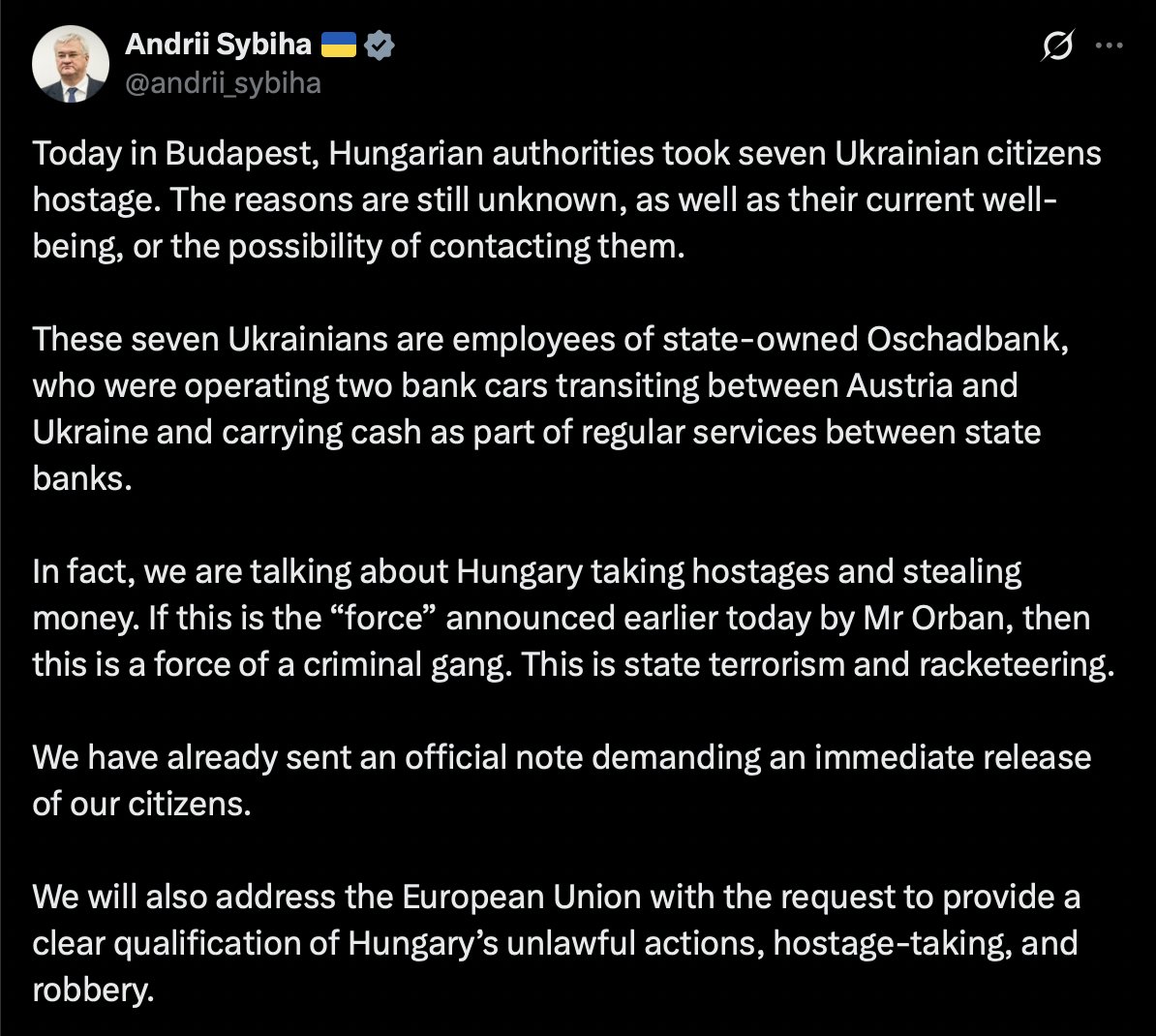
Viktor Orbán's government is intentionally trying to provoke a conflict with Ukraine, because they see this as their only chance of winning the April 12 election where they're trailing the opposition considerably.
On this incident: what I'm hearing from Hungarian government-connected sources is that the trucks and the bank employees were detained as part of a political operation. A fabricated tax authority (NAV) investigation was created as the legal basis, and counter-terrorism forces were sent in. According to the information — said to have originally come from Russian sources — one of the guards carrying the money was a former high-ranking Ukrainian national security officer. He was specifically targeted on equally fabricated money laundering charges. The other six Ukrainian guards were very likely detained illegally, even without a trumped-up legal basis.
This is the kind of escalation we expected from Orbán. It's starting. Hungary's EU and NATO partners have a huge responsibility now, and in the coming weeks.
Jörg Dornau (Afd) was arrested today and is accused of "circumvention of EU sanctions" and "use of political prisoners from the Lukashenka regime as forced labour on the farm." His residential and business premises and vehicles were searched. His parliamentary immunity was lifted
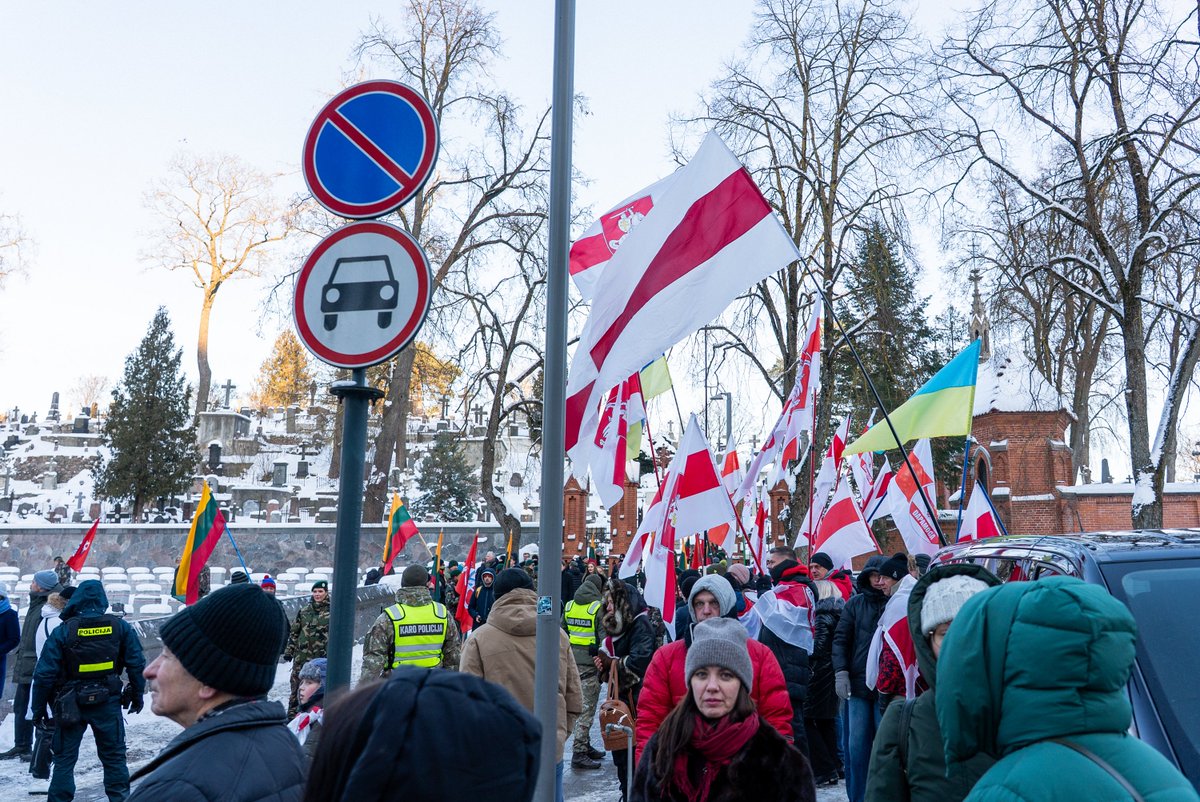
It warms my heart to see so many ⚪️🔴⚪️ flags in Vilnius today at the ceremony commemorating the 1863–1864 January Uprising.
Thank you to everyone who came. Your presence shows that the memory of the struggle for freedom lives in the hearts of Belarusians, wherever we are.
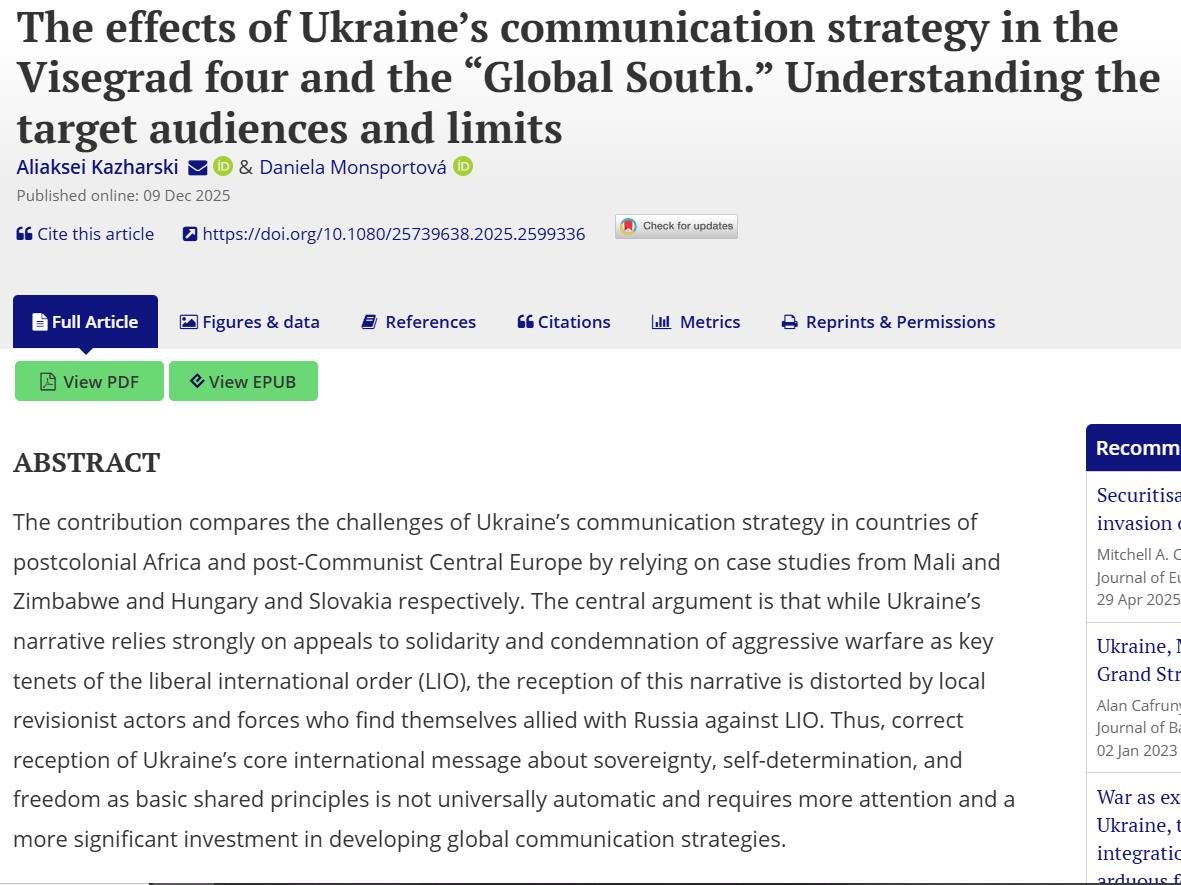
Published today: our counterintuitive comparison of how Ukraine's message resonates in Africa and CEE . Part of a forum in JCCEE ("Learning from Ukraine")
@DanielaMonsport@YKurnyshova
https://t.co/jL9pKZ9zzn