An Indian astronomer's work survives inside an 8th century Chinese text. The clue is extraordinary: 5 tiny numerical errors that travelled with the mathematics.
His name was Gautama Siddha, known in Chinese as Qutan Xida. His family came from India and settled in Chang'an.
4 generations, beginning with his father's, held posts in the Tang Astronomical Bureau, working with Sanskrit astronomical texts.
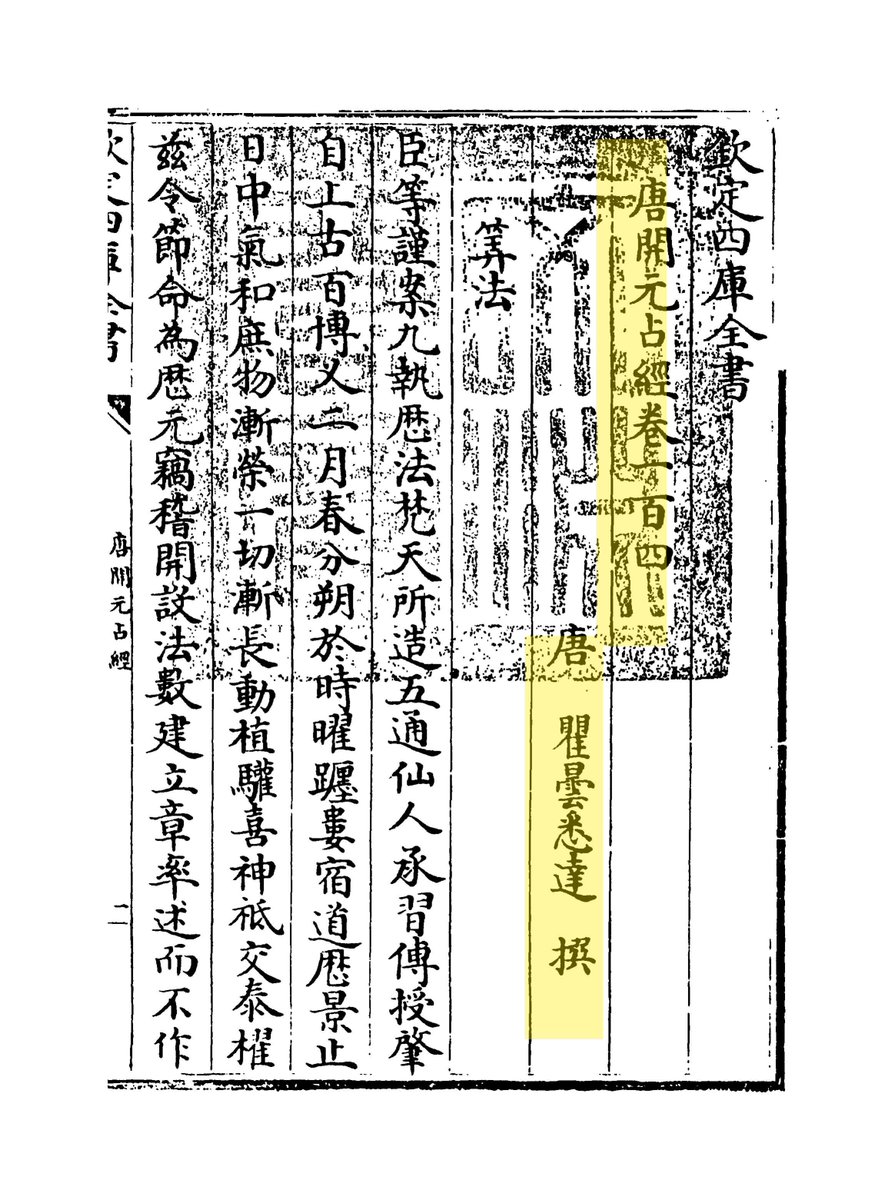
In 718, Emperor Xuanzong commissioned Siddha to compile astronomical knowledge. The resulting Kaiyuan Zhanjing ran to 120 chapters, preserving older Chinese material alongside knowledge from India.
Chapter 104 contains the Jiuzhi li, an Indian astronomical manual in Chinese. It describes decimal place value and explains what to do when a position is empty:
"Wherever there is an empty space, a dot is always placed."
The Indian numeral symbols disappeared from later copies. The explanation survived.
The chapter also contains eclipse calculations and a sine table. These were tools for calculating celestial positions, not merely descriptions of the sky.
Here is the remarkable detail....
Aryabhata's mathematical astronomy used a list of 24 sine differences: successive changes in sine values. 5 entries differ by 1 unit from the geometrically correct values.
Those same values, including the discrepancies, appear in the Chinese Jiuzhi li.
Even the small numerical imperfections survived the journey from Indian mathematics into Chinese astronomy.
Siddha's compilation itself was later lost from circulation. Around 1616-17, a copy was reportedly recovered from inside an old Buddha statue.
P.S. Sine differences let a table be built step by step. Matching numerical discrepancies are evidence of a shared mathematical tradition, not proof of which physical manuscript Siddha used.
Sources: Vijaya J. Deshpande, Indian Journal of History of Science 50.2 (2015), pp. 215-226; Bill M. Mak, Plurilingualism in Traditional Eurasian Scholarship (2023), pp. 352-362; Michio Yano, History of Science in South Asia 7 (2019), pp. 42-51; Library of Congress, Kaiyuan Zhanjing catalogue record.
Photo 1: Title page highlighted: chapter 104 and the attribution "compiled by Qutan Xida" (Gautama Siddha).
Photo 2: The zero/place-value passage, highlighted: "When the count reaches ten it advances to the next place; wherever a position is empty, a dot is always placed."
Photo 3: Sine-difference page highlighted: the first two entries, 225 and 224, with the cumulative total 449. The small highlight at the top of the next column completes the last digit of 449, where the text wraps.
Image Source: Kaiyuan Zhanjing, chapter 104, Siku Quanshu edition, Zhejiang University Library copy, via Internet Archive.
“I’ve grown up watching every single match of hers.” 🥹❤️
India’s Anahat Singh beats her idol Nour El Sherbini, an 8-time World Champion, to claim the biggest win of her career!
THIS IS HUGE FOR 18-YEAR-OLD ANAHAT!
🔥🔥🔥🔥🔥🔥🔥🔥🔥🔥🔥🔥
When we think about gravity as a concept, we tend to go with our thoughts to Isaac Newton and his apple, but an idea of gravity as attractive force, was first suggested by Indian astronomer Brahmagupta in the year 628 CE.
He called it "gurutvākarṣaṇ".
Benson plagiarized Transcendental Meditation in the 1970s from one of Maharishi’s earliest researchers. He replicated studies on TM practitioners and renamed it Relaxation Response. Towards his final years when in his 90s, I interviewed him at Harvard. I have a video of that. He acknowledges his debt to Maharishi - but too late and too little.
It is really not hard.
40 percent of modern medicines as of today come from Ayurveda.
It was almost 90 percent four decades ago before monoclonal antibodies and genetic medicine.
I will write about mathematical basis when I get time.
might be a controversial take, but —
hindus in today's era, are not philosophically developed enough to grasp the depth of their own scriptures.
this is why, even if scriptures become accessible to them, they misinterpret the content due to their lack of philosophical depth.
An Indian eye-surgery book vanished from China. Korea kept part of it.
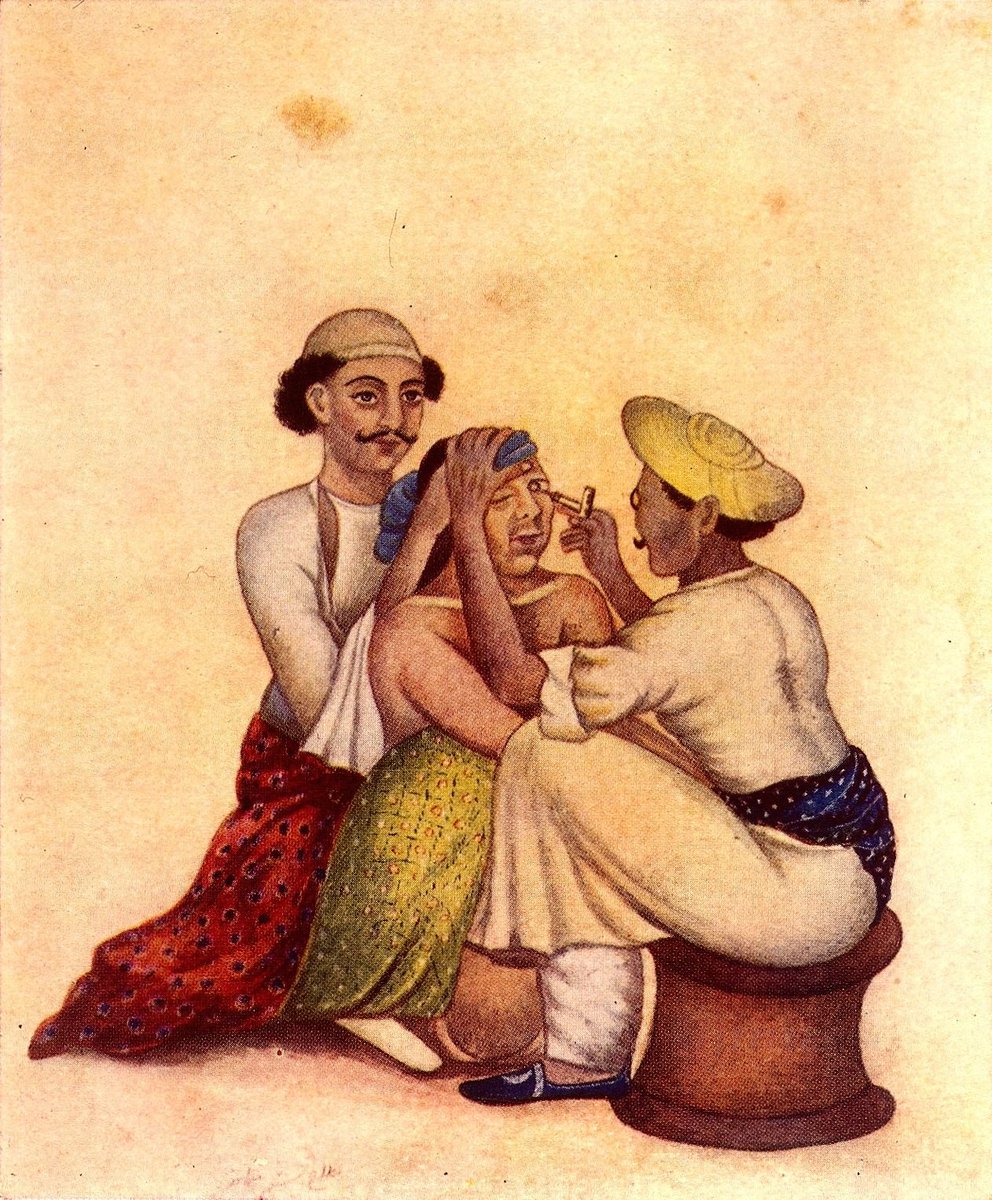
The operation was cataract couching: a needle goes in beside the white of the eye and pushes the clouded lens out of the way. The Sushruta Samhita describes the Indian procedure.
By the Tang dynasty it was in Chinese medicine, taught under the name of one book, the Longshu pusa yanlun, "Bodhisattva Nagarjuna's eye treatise".
In 752 Wang Tao's Waitai miyao already quotes an older Indian treatise on the eye.
Then the trail breaks. The original Longshu book was not handed down in China. A large part of it was copied into Korea's great medical compendium Uibang yuchwi, compiled under King Sejong in 1445.
It has 8 sections and 30 eye diseases. It names heat and wind as main causes. It says the cataract forms when poison and heat gather in the brain and the eye's "oil" runs down over the pupil.
And it gives the golden-needle method step by step, to be done only when the film has hardened "like white jade".
Korean scholars Kim and Kang call it a record of Indian medical ideas already lost in China.
An operation travelled from India to China. The Chinese copies of the book were lost. A Korean encyclopedia kept the text. 🙏🙏
Sources: Wang Tao, Waitai miyao (752); Yi fang lei ju vol. 64 (Joseon); Kim & Kang, Korean J. Med. Hist. 22(1), 2013; Deshpande, Bull. SOAS (1999)
Photo 1: Cataract couching in India (painting, undated). Wellcome Library, London, CC BY 4.0
Photo 2: Uibang yuchwi, volume 201 cover (Joseon, 1477 per Commons). Public domain, via Wikimedia Commons
🔴 News - Elon Musk quietly dropped $276 million on the GOP midterms, including $158 million to a Senate super PAC in one of the largest political donations ever.
@riteshmjn While articles address’s current situation, it’s not the whole picture. Allow me to introduce you to https://t.co/fC8VMi6kbd ! If scaled well, it can truly serve Indian needs. For reminder, India can always find friendly territories with such deposits.