Over the past many years, I have taken a personal stand in support of the NEET examination, arguing that it brought uniformity in student selection across the country and gave students from underprivileged backgrounds a real shot at pursuing their dream of medical education. In the last 5 years, the NEET UG question paper has leaked thrice. Imagine the amount of pressure that it puts on students, who had to go through the examination process yet another time when the system that was supposed to bring in uniformity was failing. Yet there was no accountability, and I believe strongly that it was that moment that brought in a shift in the minds of the students to take to the streets to cry their hearts out.
Protest is a fundamental right in a Democracy. The pertinent question, however, is this: why did the BJP-led Central Government take so long to initiate a dialogue with the protestors? Why was meaningful engagement delayed until the protest had escalated to a flashpoint? What kept you waiting?
The students and the people who are leading them also have a responsibility here. It is natural that when a protest stays on for weeks, people with vested interests will take the stage to air views that are either completely irrelevant to the initial demands of the protests or would try to completely hijack it to serve their agenda. If you remain silent and let these people with vested interests further their agenda, then you are deviating from your core objectives. Please do not let it happen!
I urge the BJP-led Central Government to engage in meaningful dialogue, uphold transparency, and take swift, appropriate action to address the concerns at hand. The strength of any nation lies in the confidence its youth place in its institutions. If our students lose faith in the fairness and credibility of our education system, we are jeopardising the future of our nation.
Mesopotamia was never the cradle of civilisation. India was.
I spent forty years in international shipping, not academia. When I began researching the history of maritime trade, I had no orthodoxy to defend. I followed the evidence, and it kept arriving in the same place: the Indian subcontinent.
Nineteenth century archaeologists dug in Mesopotamia because the climate preserved artefacts, the biblical sources pointed them there, and the Ottomans allowed the excavations. That is the entire basis for the myth of Mesopotamia as "the cradle of civilisation."
Nobody applied the same rigour to India. Mohenjo-daro was not discovered until 1922. By then the narrative had already hardened.
What was actually there was the largest civilisation of the ancient world. Three hundred cities. Fifty thousand people in each, by 2600 BC. Two thirds of them stood on the banks of the Sarasvati, the central and greatest of the seven rivers described in the Rig Veda, flowing down from the Himalayas before the river vanished entirely by 1900 BC. The Vedic kings claimed territory stretching "sea to sea," from Afghanistan to Maharashtra, some 1.5 million square miles, against Egypt's 13,000. A dock at Lothal built to handle thirty ships of sixty tons, unmatched in Europe for four thousand years. When it was first excavated, it was recorded as a bathing pool.
When the scale became impossible to dismiss, the theory was not corrected. It was replaced with a story of pale-skinned nomads from the steppe who supposedly arrived around 1500 BC and brought civilisation with them. There is no evidence. The chronology doesn't work. The Vedas describe no invasion.
In 2019 a Harvard-led genetic study revived the claim, and the press reported it as confirmation. It was not. The same study found the builders of these cities were indigenous. The Sarasvati river that the Rig Veda described had already dried up before these newcomers arrived. What the study also found is that a small group of men, arriving after the Sarasvati had already dried up, interbred with the existing population and left a genetic signature. That is all.
So, where they chose to dig was mostly an accident of climate and access. The Aryan invasion theory was constructed because an Indian civilisation that owed nothing to Caucasians was a fact the late nineteenth century could not accommodate.
Link to full Substack essay with sources in the comments below.
Assume the movie had flopped and the director lost his entire $750,000 investment. How many crew members would have voluntarily returned their fees to help offset his loss?
This is the fundamental asymmetry in risk and reward. When someone puts up their own capital and shoulders the real financial risk especially in a high-failure industry like entertainment they alone bear the downside.
Yet the moment the project succeeds, suddenly everyone who was paid upfront wants a bigger piece of the pie. The same people who would not have shared in the loss now feel entitled to share disproportionately in the upside.
If you accept payment for your work regardless of outcome, you’ve already been compensated for your risk (or lack thereof). Why should the person who risked everything not be allowed to reap the rewards when their gamble pays off?
Google which is cash surplus, just announced an additional capital raise of $80 bn.
Google annual profit is $160 bn, last quarter $62 bn, and market cap $4.5 trillion. That is close to total profits and market cap of all Indian listed companies put together.
It’s a wake up call to all companies to invest into the future, whatever the present maybe.
Now that IPL is done and dusted, time for India to focus on business of business.
Starting tomorrow, Supreme court of India is on a six-week summer vacation and will be operating at just 19% of its capacity. There are 53 million cases pending in Indian courts - 93,143 of them are pending in the Supreme Court.
A judge can go on a vacation, a judiciary cannot.
Why is private capex in India still weak despite good corporate profits? This has been concerning the government rightly and our Hon FM @nsitharaman in particular. So I spoke to a lot of businessmen and here is what I conclude:
- Policy and tax uncertainty
- Fear of unpredictable regulatory action
- Many new age companies including start-ups want to invest in asset light businesses over building factories
- Weak demand visibility in some sectors
- Long legal and approval delays
- Global diversification seen as safe hedge
- New generation in family-run businesses are more interested in family office investments rather than working hard.
This is real global power. Trump visiting China with the cream of corporate America just a few days after China formally declared the US war on Iran illegal. China has imposed counter sanctions against US sanctions on banks doing business with some Chinese oil cos.
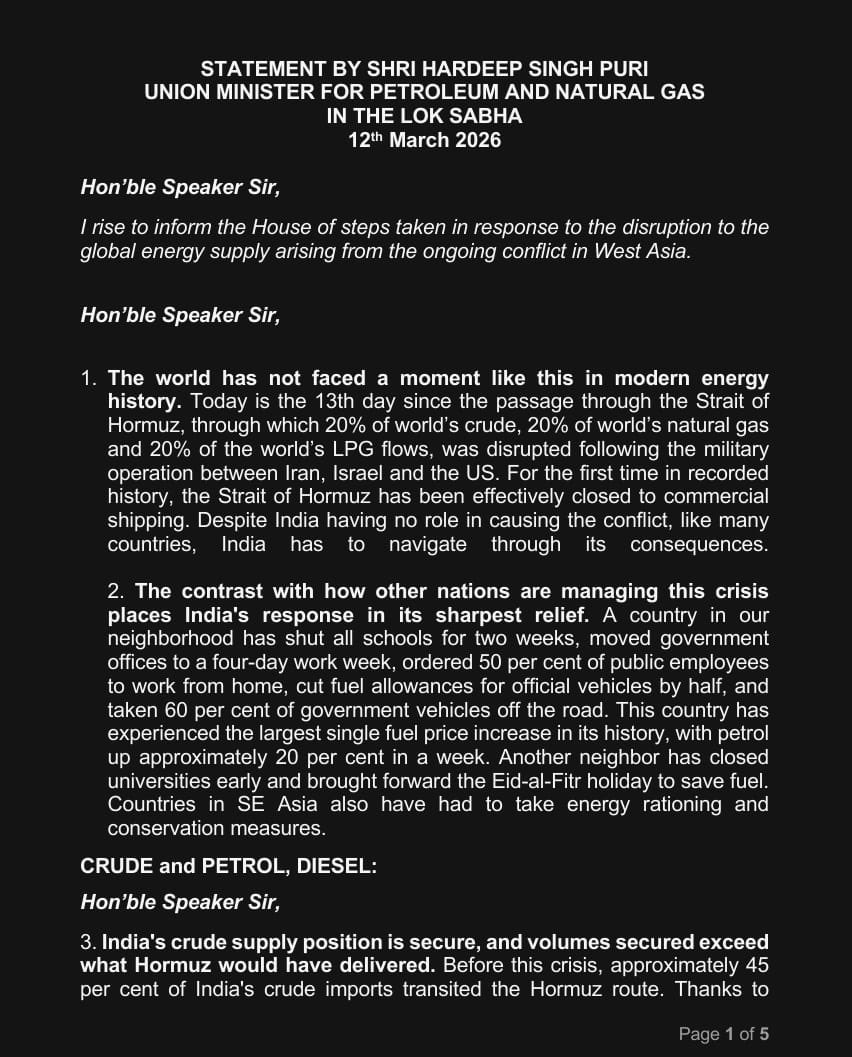
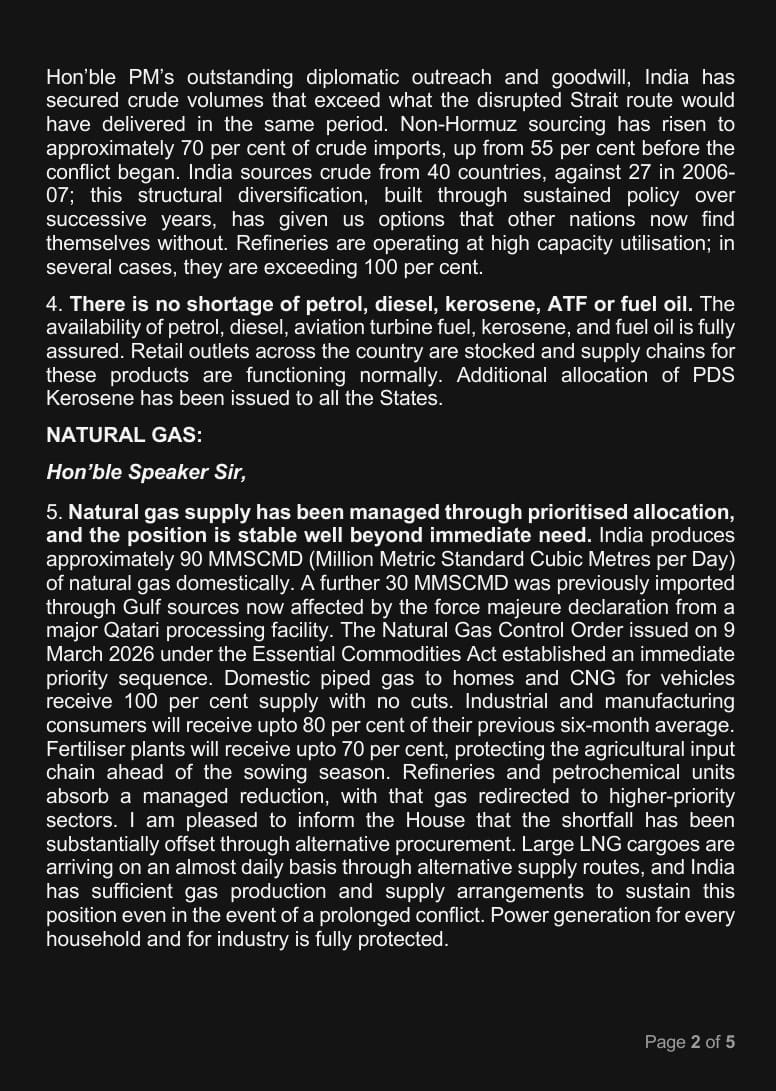
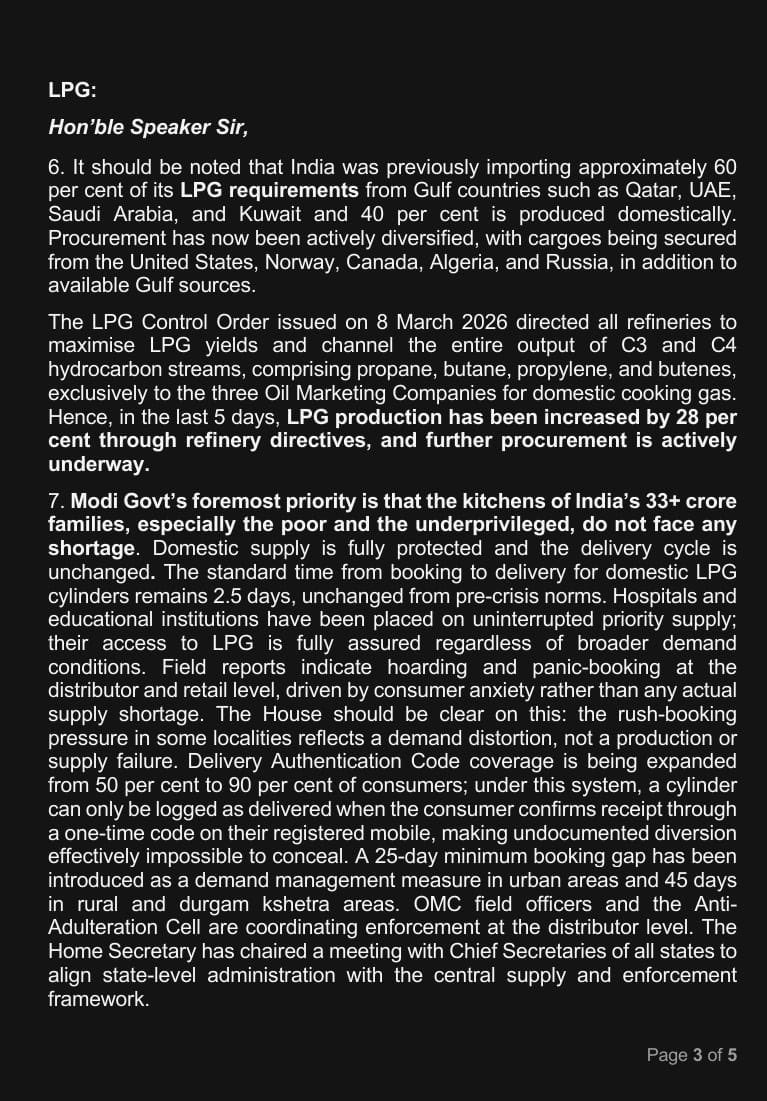
Despite the current geopolitical situation involving major energy producers, our energy imports are secure and continue to flow from different sources using non-Hormuz routes.
We are comfortably placed and are able to meet the energy requirements of our citizens.
There is no shortage of petrol, diesel, kerosene, ATF or fuel oil. The availability of petrol, diesel, aviation turbine fuel, kerosene, and fuel oil is fully assured. Retail outlets across the country are stocked and supply chains for these products are functioning normally.
Domestic piped gas to homes and CNG for vehicles receive 100% supply with no cuts.
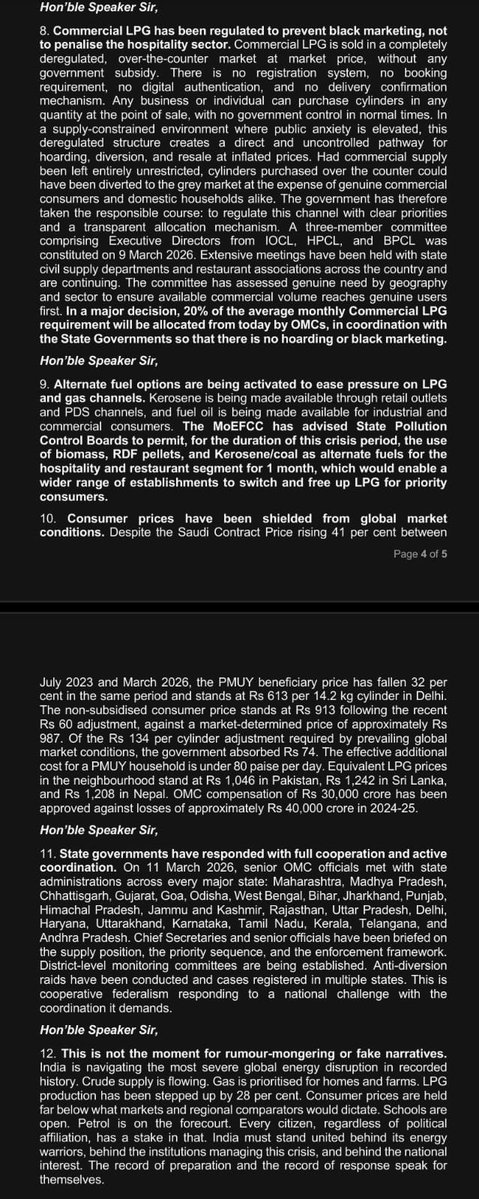
Modi Govt’s foremost priority is that the kitchens of India’s 33+ crore families, especially the poor and the underprivileged, do not face any shortage. Domestic supply is fully protected and the delivery cycle is unchanged.
In a major decision, 20% of the average monthly Commercial LPG requirement will be allocated from today to restaurants and eateries by OMCs, in coordination with the State Governments so that there is no hoarding or black marketing.
This is not the moment for rumour-mongering or fake narratives. India is navigating the most severe global energy disruption in recorded history. Crude supply is flowing. Gas is prioritised for homes and farms. LPG production has been stepped up by 28%.
Like we have done in the past, now is the time for the nation to come together and overcome this challenge.
My statement in Lok Sabha today:
https://t.co/XyrSZJMvVA
A Kite festival in Pakistan Vs. A Kite festival in India as covered by Reuters.
Reuters seems to be doing blatant GLISCO-DS propaganda that's mostly anti-India with pathetic brown-sepoys, pakis, chinese, & white-racists running many reports against India and its interests.
Media in India which subscribe to their wire service paying millions, end your subscriptions. Or at least vet their news before you post. GoI needs to think about regulating their fake news and propaganda.
Same can be said about Bloomberg. Especially their Asia desk. It seems to be run 24x7 to hit India's economic interests and political stability. For, you know who.
The one who has the money and power to influence. So it's not Pak, which only infiltrates with English speaking reporters and columnists to work as sepoy to this power running the GLISCO-DS.
Minister @PiyushGoyal Please intervene. The tender system has been gamed with high criteria of revenues. The big 4 are being favored by govt for various reasons. Govt pays very high rates. Smaller Indian firms are being discriminated against by govt, this has become a closed market. How can India grow its own large firms with such capture of govt. our PM @narendramodi vision of Indian firms is getting sabotaged. Needs action by @DPIITGoI@sanjeevsanyal@nsitharaman@amitabhk87@NITIAayog
We talk a lot about India's growth story. But one chapter that doesn't get enough attention is energy. India crossed 50% of its electricity capacity from non-fossil sources in June 2025, five years ahead of its Paris Agreement target. 44.5 GW of renewable energy was added in a single year, nearly double the previous year.
The very fact that this has happened while the economy is growing at this pace speaks to the quality of policy and execution. A milestone that deserves recognition.
As I head out to discuss #Budget2026 with @navikakumar at @TimesNow, I remember when it used to be presented at 5 pm to align with London midday. In 1999 Vajepeyi govt changed it to 11 am.
So much colonial hangover persisted for so long.
Minister @nsitharaman please have a Full Open Transparent Inquiry on this. We lost Siddarth founder of Coffee day to reported tax terrorism. Too many people are terrified by tax officials- an assault on citizen rights-No way to govern our country. PM @narendramodi Sir, please protect tax payers from these kind of attacks and assault on citizens rights. The whole raid process is very brutal. Our FM has been giving such officials more and more powers but where is citizens protection? Are officials punished for a wrong raid? No. Over last 3 years Rs 72L cr has been collected through direct taxes? A record with voluntary compliance and technology. How much has been collected through such raids? How much is stuck in litigation, over ruled by court’s? @FinMinIndia must give Full data. Sir please protect tax payers.
BIG BREAKING ⚠️
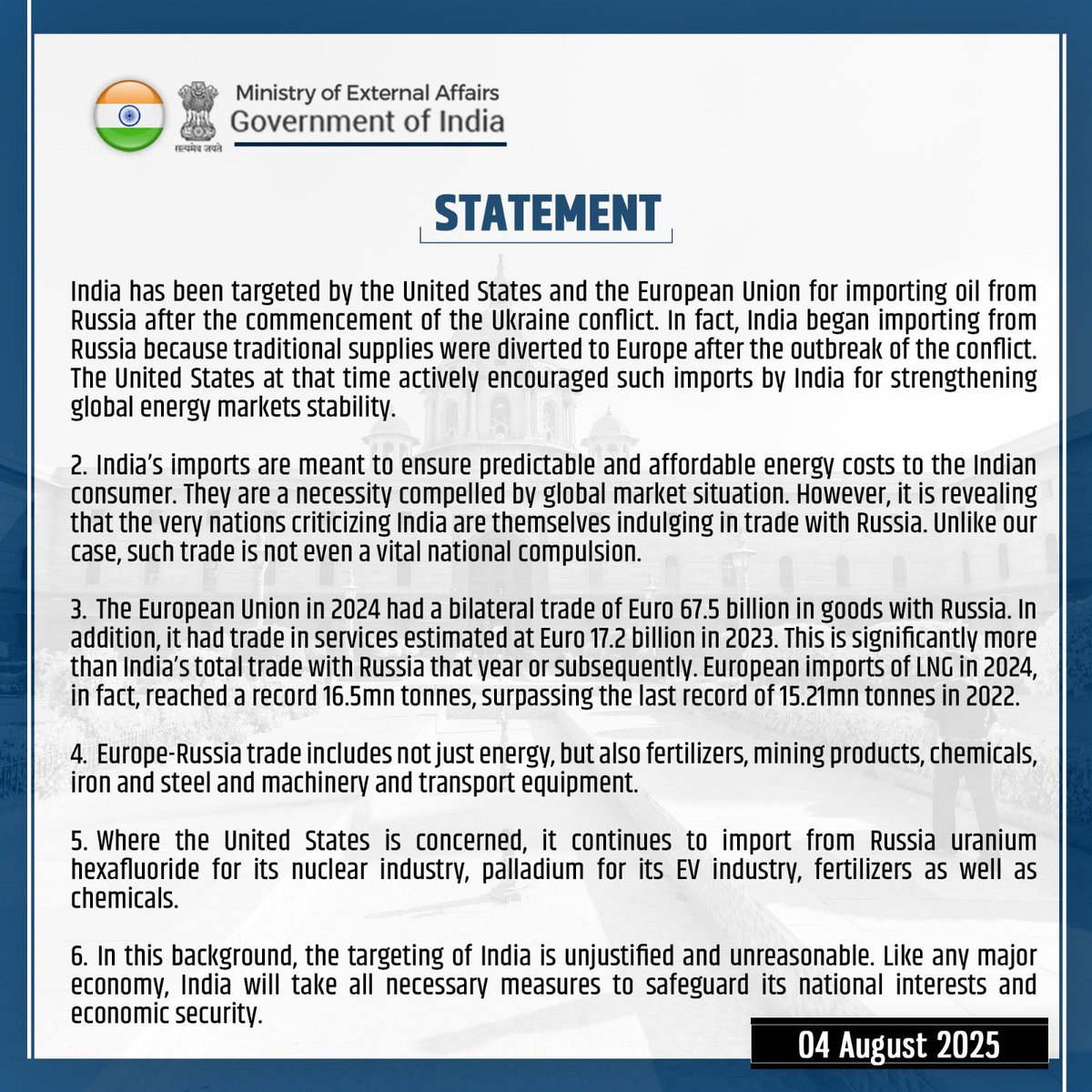
India replies to Trump with no half-measures, calls out American hypocrisy on Russian oil, says India will “safeguard its national interest and economic security”.