Meet Zayn, Maya & Alex!
Three characters, one JavaScript adventure!
Learn, code, and grow with us.
🚀 Season 1 coming soon!
#JavaScriptAdventures#JavaScript#DevZiaus
Your browser doesn't store your account.
It holds a loyalty card with a member number. The server keeps the ledger: your name, orders, points.
Card = cookie.
Ledger = database.
Session ID or JWT inside that card? Pick one.
🚀 Coming Soon: The Adventure with JavaScript — Season 1! 💻✨
Join Zayn, Maya & Alex to learn JS the fun way, one comic at a time: 💬 Real conversations 🧩 Simple explanations 🚀 Practical examples
New episodes every week! Ready to go from Zero to Developer? 👇
#JavaScript
A good API needs less documentation than a bad one.
5 rules that stop the guessing:
- Nouns in URLs, verbs in methods
- Honest status codes
- One error shape everywhere
- Paginate every list from day 1
- Version before you need to
Which one gets broken most?
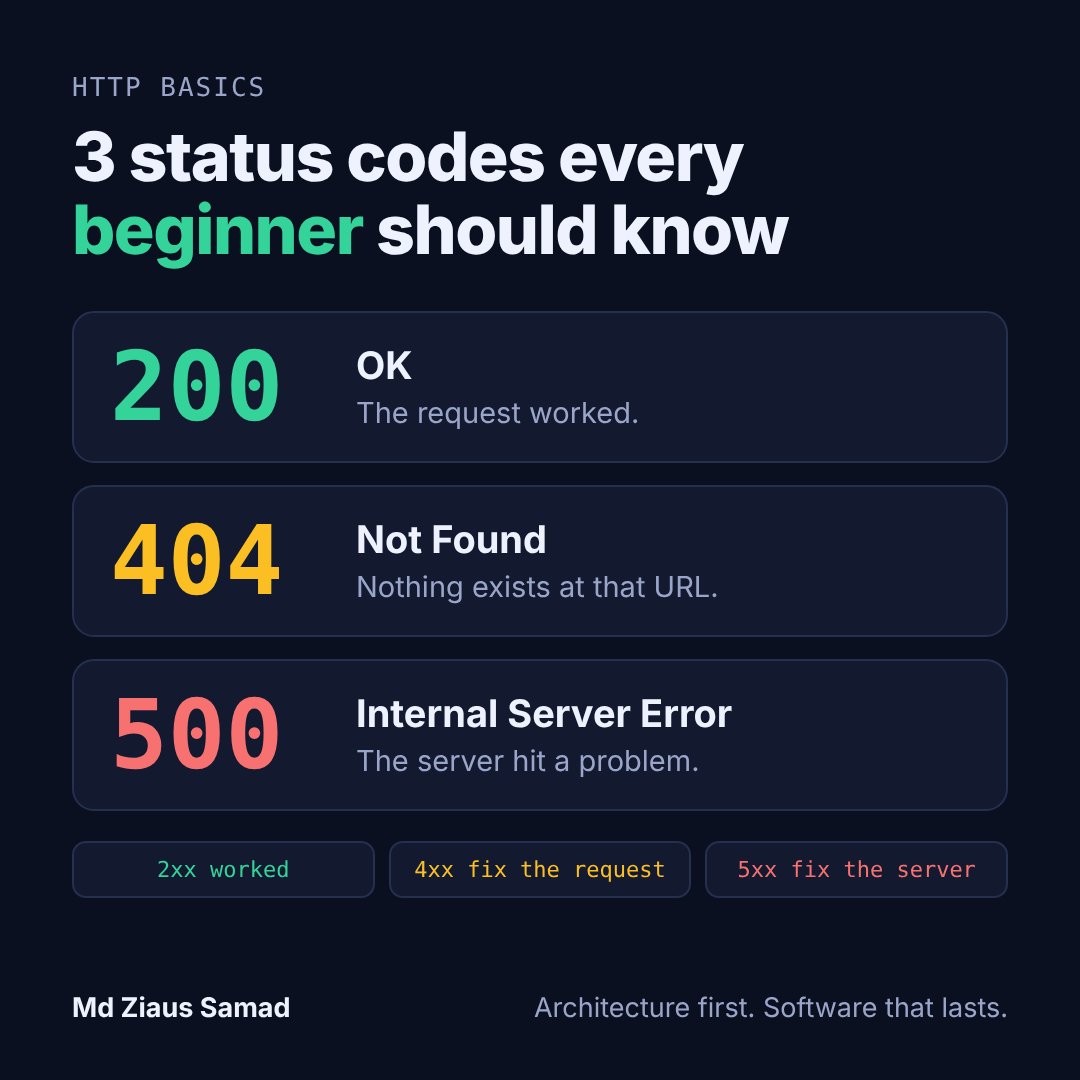
3 HTTP status codes every beginner should know:
200: it worked
404: nothing lives at that URL
500: the server broke
4xx means fix your request. 5xx means fix the server.
404 or 403 for a resource you can't access? Pick a side.
Rewrite the backend, swap the database, change cloud providers. If the menu stays the same, the app on the other side keeps working.
Version in the URL (/v1) or in a header? Pick a side.
The server replies with a status code and data.
200 means it worked.
404 means it isn’t there.
500 means the server broke.
The data usually comes back as JSON.
Picture a restaurant.
You’re the client. The waiter is the API. The kitchen is the server and database.
You read the menu, place an order, and get a plate back. You never enter the kitchen.
You click “Place order”. 7 stops later, the page updates.
Browser → DNS → TLS → HTTP → middleware → handler → database, then all the way back.
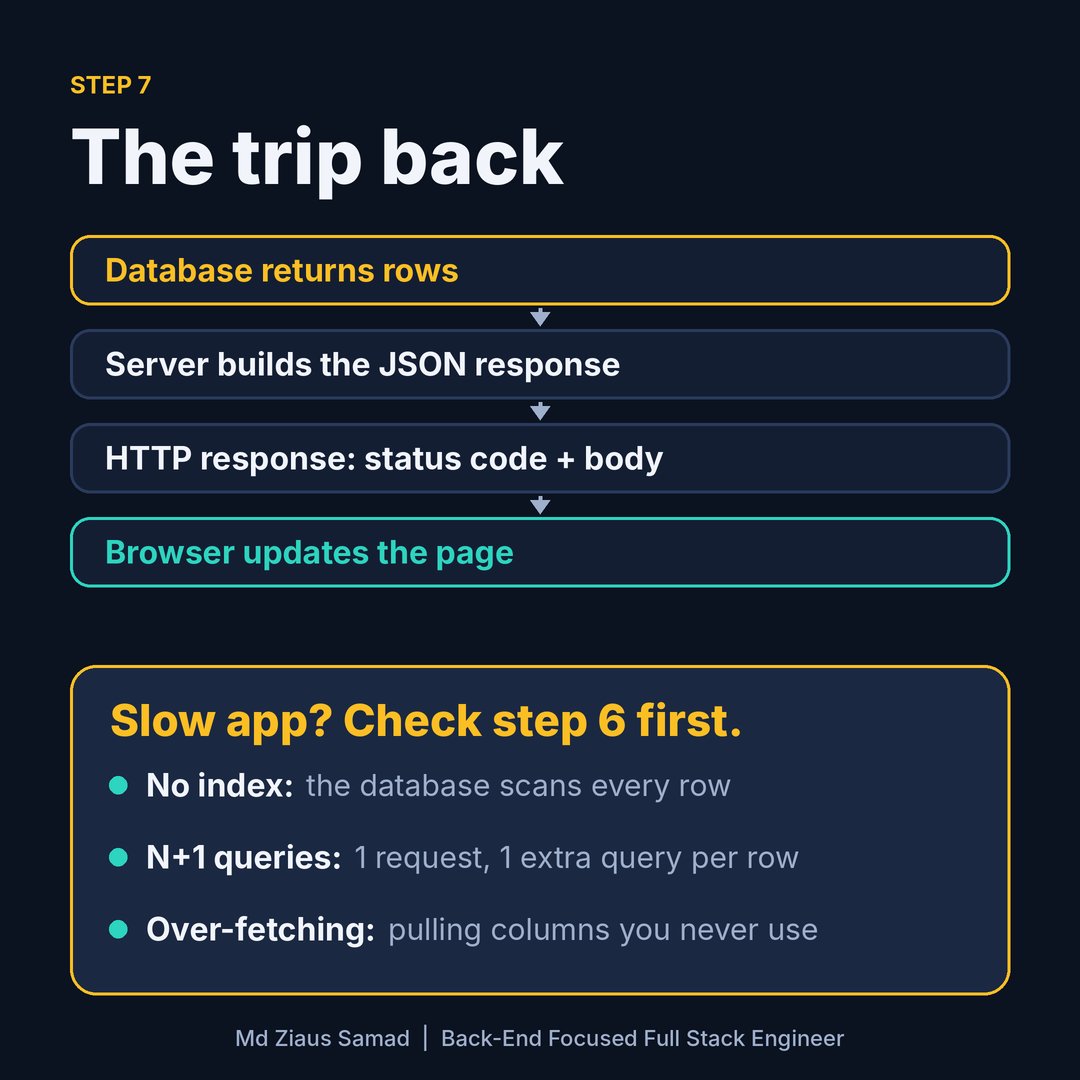
Slow app? Check the query before the framework.
3 usual suspects in stop 6:
No index: the database scans every row
N+1 queries: 1 request, 1 extra query per row
Over-fetching: columns you never use
Slow endpoint: do you check the query first, or the middleware? Pick a side.
Stop 6 is the database. Stop 7 is the trip back: rows become JSON, JSON becomes a response, the browser updates the page.
When an app feels slow, I’d check stop 6 first.
Stops 4 and 5 are your code.
Middleware checks auth and validates input
The route handler runs your logic
Reject bad input here, before it ever reaches the database.
Stops 1 to 3 are the network.
DNS turns the domain into a server address
TCP + TLS open a secure connection
The browser sends the HTTP request: method, path, headers, body
Follow to win 1 BTC!
We're giving away 1 #Bitcoin as we race to 5M followers! 🏁
🎯 From 4.6M–5M followers, every +0.1M = 200 winners split 0.2 BTC
👥 1,000 winners in total
✅ To join:
Follow @bitgetglobal
RT + tag 3 pals w/ #FollowToWin1BTC
Fill out: https://t.co/mqL1Gz6rET
Follow to win 1 BTC!
We're giving away 1 #Bitcoin as we race to 5M followers! 🏁
🎯 From 4.6M–5M followers, every +0.1M = 200 winners split 0.2 BTC
👥 1,000 winners in total
✅ To join:
Follow @bitgetglobal
RT + tag 3 pals w/ #FollowToWin1BTC
Fill out: https://t.co/mqL1Gz6rET