The jumbo octopus, whose actual name is Grimpoteuthis, lives on the ocean floor at extreme depths – up to 13,000 feet. The small creature is just about 8 inches tall. They float just above the seafloor looking for food, which is usually snails and worms.
Marine Lguanas-
Marine Iguanas are lizards found only on the Galapagos Islands of Ecuador, with each island hosting marine iguanas of different sizes and shape. Their population has been threatened in the recent past due to the high number of predators that feed on the lizards
Peacock Parachute Spider -
This large (about 20cm across) tarantula [Poecilotheria metallica], is named after its purply-blue, metallic legs and its habit of jumping down from trees.
The Emu Bird-
Tall and majestic, the emu belongs to a group of flightless running birds known as ratites, the most primitive of the modern bird families. The ratite family includes the kiwi, ostrich, cassowary, and rhea, all birds found only in the Southern Hemisphere.
Blue Morpho
One of the largest butterflies in the world, the Blue Morpho lives in the rainforests of Latin America. Its brilliant blue wings have a brown underside.
*Candy Crab*
Scientific Name: Hoplophrys oatesi
Class: Malacostraca
Habitat: Indo-Pacific Ocean
The candy crab (Hoplophrys) belongs to a monotypic genus, meaning it has no closely related species. It grows to 2 cm long and can camouflage itself in bright colors.
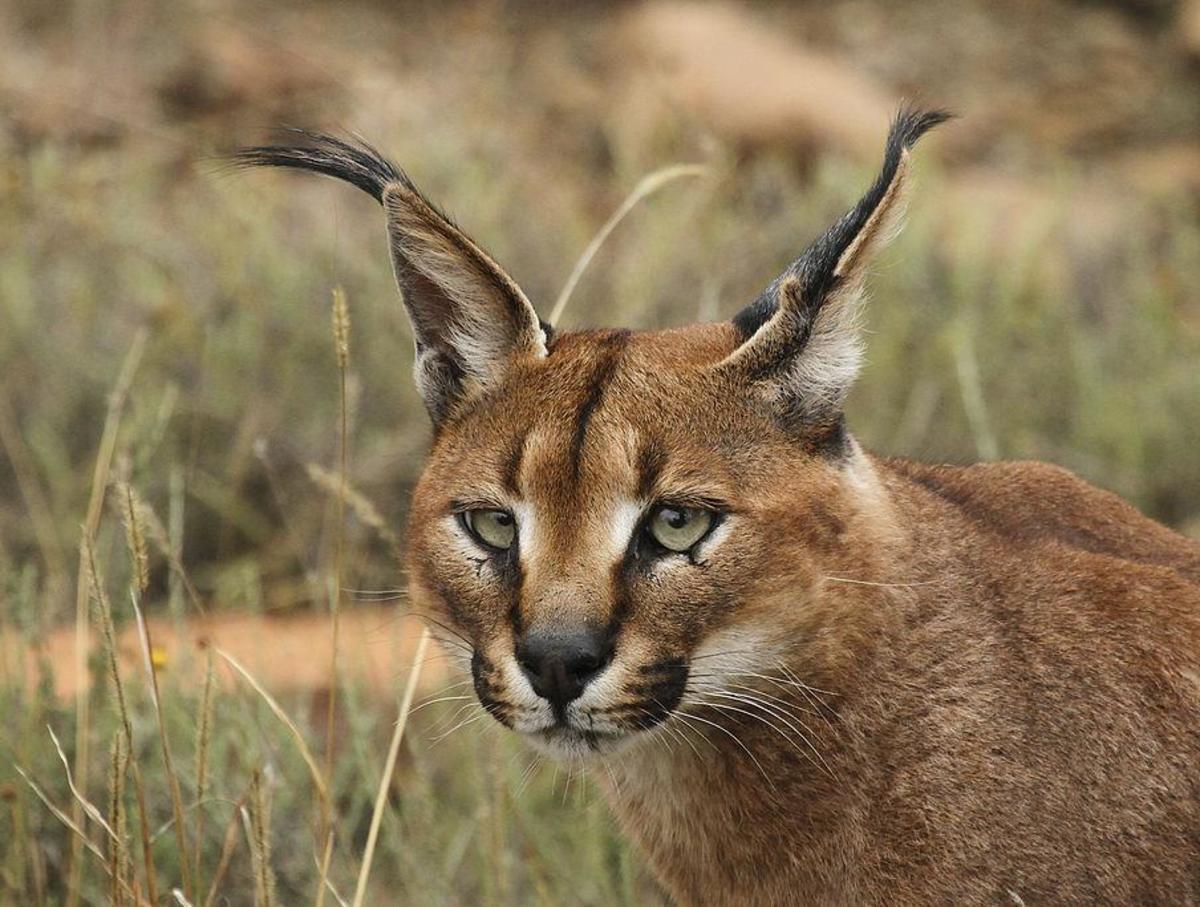
*Caracal*
Scientific Name: Caracal caracal
Class: Mammalia
Habitat: Africa, Middle East, Central Asia, and western India.
The caracal gets its name from the Turkish words kara kulak, meaning `black ear'. It has a number of adaptations that allow it to live in a diverse range .
Andaman Cobra
The Andaman and Nicobar Islands have a variety of species, including turtles, cobras, macaque, and turtles. The islands have fragile ecosystems, and out of the 572 islands, only 36 are inhabited. Nicobar is completely out of bounds for tourists.
Barasingha
WHERE: Uttar Pradesh,
Madhya Pradesh, and Assam
Barasingha, a 12-horned swamp deer (bara = 12 and singha = horns), lives in the Kanha National Park in Madhya Pradesh. The state animal of Madhya Pradesh almost went extinct in the 1960's.


![NationFauna's tweet photo. Peacock Parachute Spider -
This large (about 20cm across) tarantula [Poecilotheria metallica], is named after its purply-blue, metallic legs and its habit of jumping down from trees. https://t.co/a6tbdRWntz](https://pbs.twimg.com/media/Ew0kftjVIAMr-cP.jpg)