I used to report on what I was reading outside of work on this site. When it became a cesspool I stopped, but now I've teamed up with author (and friend) @EricaStern8 and we have taken our reading habits and anxiety over to substack. Check it out here:
https://t.co/VEMQFOvGyx
@jongeeting "Connective tissue" is definitely the right way to think about it. Would need to read and talk more to figure out if that's at all advantageous compared to starting fresh. Happy to chat at some point!
@jongeeting Curious how PA folks are thinking about old case law like Surrick, requiring some version of "fair share" zoning. Anything to build on, or totally not worth it?
@yfreemark @PEWilliams_ To make matters more infuriating, I’m fairly sure that paper compares actual LIHTC to a “stylized” voucher program without administrative frictions (see fn 6). Well sure that’ll definitely make one look better! (And I say this as someone relatively skeptical of LIHTC)
Housing vouchers can be transformative, but I will never get over how indefensible this administrative system is. After 15 years... you get six days... just to apply for a waitlist.
Ultimately, reform here requires moving HCVs towards being an entitlement.
New Yorkers will have 6 days to apply for the Section 8 waitlist from June 3rd to June 6th, the first time the waitlist has opened since 2009. Of those that apply, 200K will be selected by lottery for the waitlist. Here are the current income limits https://t.co/7KhR8AewyP
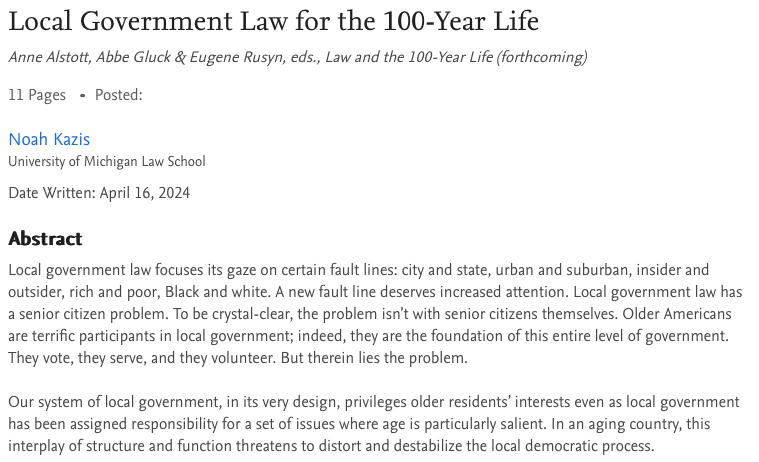
I love this paper, and it's a good excuse to finally post my own forthcoming chapter on age and local government law.
https://t.co/uKWvI21zLR
That seniors run the show is something everyone in local gov knows--but not something we talk about in the legal literature.
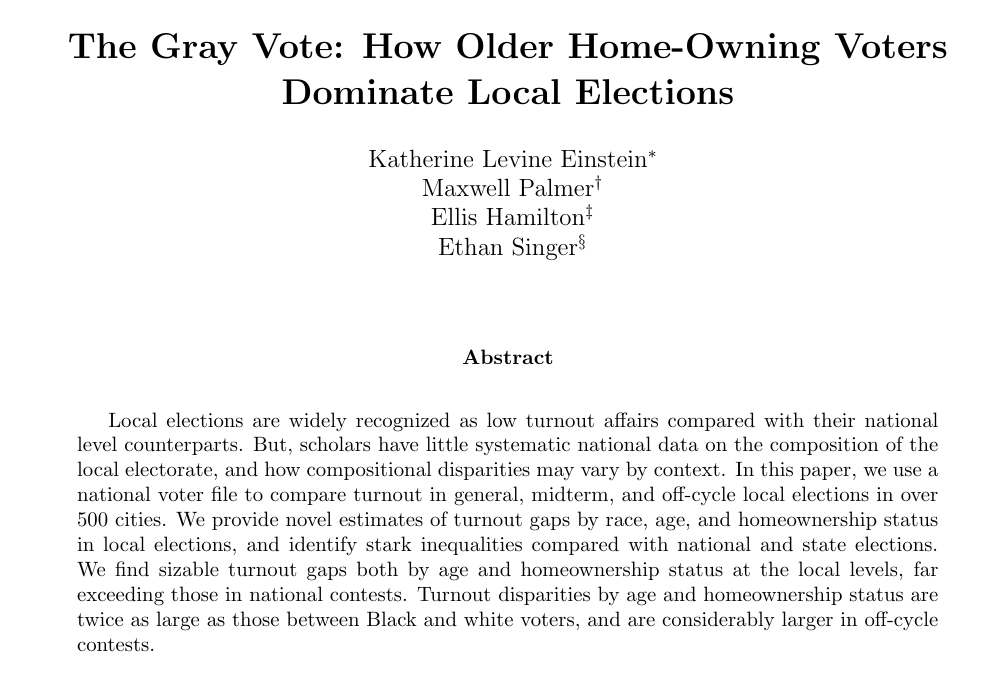
Important new paper. State & local candidates are like "unlike those fatcats in DC, I'm close to the people" but lower level elections have the most unrepresentative electorates & donors, lowest info, and are most influenced by money.
ungated: https://t.co/4nFC4vYmFB
The chapter is part of Anne Alstott, @AbbeGluck, and Eugene Rusyn's fascinating exploration of "Law and the 100-Year Life" -- it's such a privilege to get to partner with my own law school profs!
I try to outline why local government divides people by age, why older residents are disproportionately represented, and how existing mechanisms for managing conflict fall short. Finally, I offer a schematic of the three possible paths to resolving age-based tensions.
Great job opportunity for recent law grads interested in housing/land use! (It says PhD required, but JDs are welcome).
I loved my time in a similar role at the @FurmanCenterNYU and @TernerHousing is outstanding too.
https://t.co/YgQW8nxYmo
If you think the process is paperwork and heckling that makes projects worse, it doesn't matter how much or little the process costs. If you think it's necessary for informed decisionmaking and basic self-determination, then even big costs seem worth paying. (3/3)
The cost side is where the data is, so that's what we talk about.
But I think almost all the work is being done on the benefits side. Does an EIS actually surface important considerations? Does the third zoning hearing actually improve planning? (2/3)
Zach's work is always thoughtful and this is no exception. His framing also reminds me a point I've been meaning to make about the permitting reform discourse(s).
Most argument is on the cost side of the ledger: how much delay, how much more expensive, for which projects. (1/3)
NEW PAPER: “Getting Infrastructure Built: The Law and Economics of Permitting,” on:
- What to consider in design of permitting rules
- The evidence
- A possible "green bargain" that benefits efficiency, the environment, & democracy 🧵 1/
https://t.co/gaknMzyHbY