The widow & daughter of late Sergii Prykhodko were presented the Captain Mbaye Diagne Medal by @antonioguterres.
@UNPeacekeeping's highest honour for bravery was also bestowed on Sergeant Matías Reyes.
Both men saved many lives while #ServingForPeace.
https://t.co/jqkfZV87TX
[Must Watch] Now at 15h00 #AfricanRenaissancePodcast hosts Nigerian scholar Prof Funmi Olonisakin
Don’t forget to tune in.
Link: https://t.co/J2C4ddTFdm
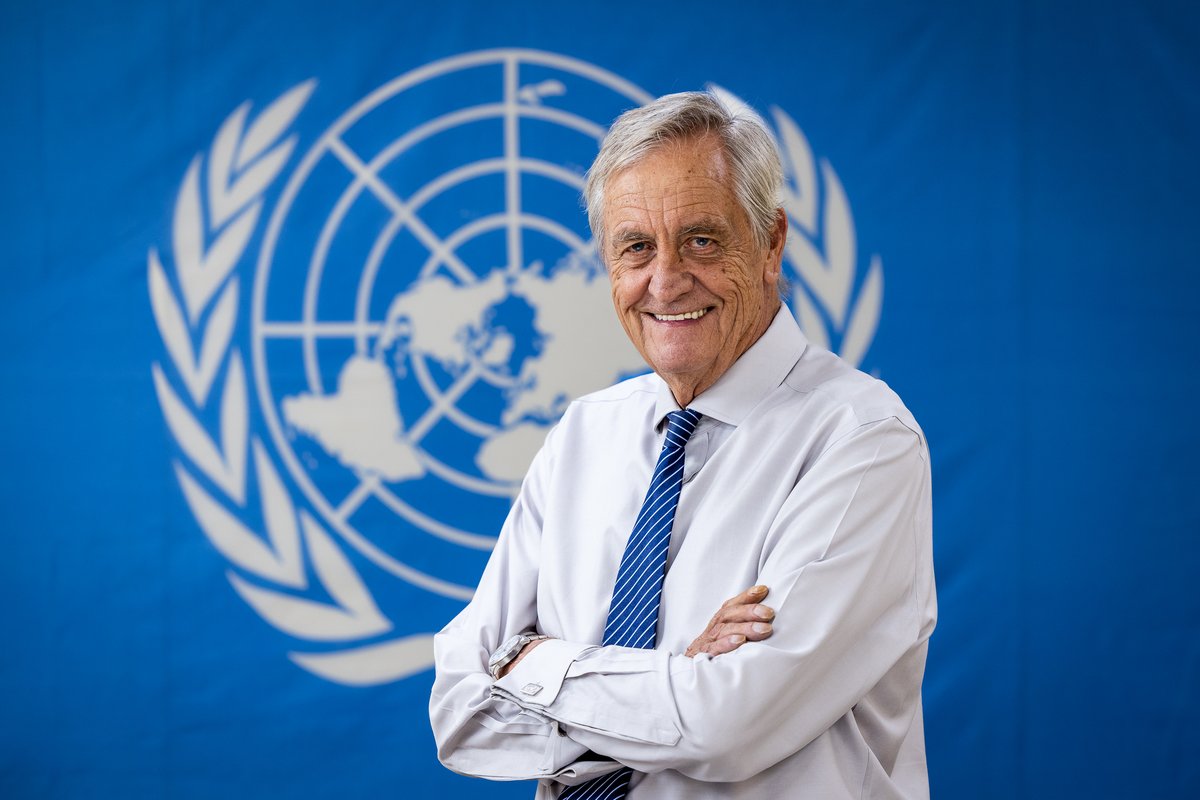
#UNMISS mourns the loss of our Special Representative of the Secretary-General, Nicholas Haysom, who inspired all those whose lives he touched with his principled leadership, wisdom, and unwavering commitment to peace in #SouthSudan 🇸🇸.
https://t.co/fwSbn7ggdE
"Our UN Mission in South Sudan @unmissmedia is working around the clock to ease tensions – engaging all parties and boosting protection of civilians (...)
For the sake of the long-suffering people of #SouthSudan, it's time for dialogue and de-escalation." - UN Secretary-General
"All the dark clouds of a perfect storm have descended upon the people of the world’s newest country" @UN Secretary-General @antonioguterres warned about the situation in #SouthSudan. He called on the country’s leaders to put down their weapons and put people first. @unmissmedia
#UNMISS is calling for an immediate cessation of hostilities and urgent dialogue between #SouthSudan's leaders to de-escalate tensions and restore calm, following clashes between armed forces outside the capital, Juba.
FULL STATEMENT: https://t.co/UtNwiFFoq5
#A4P
"South Sudan is teetering on the edge of a relapse into civil war." - @unmissmedia chief Nicholas Haysom warned the @UN Security Council today as he briefed on the grim situation in #SouthSudan 🇸🇸.
Flooding the Zone with Shit: it was time for SA
After two weeks of intense discussions in the U.S. on South Africa’s relations with Washington, I thought I’d have one last quiet evening to reflect. Instead, as I prepared to head back to Joburg/Pretoria from NY, the news broke—Marco Rubio had declared South African Ambassador Ebrahim Rasool persona non grata, calling him a "race-baiting politician who hates America."
After days of conversations filled with concern, confusion, and even quiet apologies—“Sorry we/they’re putting you through this”—seeing it unfold in real time was surreal. Not because it was unexpected, but because it confirmed what I had heard repeatedly: this isn’t just about race or South Africa’s ICJ case against Israel. It’s about punishing any dissent and rejecting international mechanisms that challenge U.S. interests. The U.S. no longer seeks global legitimacy—it believes it can battle the world on all fronts. Expelling Rasool isn’t just erratic—it’s part of an order-transforming process.
For decades, the U.S. was both architect and enforcer of the international system, balancing its role as guarantor, enforcer, and disruptor. But when it abandons the very institutions it once led, this isn’t just a shift. The mask hasn’t slipped—it’s been ripped off by the US itself.
It would be easy to dismiss Rasool’s expulsion as another tense moment in U.S.-South Africa relations. But the real issue is precedent. No Global South country can be allowed to successfully use international law against a U.S. ally, especially being one of the few left. This isn’t about Pretoria. It’s about who might be next.
The irony is glaring. Washington’s accusations of “race-baiting” against South Africa feel like projection. This isn’t about racial division—it’s about burying the ICJ case in controversy. The strategy is clear: distract, discredit, and divert. But the bluntness exposes its weakness.
Over the past two weeks, I’ve spoken to diplomats, policymakers, and academics. Many are disillusioned. Some joke about quitting international affairs altogether, retreating to the private sector. Others are anxious, wondering if they’ll be next. The frustration is real, but exhaustion runs deeper—watching institutions they believed in be hollowed out by power politics.
The real question isn’t about multipolarity or U.S. decline. It’s about power. The U.S. still dominates financially, militarily, culturally. But now, it is throwing away the ressemblance of legitimacy that once made its dominance tolerable. Abandoning the structures that gave you influence doesn’t just erode control—it creates a void.
And voids don’t stay empty for long.
This isn’t just a policy shift. It’s a strategy—one built on disruption, making global governance impossible. Steve Bannon called it “flooding the zone with shit”—overwhelming the system with chaos so no one can process what’s happening. That’s no longer just a domestic tactic. It’s defining international relations.
So where does that leave us? At a crossroads. The U.S. is walking away from the system it built. The message is clear: “Deal with your own mess.” Maybe it’s time we do just that. Not through bureaucratic tweaks, but by redefining global governance itself. The longer we wait, the harder the hit will be.
Rasool’s expulsion might seem minor in global politics. But small moments add up. And sometimes, they trigger something bigger. This feels like one of those moments. The rules we thought governed international relations? They were never absolute, we knew it. Now, we have to decide what comes next.
An attack on an #UNMISS helicopter undertaking an evacuation process in conflict-affected Nasir, #SouthSudan resulted in a crew member killed and two other injured. Several of those being extracted were also reportedly killed. The mission urges all actors to refrain from further violence and the country’s leaders to urgently work together to resolve tensions.
Full press release: https://t.co/fXYPu7muGh
Today, the Secretary-General's Special Representative & Head of the @UNPeacekeeping mission, #UNMISS, Nicholas Haysom, briefed the Security Council on the situation in #SouthSudan 🇸🇸
His full remarks: https://t.co/O3DBKKK69E
#A4P#UNSC
UN Photo/Loey Felipe
Successful Ministerial AU High-Level Committee (C5) on #SouthSudan visit to Juba reaffirming AU’s commitment to concluding the transition process. Implementing the R-ARCSS & establishing unified defence & security forces is critical to state-building, stability & development in🇸🇸
President Salva Kiir met with the Special Representative of the @UN Secretary-General, Nicholas Haysom, and the Deputy Special Representative-Political, Guang Cong, to discuss South Sudan's progress toward a more stable and democratic future.
Prof Alex De Waal:
"I care about both Gaza and Sudan. It’s distasteful to compare extreme human suffering. But we can use the international metrics for famine to explain why each humanitarian crisis is uniquely terrible – and why people caught in both need urgent action."
https://t.co/pp3WtROqTm
Delighted to welcome my Brother UNSG @antonioguterres, my Sister DSG @AminaJMohammed and their Teams in Addis Ababa this morning for the 8th AU/UN Annual Meeting. During the day, we will discuss the concrete progress, challenges experienced & the way forward on our three strategic Partnership Frameworks on Peace&Security, Sustainable Development and Human Rights.
“I am deeply concerned by these brutal acts and urgently call on the Government of #SouthSudan to conduct an immediate investigation to bring perpetrators to justice swiftly,” says Mr. Nicholas Haysom, the SRSG & Head of #UNMISS.
Full Press Release: https://t.co/LWG1guoMTU
#A4P
🗺️"You sometimes have to adapt your plans, to make sure you reach & protect all civilians in #peaceoperations".
In our Mission Leadership Digital Tool - hear DSRSG-P Guang Cong, @unmissmedia sharing his experiences as mission leader in South Sudan🇸🇸
👇
🔗https://t.co/UMMBQ2T78X
🚧Mobility can be a serious challenge to protecting civilians.
🗣️Hear Guang Cong, DSRSG-P at @unmissmedia South Sudan explain the
3⃣ tiers approach to #ProtectionofCivilians.
🖥️https://t.co/SLwUGJbqlg
Learn more in our Mission Leadership Digital Tool
🔗https://t.co/wk2Num5k8b