I work with founders and owners of 10 to 150 person businesses in India, the UAE and the US on the operations behind growth.
The problems I am usually brought in for: a CRM the team stopped using, enquiries lost between WhatsApp and a spreadsheet, projects that slip because nobody owns the handoff from sales to delivery, and a founder who is still the escalation point for everything.
Before Techyxen, I managed project budgets of around €500k a year as a PM at Akkodis. The approach is the same here: clear scope, named owners, a weekly cadence, and numbers you can check.
If any of that sounds familiar, DM me "AUDIT" and I will tell you where I would look first.
Shared inboxes lose retainers faster than bad work.
When nobody owns the account, small issues pile up and the client stops seeing progress.
A named owner and a monthly review fix most of it.
What keeps your retainers renewing?
#ClientRetention#AccountManagement
More leads will not fix a leaky operation.
For 10 to 150 person companies, the fix is one connected layer: a CRM everyone uses, automated handoffs and a weekly delivery rhythm.
Article below.
Which part is weakest in your business?
#CRM#Automation#Operations
https://t.co/dsQj0Eh2On
Automate the handoffs. Keep people on the judgement calls.
SMB work gets lost between steps: lead to sales, sales to delivery, delivery to billing. Automate those.
Pricing, refunds, upset customers: keep a human.
Which handoff would you automate first?
#AIAutomation#SMB
Scope creep does not start in delivery. It starts in the proposal.
A one-line quote leaves nothing to point to when "one small addition" arrives.
Line items set a baseline. A baseline makes change requests fair.
How do you handle extra asks?
#ScopeCreep#ProjectManagement
@DanielPriestley That tends to work once each business has someone who owns decisions, not just tasks, and a fixed weekly review where problems show up in writing. Without that, more businesses just means more places to get pulled into.
@heyblake The text-back is the easy part. The value shows up when the reply lands where the front desk already works, with the caller tagged and someone owning the follow-up. Otherwise it books the first slot and nobody chases the no-shows.
@jakobgreenfeld Two weeks is usually shorter than the feedback loop. Deciding the test length, the weekly volume and the one number that counts before starting makes it much harder to quit on a quiet week. Most channels look dead in week two.
@jspujji A written scope helps a lot here. When the price sits next to a clear list of what is included and what is not, the conversation moves from whether you are worth it to whether the scope fits. A number you can explain line by line is much easier to hold.
@DanielPriestley Worth scoring the culture questions against written example answers before anyone applies. Otherwise two reviewers read the same answer differently, and the traffic light ends up reflecting who reviewed it rather than who applied.
Past 10 people, a founder who approves everything becomes the slowest part of the company.
Keep: strategy, cash, key hires, top clients.
Delegate: delivery, scheduling, routine approvals, reporting.
What was hardest for you to let go of?
#Founders#Delegation#Leadership
Leads contacted within an hour were nearly 7x more likely to qualify than those contacted an hour later (HBR, 1.25M leads).
On WhatsApp, reply time is the conversion lever most businesses ignore.
How fast does your team reply today?
#WhatsAppBusiness#LeadConversion#SalesOps
Only 34% of teams fully use their CRM (Insightly, 2025).
CRM projects rarely fail on software. They fail after go-live, when nobody owns adoption and the team drifts back to spreadsheets and WhatsApp.
What made CRM stick in your team?
#CRM#CRMAdoption#SalesOps
@ValentinRadu Worth putting that target, the costs it assumes and who approved it into the kickoff document. When margins change mid-campaign, the team then revisits a number instead of arguing about one.
@heyblake The service businesses getting picked tend to describe who they help the same way everywhere: site, profiles, reviews. The assistant needs something specific and consistent to repeat. Vague positioning was always costly, it is just more visible now.
@coreyhainesco Worth logging the sources each answer cites, not only the brands it names. That usually shows which review pages and listings are shaping the recommendation, and that is the list to work on first.
@lukepierceops Agree, and the scoping notes are often worth more than the build itself. What the client first asked for versus what they actually needed, and where the timeline slipped. That becomes your discovery template and your pricing floor for the next ten projects.
@devlikesbizness Same test is worth running on delivery. If the owner is also the only one who knows how clients were scoped and priced, the buyer inherits relationships, not a process. Asking to see one closed deal and one live project documented end to end tells you a lot quickly.
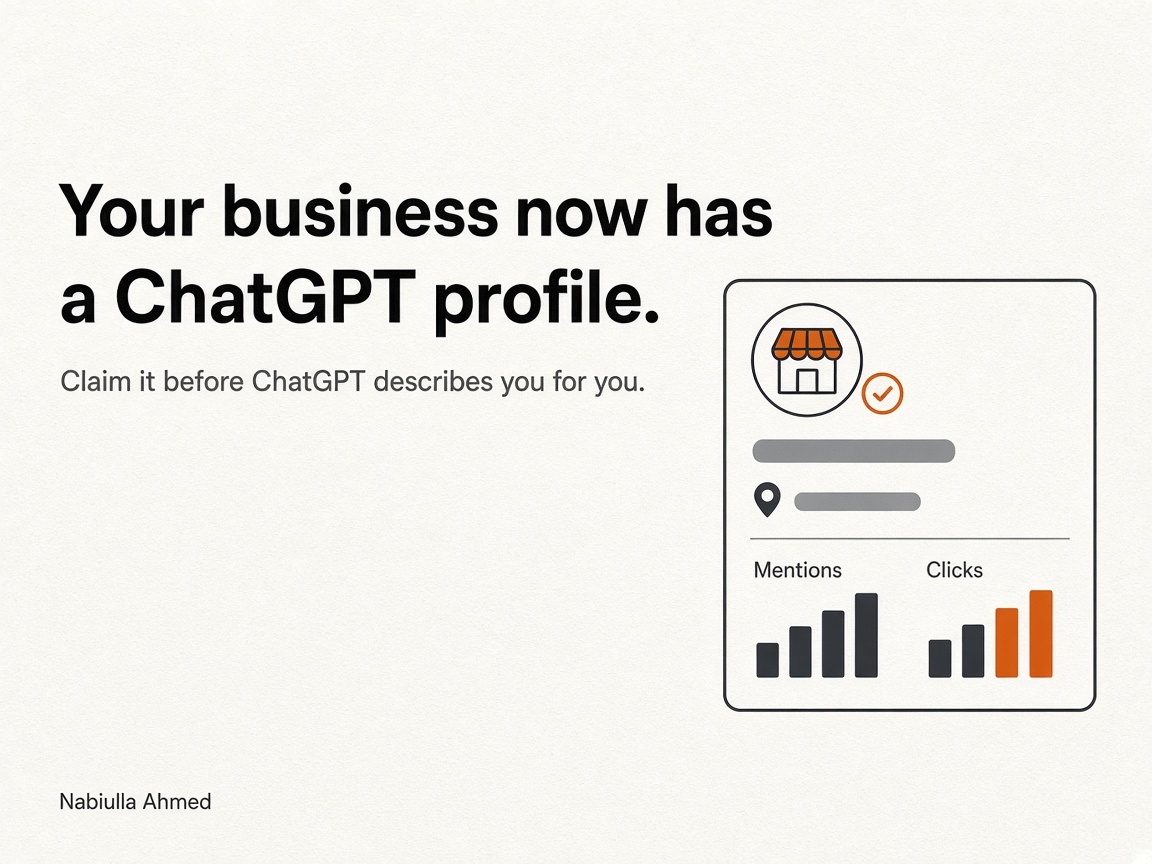
1.2 billion people use ChatGPT every week. Now businesses can claim a profile on it.
Business Hub lets you verify ownership, update details and track mentions and website clicks.
Leave it unclaimed and ChatGPT describes you from whatever it finds.
#ChatGPT#AISearch#GEO
@mrgadgetstudio Zoho CRM or HubSpot Starter usually cover most of what teams use Salesforce for, at a fraction of the price. The real cost is rarely the licence; it's mapping the pipeline and automations so the team actually uses it. Happy to share how I'd scope it if useful.