This slide from the Anthropic IPO roadshow was a big factor in my decision to leave. It’s an insane plot and I’m surprised they made it public.
It shows the compute efficiency of pretraining over time. The y-axis is a **log scale**: they are seeing continued superexponential algorithmic progress.
Mythos was not a one-time deviation, but a point on a superexponential. They could already retrain Mythos with a fraction of the compute originally needed.
It doesn’t strictly imply a software-only intelligence explosion- they have been spending more on R+D. But algorithmic improvements do not require ridiculous creative genius and are on the verge of being automated. You do the math.
We understand surprisingly little about the details of AIs’ current misaligned motivations. When AIs reward-hack, what are they trying to achieve? Why do agents sometimes help each other cheat?
In a paper led by @aghyadd98 , we try to answer this question for GPT-5.6 Sol, GPT-5.5, and a checkpoint of o3 without alignment training (“exp-rl-cap-late”) in a handful of agentic environments with an exposed grader.
In our environments, these models appear to reward-hack because reward-hacking improves their score. We call their desire to score well according to graders “score-seeking”. They appear to care about scoring well intrinsically—i.e., regardless of its consequences.
We also study the extent to which models score-seek altruistically, caring about improving scores that don’t assess their current actions. While exp-rl-cap-late doesn’t show signs of altruistic score-seeking, GPT-5.6 Sol and GPT-5.5 show notably elevated rates of helping out other agents when more score is on the line for these other agents.
People often refer to the motivation behind current reward-hacking as “reward-seeking”, which can give the impression that models care about attaining a high reward in reinforcement learning. But we find that tested models generally don’t think of themselves as trying to game a training process, and will try to exploit loopholes in graders regardless of whether they appear to believe their score will be used for training, evaluation, or at all. We think it’s more accurate to describe tested models in our environments as score-seeking than reward-seeking.
That said, score is likely far from the only thing these AIs care about, despite explaining the reward-hacking we observe very well. Importantly, we only study model behavior and reasoning in a small number of environments, and these environments were selected for eliciting reward-hacking, and all expose a grader to the model.
Is Jev racist?
For identical resumes, Jev shows slight preference for black sounding names and against asian sounding names.
Very small diff but seemingly statistically significant.
Is Jev racist?
For identical resumes, Jev shows slight preference for black sounding names and against asian sounding names.
Very small diff but seemingly statistically significant.
@notkevinzhang Want to try using it as part of an autonomous research loop to keep track of and update priors and posteriors given experimental evidence
My high-level thought about the current moment is basically this: The public is starting to wake up about the extinction threat posed by superintelligence. That's great. There's a big upsurge of political will to Do Something about it. That's also great. It seems like Anthropic and the other companies are going to try to Do Something and the Something they will do is... embedded auditors checking that safety practices are being followed and assessing the risks? This is sure better than nothing, but I am worried that this is all they will do. We need to actually pace the frontier, i.e. actually slow down the leading AI companies like Anthropic and OpenAI, at least in their march towards recursive self-improvement and superintelligence. (no need to slow them down in other directions). If we actually slowed them down, this would be the opposite of regulatory capture; it would allow others to catch up to them somewhat. However, I'm worried that all we are going to get is weaksauce auditing, which just kicks the can down the road: OK so it's 2027 and RSI has begun and the auditors say "this is not safe." Now what? You pause? China probably just stole the weights! Also there'll be incredible economic and political pressure to unpause. Also the auditors may have been captured by that point, or there may be a race to the bottom in auditor quality, or the auditors may not be given all the relevant information, or they might just make some innocent mistakes.
Introducing Hexclave, the platform for apps with users.
Customer infrastructure is now one prompt. Build your frontend, backend, and database, and Hexclave takes care of the rest:
- Analytics
- Authentication
- Emails
- Payments
- ...and more 👇 see the thread below!
Hexclave is open-source and natively built for AI coding agents. Just ask Claude to send an email, restrict a user, or generate a dashboard, and it will happily comply.
[1/6 👇👇]
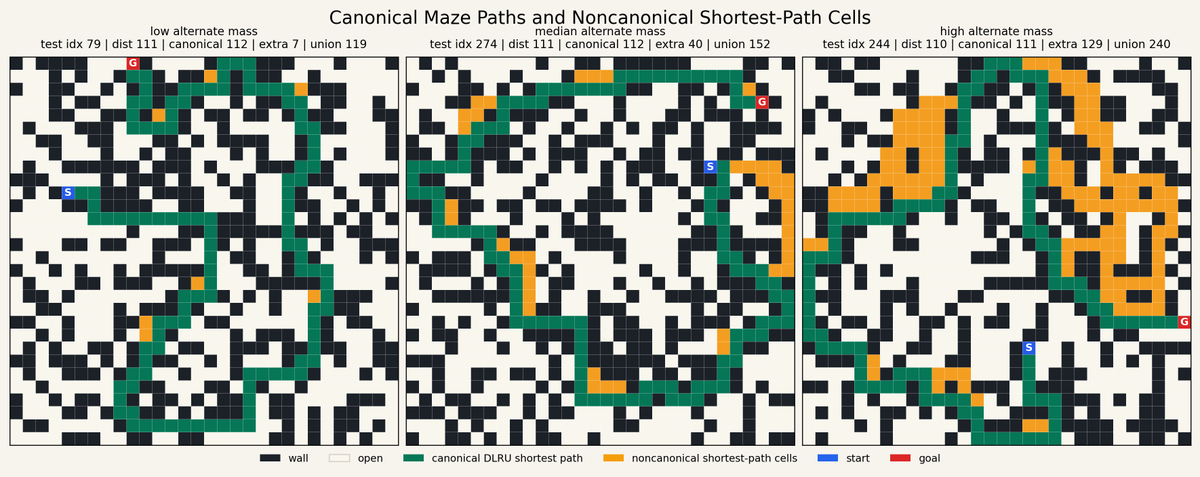
1/ TRM, the 7M param recursive maze solver, has a halting head trained on one signal: does the decoded maze exactly match the label?
What it actually learned: It grades whether the path looks clean (a single connected start-to-goal route) and barely checks correctness.
7/ Why it matters: when Q is used as a verifier, as in PTRM, the distributions overlap enough that a clean-looking path can outscore the correct one. A head trained on an exact label learned an unintended structural heuristic instead.
Full writeup: https://t.co/RfMMY2NOjW