@mattyglesias@mlipman13@jasonfurman@edavidds Had some time to actually calculate this today. This is person-weighted instead of tax-unit-weighted like the other graph (because persons have health insurance not tax units) but it should basically overlap.
Tras horas de tensión e incertidumbre, el cuerpo de la periodista libanesa Amal Khalil ha sido hallado bajo los escombros de un edificio en el que se refugió tras ser bombardeada en su vehículo con una colega. El ejército israelí disparó a sus rescatistas https://t.co/adfPuSPrJW
Ms. Rachel on the ICE Dilley detention center: “It’s heartbreaking talking to the kids and their families. They’re talking about water they can’t even drink that makes them sick. There’s been worms in the food. The food’s rotten sometimes. What really frightens me is the dangerous, inadequate medical care. These are basic human rights for children and we can all agree not to harm and abuse children. I’m kind of in shock about what I’m hearing and I don’t think people really know what’s going on inside of Dilley”
"In Paris, primary school enrollment has fallen by a quarter in the past decade. First year elementary school enrollment in New York fell 18% in the decade to autumn 2024, while in Barcelona, preschool entry fell 16% between autumn 2016 and autumn 2024."
https://t.co/TIMbzip6v5
Tax Day op-ed by Jeff Bezos-owned WaPo parrots a familiar line we've heard from tax-dodging companies: "we're just following the law."
What they don't tell you: all too often, they ghostwrite the tax law.
Memo to @wapo: less tax punditry and more smart tax reporting, please!
When simulation becomes the norm, it weakens the human capacity for discernment. As a result, our social bonds close in upon themselves, forming self-referential circuits that no longer expose us to reality. We thus come to live within bubbles, impermeable to one another. Feeling threatened by anyone who is different, we grow unaccustomed to encounter and dialogue. In this way, polarization, conflict, fear and violence spread. What is at stake is not merely the risk of error, but a transformation in our very relationship with truth.
🇫🇷🥹 Thierry Henry with a heartfelt message to Antoine Griezmann:
"Antoine, I have something to tell you. Thank you for everything you’ve done for French football, the national team, and simply for football. You’ve given me a lot."
@CBSSportsGolazo
Hundreds of millions of people throughout the world are immersed in extreme poverty. Yet, disproportionate wealth remains in the hands of a few. It is an unjust scenario, in the face of which we cannot fail to question ourselves and commit to change things. There is no lack of resources at the root of disparities, but the need to address solvable problems related to a more equitable distribution of wealth, to be achieved with moral sense and honesty.
This is 100% completely unsustainable as a society.
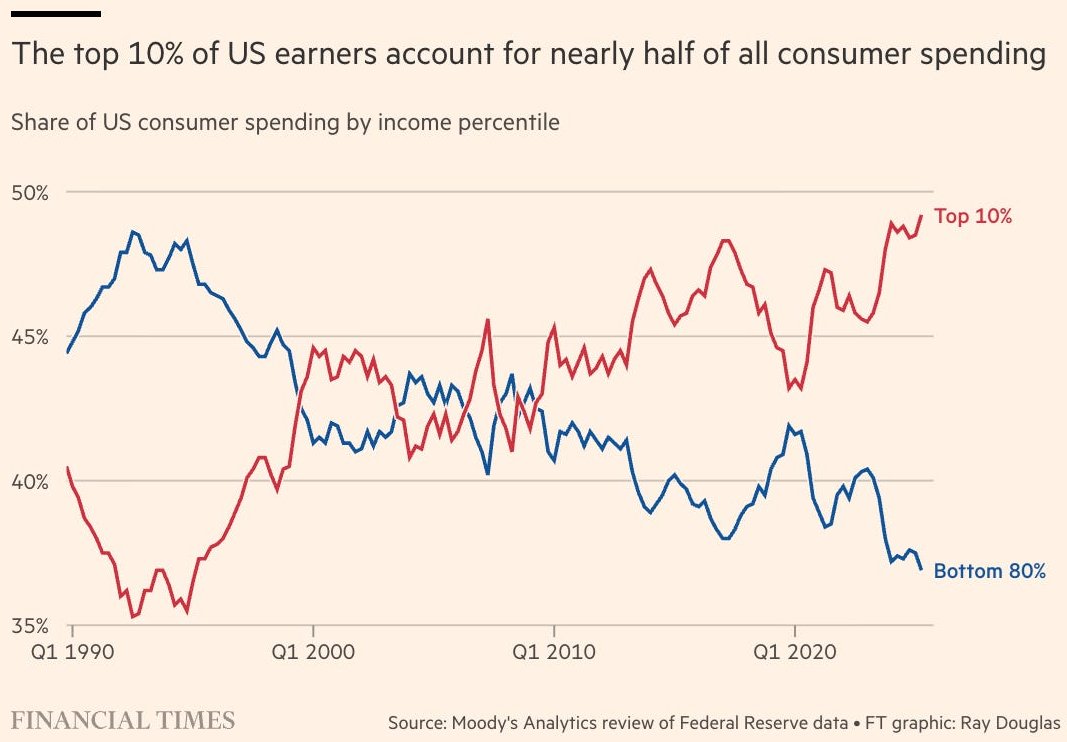
Nearly 50% of all consumer spending now comes from the top 10% of earners.
The bottom 80%?
Their share keeps falling.
This is why the economy can look strong in the data while millions of people feel like they're falling behind.
Important @sffed paper: What if supply constraints aren't driving housing price growth, and instead, increasingly wealthy people have bid up prices in certain metros? Construction has tracked well with population, but net income drives the divergence: https://t.co/0PT5mgU3nl
"Antitrust and Industrial Policy: A Misunderstood Relationship."
This is a new draft academic paper I've been working on for a while (serious comments welcome). It suggests that the antitrust regime should be understood as a part of the industrial policy toolkit, as opposed to inherently in tension with a strategic economic policy. Antitrust is a tool of industry discipline; when used successfully it can complement traditional tools for strengthening industry.
The paper is intended for scholars and practitioners of strategic economic policy. The paper identifies three mechanisms for strengthening domestic industry: direct aid, support, and discipline. Antitrust can be used as a tool of industry discipline, by requiring competition instead of collusion, and by lessening the exclusionary effects of monopoly and oligopoly.
Part II is a case study of four 20th century U.S. tech industries: automotive, aerospace, computing and telecommunications. It suggests that differential antitrust treatment of the four industries helps explain differing industry structures and succession patterns, and may explain different levels of growth and innovation.
https://t.co/bl1SACz88F
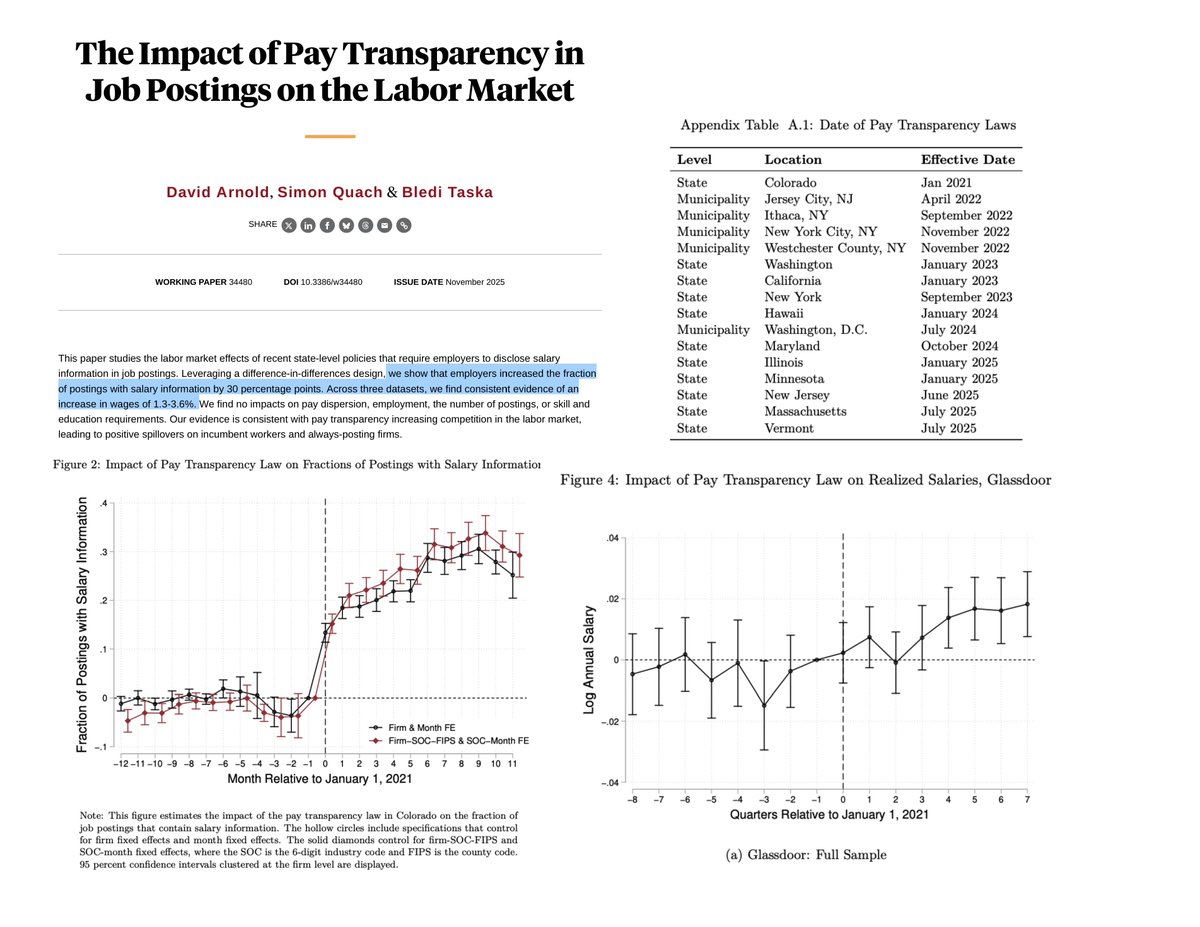
When states like Colorado passed policies requiring employers to disclose salary information in job postings, what happened?
It increased competition, and raised wages, without harming employment or changing skill requirements.
Improved functioning of markets, helped workers.