Como explicaba por aquí hace unas semanas, Milton Friedman sostenía que hay 4 formas de gastar dinero:
1️⃣ Tu dinero en ti mismo → máxima eficienta (cuidas el coste y el resultaso).
2️⃣ Tu dinero en otros → cuidas el coste, pero no el resultado.
3️⃣ Dinero ajeno en ti mismo → te da igual el coste, pero te importa el resultado.
4️⃣ Dinero ajeno en otros → despilfarro total (ni cuidas coste, ni resultado)
El autónomo que coge una baja se encuadra en el grupo 1.
Cada día sin facturar sufre una pérdida real –inmediata, suya y sólo suya– que nadie le cubre.
Por lo tanto, el incentivo para analizar con rigor si de verdad necesita cogerse una baja laboral es máximo.
Sin embargo, el asalariado –especialmente el de un sector público fuertemente sindicalizado, con puesto de trabajo garantizado habitualmente de por vida y sin presión competitiva o riesgo de quiebra– se encuadra en el grupo 3 (desde la perspectiva del trabajador) o el 4 (desde la perspectiva del Gobierno).
En su caso, el incentivo para cogerse una baja laboral a la mínima que le duela el dedo gordo del pie o esté triste porque ayer le dejó la novia es máximo.
Porque el coste de su baja laboral siempre lo asume un tercero, ya sea la empresa o el contribuyente.
Desde el punto de vista del trabajador, es dinero ajeno gastado en uno mismo.
Desde el punto de vista del Gobierno (que no toma medidas efectivas para atajar el creciente absentismo laboral), es dinero ajeno gastado en otra persona.
Esta noticia del WSJ sí que me parece interesante.
El fondo de private equity CVC (🇬🇧) ha vendido su participada Skroutz (un e-commerce griego) a Blackstone (🇺🇸) por c. €750M EV (€635M EqV), en un proceso competitivo (public tender) en el que no ha utilizado banqueros de inversión.
Por iniciativa del propio CEO de Skroutz, CVC desarrolló un portal impulsado por IA que funcionaba como un “infomemo” interactivo.
Este portal contaba con un chatbot (analista) que respondía en tiempo real a las preguntas de los potenciales compradores sobre due diligence, estados financieros, negocio y características de la operación.
La IA sólo escalaba las preguntas cuando los potenciales compradores ya estaban en condiciones de interactuar directamente con el management de Skroutz.
En los viejos tiempos, CVC hubiera contratado un equipo de banqueros (a los que tendría que pagar comisiones de 7-8 cifras) y hubiera estado 6-12 meses gestionando teasers, NDAs, infomemos, management presentations… hasta cerrar la operación.
Parece ser que es el primer caso (al menos, que se haya hecho público) del uso de IA para sustituir completamente a los banqueros de inversión en una operación de M&A.
Y el caso aparece justo cuando las firmas de Wall Street están reduciendo drásticamente las contrataciones de analistas júnior (hasta en 2/3 según algunas fuentes).
Me faltaría saber si, en algún momento del proceso, compradores o vendedores echaron de menos el poder dialogar con un ser humano.
Porque hay mucho chatbot (el soporte a usuario de esta red social es un ejemplo paradigmático) que es absolutamente incompetente.
En este caso, supongo que, si la operación se cerró, la experiencia no debió ser mala y el chatbot era razonablemente “inteligente”.
@AlFl@Jason@grok If it was that easy…. Also, he is confusing customer acquisition with customer retention, not the same thing. Still, pretty cheap way of trying to get someone back
I don't usually write personal stuff, but a few words about my experience of being interviewed by Gary Stevenson.
It started with a nice chat, comparing taste in hoodies... then the tone changed. He demanded to know why I'd deleted a tweet criticising him.
"Sigue siendo tú. Con ambición sin límites y humildad. Los campeones se miden en las caídas y en cómo se levantan."
España está contigo, Matador. Volverás más fuerte. 💪🇪🇸
Lee la carta completa:
https://t.co/NVa3gwEdGa
Ione, la comparación es falsa y usted lo sabe.
El Papa viene como Jefe de Estado del Vaticano, un país soberano, neutral, sin ejército, sin armas nucleares y que no ejecuta a nadie. El Vaticano tiene relaciones diplomáticas con 183 países y nunca ha apoyado el terrorismo.
Un Ayatolá, en cambio, representa a la República Islámica de Irán, un régimen que:
Ejecuta a cientos de personas al año (incluyendo mujeres por no llevar hiyab correctamente).
Apoya activamente a grupos terroristas (Hezbolá, Hamás, Hutíes).
Opone la pena de muerte a homosexuales y reprime brutalmente las libertades.
Amenaza constantemente a Occidente y a Israel.
¿De verdad equipara un Estado pacifista como el Vaticano con una teocracia autoritaria y violenta como Irán?
A usted no le molesta que venga un Jefe de Estado religioso. Le molesta que sea cristiano y no de su pseudoreligión woke. Esa es la incoherencia.
La cronología de un 𝙢𝙞𝙡𝙖𝙜𝙧𝙤
La historia de una 𝙥𝙚𝙧𝙢𝙖𝙣𝙚𝙣𝙘𝙞𝙖
¡Revive la remontada de @casademontBZ para certificar la salvación en #LigaEndesa!
Pelos de punta 💫
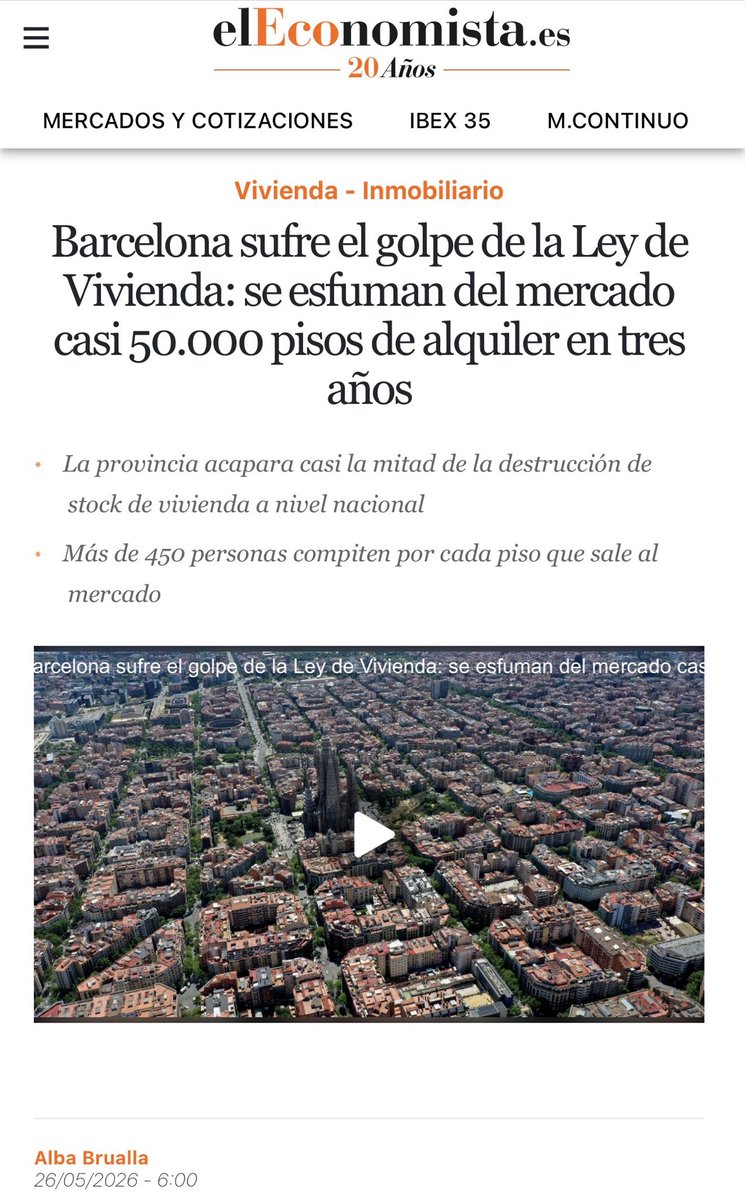
El estropicio que han provocado las leyes nacionales y catalanas en el mercado de alquiler de vivienda en Barcelona se estudiará en los libros de historia:
• Desaparición de 50.000 viviendas del mercado en 3 años.
• Los escasos caseros que se mantienen en el mercado tienen a 450+ potenciales
Inquilinos donde elegir, expulsando del mercado a todo inquilino que no ofrezca garantías de que va a cumplir su parte del contrato.
Y los políticos demagogos siguen sin reconocer su responsabilidad en el fracaso, buscando chivos expiatorios.
No hay nada como el populismo para aleccionar a un rebaño de votantes, absolutamente idiotizados por un sistema educativo público que prioriza la dependencia sobre el pensamiento crítico.
Desde hace un tiempo, las democracias son pasto de demagogos.
O creamos poderosos contrapesos (checks & balances) contra esa lacra de la política; o nos planteamos el “extremo” del sufragio censitario (votan los que contribuyen); o acabamos dando la razón a Aristóteles cuando reconocía que las democracias tienden a convertirse en el gobierno de las masas ignorantes, en manos de demagogos
A Oxford PhD student got flagged for submitting AI-generated work.
His advisor called it the most sophisticated research process he had seen in 20 years.
The student had not used AI to write a single word.
Here is the workflow that got him reported.
He starts every essay with a diagnostic he calls brutal. He dumps his rough argument into Claude and asks one question: what are the three weakest logical jumps in this reasoning, and where would a hostile examiner attack first? The AI does not write his essay. It destroys his draft, and then he rebuilds from whatever survives.
Most students using AI are doing the opposite. They hand Claude a topic and ask it to write. He hands Claude his thinking and asks it to find every place where that thinking falls apart. The difference between those two approaches is the difference between outsourcing your brain and sharpening it.
The second step is the one that made his advisor go quiet. He uploads the five most important papers in his field alongside his draft and asks Claude what claims in his argument contradict or oversimplify what these authors actually found. Most PhD students cite papers they have skimmed once. He cites papers he has been forced to genuinely reckon with, because Claude keeps catching the places where he got them wrong.
The final move is almost unfair. Before he submits anything, he pastes his conclusion and runs one more prompt. He asks what a philosopher of science would say is missing from this argument and what assumptions he is making that he has not defended. His essays come back from reviewers with phrases like unusually rigorous and demonstrates rare critical depth, and his committee has no idea that the depth came from a machine asking him harder questions than any human in his department was willing to ask.
The academic integrity hearing lasted three hours. The panel asked him to rebuild his methodology from scratch in the room. He opened his laptop and showed them exactly how the workflow ran, prompt by prompt. They did not just clear him. They gave him the highest grade in the department's history and asked him to present the process to faculty.
Here is what that story actually means. What took most PhD candidates six months of back-and-forth with advisors, he was compressing into a single session because he had figured out something almost nobody else has. AI does not make your thinking better by replacing it. It makes your thinking better by attacking it faster than any human critic ever would.
He was not using AI to write. He was using it to think harder than he could alone.
The tool is the same one everyone has. The workflow is the part nobody is teaching.
Como he explicado en numerosas ocasiones, el sistema es electivo desde hace 30 años.
Desde 1996, cualquier abogado tiene la opción de elegir entre mutualidad (sistema de capitalización) y SS (sistema de reparto). Incluso pasarse de la mutualidad al RETA.
Por su formación jurídica, un abogado que elegió la mutualidad no podía desconocer qué es lo que estaba contratando (“ignoratia iuris non excusat” o, en lenguaje coloquial, “el Derecho no protege a los tontos”)
Por ello, considero ventsjos que profesionales formados -incluidos aquéllos capaces de interponer demandas contra complejos instrumentos financieros comercializados por bancos- exijan pasar a un sistema al que podrían haber accedido durante las últimas tres décadas.
Algunos me han replicado que la mutualidad “les ha engañado”, que les prometieron pensiones de jubilación que, con sus magras aportaciones anuales a su plan de capitalización, eran imposibles de conseguir.
Yo, personalmente, no recuerdo haber sido engañado.
Sabía perfectamente lo que había, aunque sea porque tengo la suficiente formación para saber qué estaba contratando.
Pero si algún compañero considera que ha sido objeto de un fraude, mi pregunta es a qué espera para interponer la correspondiente demanda contra los gestores de la mutualidad.
Y es que, para mí, todo se resume en sacar ventaja del sistema.
Pasarse a un sistema que, en principio, les va a ofrecer mejores prestaciones, sin importarle lo más mínimo quién sufre el coste de pagar esas prestaciones.
Jóvenes abogados (y otros trabajadores) con la expectativa de que, cuando les llegue el momento de jubilarse, recibirán un trato similar.
Trato que jamás van a recibir, pues más pronto que tarde, el sistema español de pensiones necesitará de una profunda reforma.
Porque no es sostenible que España tenga uno de los sistemas de pensiones públicas más generosos del mundo.
En el fondo, se trata de el “qué hay de lo mío” que lamentaba en mi post de la semana pasada.
Un Estado paternalista que ha acostumbrado al ciudadano a rescatarle, incluso cuando toma malas decisiones.
Aquellos que abogan por garantizar un futuro sostenible para las generaciones venideras son los mismos que no dudan en dejarles un sistema de pensiones insostenible, que va a ser incapaz de proporcionarles los mismos beneficios de los que los primeros disfrutan.
La solidaridad intergeneracional está hecha añicos.
Ken Griffin went home on a Friday "fairly depressed" after watching AI agents at Citadel do work that used to take teams of PhDs in finance months to complete. Done in days.
His words: "These are not mid-tier white collar jobs. These are extraordinarily high skilled jobs being automated by agentic AI."
This is the head of one of the most successful hedge funds in history saying the people he pays seven figures to analyze markets and structure deals are being replaced by software that works in hours instead of months. Not theoretically. In his own office. Right now.
The Coatue deck we covered earlier this week called agents "the biggest unlock" in AI. Griffin just confirmed it from the buy side. The shift from copilots to agents is not a future event. It is already happening at the highest levels of finance.
Hoy publico en @elmundoes una tribuna en homenaje a Jon González.
Esta semana cerró su cuenta en X. La cerró después de que un activista publicara un hilo destapando que trabajaba en una gran empresa, etiquetara a la compañía y sugiriera que aquello requería investigación interna. La idea de fondo: lo que se dice solo vale por quién lo dice.
Jon descargaba datos del INE, Eurostat y el Banco de España, montaba gráficos limpios y los publicaba a coste cero. Sin tertulia, sin grito, sin teatro. A veces incomodaba a una mitad del país, a veces a la otra. Decenas de miles de seguidores se han quedado sin ese material.
El método importa más que el caso particular. Cuando los números aprietan, el ofendido recurre a la falacia genética con una desfachatez que sería cómica si no fuera tan eficaz. No se discute el dato porque no se puede. Se desplaza la pregunta hacia el empleador del autor. La asimetría es la materia prima: yo etiqueto a tu empresa, tú te juegas el trabajo.
Mientras tanto, España atraviesa la mayor subida real de impuestos de su democracia por la progresividad en frío, el déficit contributivo de la Seguridad Social ronda el 4% del PIB, la vivienda se ha despegado del salario de los jóvenes y la productividad lleva una generación estancada. El país necesita más gente que sepa leer una serie temporal, no menos.
Cada uno de estos episodios entrena al siguiente analista joven a hacerse pequeño. Esa es la factura que pagaremos todos.
https://t.co/JRaMferxVS
🚨 ¡Esta sentencia tiene truco!
Y nos afecta a todos; vamos a verlo:
Los datos médicos…
✅ Son confidenciales.¹
✅ Están especialmente protegidos, y tratarlos está prohibido, salvo excepciones tasadas.²
✅ La prestación de asistencia sanitaria es una de esas excepciones.³
✅ Los sanitarios —médicos, enfermeros— pueden acceder a tu historia clínica al proporcionarte asistencia sanitaria.⁴
✅ Un administrativo de un centro de salud no es un sanitario, pero puede acceder a tu historia clínica solo en la medida en que sea imprescindible para realizar sus funciones.⁵
Hasta aquí, todo correcto:
— Un sanitario puede acceder a tu historia clínica para atenderte, y bajo deber de confidencialidad. Pero, aunque sea médico, no puede acceder a tus datos «porque sí».
— Un administrativo puede acceder a partes limitadas de tu historia clínica para, por ejemplo, citarte. Pero no «por cotillear», que es lo que condena la sentencia de abajo.
😱 Ahora viene la trampa:
Como ciudadano…
✅ Tienes derecho a consultar tu historia clínica.⁶
✅ Tienes derecho a denunciar accesos injustificados a tu historia clínica.⁷
❌ No tienes derecho a saber quién ha accedido a tu historia clínica.⁸
💥 ¿Ein?
Puedes consultar tu historia clínica, pero no puedes consultar quién ha accedido a ella, porque eso revelaría la identidad de quienes accedieron.
Entonces, ¿cómo se pueden denunciar accesos injustificados, si no se puede conocer dichos accesos?
Este es el callejón sin salida de la normativa sanitaria y de protección de datos actual.
⁉️ Entonces… ¿cómo es posible esta sentencia?
Porque hay dos comunidades que han deshecho el lío con legislación sanitaria propia: Navarra y Extremadura.⁸ ¡Los ciudadanos de estos territorios sí pueden saber quién ha accedido a su historia clínica! En el resto del país, no.
🧐 Ahora, querido Watson… ¿ves de dónde es la sentencia que enlazo debajo?
Afirmativo: de Navarra. 🚀
🧐 ¿Y qué dice el Sistema Nacional de Salud?
Dice una cosa muy interesante:⁹
«El ciudadano puede realizar el seguimiento de los accesos realizados [a su historia clínica digital], a fin de verificar su legitimidad. […] Cada vez que un ciudadano haga uso de esta funcionalidad, ejercerá como auditor
externo del sistema, sumándose al resto de elementos que conforman la estrategia de seguridad del sistema […]».
Es decir: que cada ciudadano pueda auditar los accesos a su historia clínica no es solo un derecho, sino que forma parte de una estrategia integral de seguridad.
🤯 Jaime, me mareo… ¡hazme un resumen!
➡️ Pídele a tu político de confianza¹⁰ que legisle en tu territorio el acceso a la identidad de quienes acceden a tus datos médicos.
🟢 ¿No es eso ilegal?
En absoluto: Ya está pasando en Navarra y en Extremadura. Es reforzar la seguridad y confidencialidad de la infraestructura pública de datos de salud.
🔁 ¡REDIFUNDE, amigo! 🔁
Pasito a pasito, tendremos un país mejor. 💪
___
¹ Art. 7 Ley 41/2002
² Art. 9 RGPD.
³ Art. 9.2.h RGPD.
⁴ Art. 16.1 Ley 41/2002
⁵ Art. 16.4 Ley 41/2002
⁶ No por el art. 15 RGPD sino por el art. 18 Ley 41/2002.
⁷ Arts. 197.2 y 198 del Código Penal.
⁸ Informe 3/2021 de la @AEPD_es.
⁹ Documento «El Sistema de Historia Clínica Digital del Sistema Nacional de Salud», del Instituto de Información Sanitaria de la Agencia de Calidad del Sistema Nacional de Salud, en su pág. 16.
¹⁰ Oxímoron. 😂
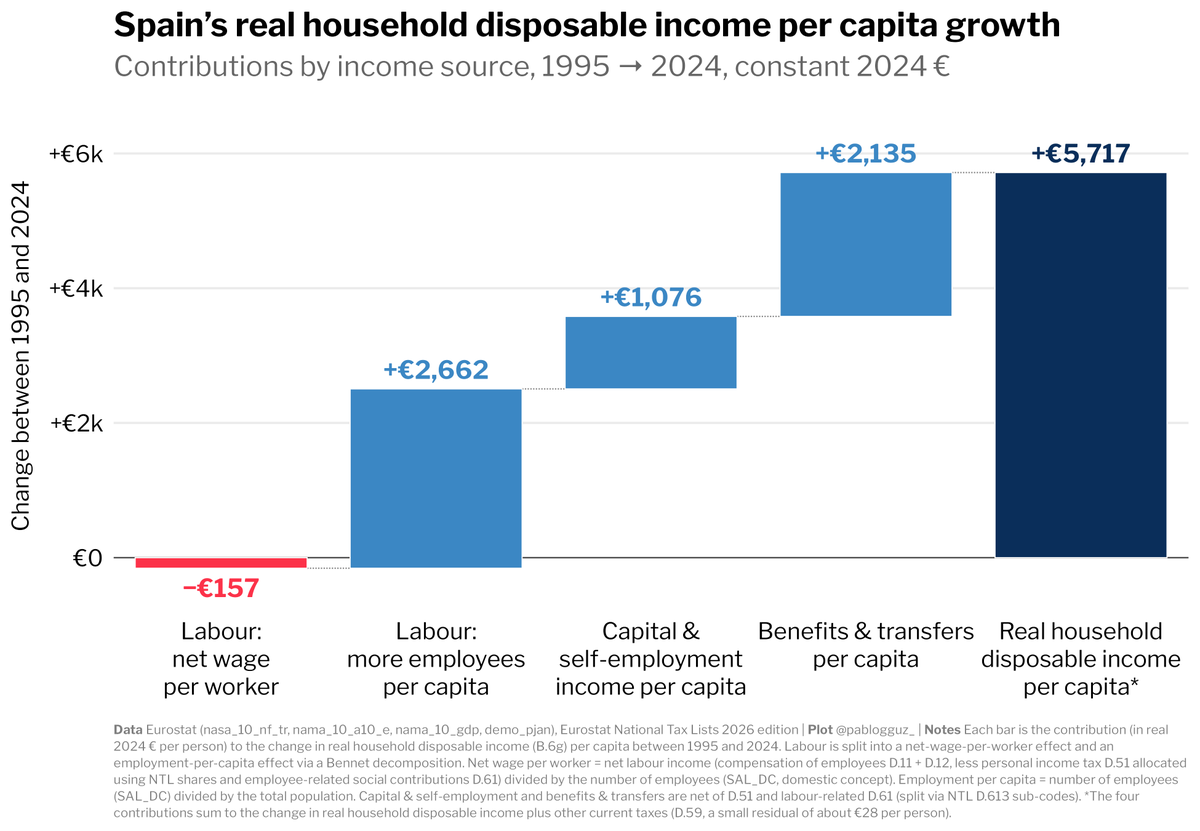
spain needs a different growth model.
in the last 30 years, real household disposable income per capita has grown by roughly 38% in real terms (around €5.7k per person at 2024 prices). this can be decomposed into growth in net labour income per capita (+16.7 pp), cash benefits such as pensions (+14.2 pp), and capital and self-employment income per capita (+7.2 pp).
however, the labour contribution came entirely from the extensive margin (pulling more people into employment) rather than from higher real wages per worker. in fact, the average spanish employee takes home slightly less in real terms today than in 1995!
going forward, this model is unlikely to keep working. the extensive-margin gains came from two channels, both of which leaned on favourable conditions that are (most likely) not going to repeat. the first is that the working-age population grew faster than the total population during the 90s and 2000s, mainly because of the favourable age structure left behind by spain's baby boom (the large cohorts born in the 1960s and 1970s moved into prime working age while the cohorts behind them were smaller), but also because of immigration waves that were disproportionately working-age. this is what demographers often call a demographic dividend, which lifts the employment-to-population ratio purely by composition (even with no change in how much any given working-age person works). the second channel is that, within the working-age population, the employment rate rose substantially, from below 50% in the mid-1990s to around two-thirds today.
of course, none of this is bad, but there is only so much further either channel can go. the demographic dividend is already reversing: the baby boom cohorts are now moving into retirement, the cohorts replacing them are much smaller, and ageing will push the working-age share of the population down. the employment rate itself is approaching a natural ceiling -- there is still a gap relative to the average advanced european economy but it is not large, and closing it would only buy spain a few more years of compositional growth.
immigration, often raised as the way out, cannot realistically offset the demographic drag ahead. the scale of net inflows required to offset ageing on a sustained basis is multiples of any plausible figure consistent with social and political constraints in european countries, and even if such flows materialised, immigrants themselves age and accrue the same retirement pension entitlements as natives. in other words, sustaining the current demographic structure would require a permanent inflow large enough to offset both the ageing of the native population and that of past migrant cohorts, indefinitely. fertility, however, is now falling across virtually every region of the world, and the global working-age population is projected to peak within a few decades and then decline. there is simply no migrant pool waiting to be drawn from on the scale spain would need.
this is also why cash benefits cannot keep doing what they have been doing. it is worth being explicit about why retirement pensions, specifically, are at the centre of all this. spain runs a defined-benefit, pay-as-you-go public pension system: pensions are not the actuarial outcome of what each worker contributed, but a function of years contributed and final wages, paid out of the contributions of those currently working. the current system promises retirees an internal rate of return on their contributions that is significantly higher than anything the payments into the system can plausibly grow at. and because the payments into the system are, mechanically, the number of contributors times the average wage on which they contribute, a gap of that kind is sustainable only as long as the contributing base keeps expanding fast enough relative to the receiving one. the same demographic dynamics that enabled the extensive-margin growth of the last three decades are what allowed this to (sort of) work, but these are now reversing. on top of that, the system already runs a structural deficit: only about three-quarters of contributory pension expenditure is covered by social contributions, and the rest is financed out of general taxation paid by the entire population.
and pensions are not an independent source of household income. they are funded by taxes, and taxes have to be levied on income generated somewhere in the economy. in spain, as in any developed country, that income is overwhelmingly the wage bill: personal income tax and social contributions on labour. so the real question is whether labour income per worker is growing.
gross compensation per worker (including social security contributions) has in fact risen slightly in real terms since 1995, by around 5%. but the entire gain (and a little more) has been absorbed by a widening fiscal wedge, so that the take-home wage is marginally lower today than it was thirty years ago. in other words, the modest productivity gains the spanish economy has managed to deliver have not reached workers. they have been routed, in their entirety, into financing the rising weight of transfers.
one could argue, of course, that if wages eventually start growing, the additional income can simply be taxed away to keep financing rising benefits. but that is just another way of saying that the take-home pay of the average spanish worker is supposed to stay flat for the foreseeable future, and that whatever productivity gains eventually arrive will be routed straight through to retirees. i will leave it to the reader to judge what kind of social contract that describes.
thirty years of stagnant wages is already a long experiment in that direction. either policymakers start taking productivity growth seriously or the bill comes due on a model that was always going to run out of room.
If you pitched this as a screenplay every studio would reject it for being too on-the-nose.
A 73-year-old architect walks to confession in 1926 and gets hit by a tram on the Gran Via in Barcelona. He's mistaken for a vagrant because of his worn clothes and left at a pauper's hospital. He dies three days later. His name is Antoni Gaudí. The cathedral he leaves behind is less than a quarter complete. The plans to finish it sit in his workshop as plaster models and detailed drawings.
Ten years after his death, in July 1936, FAI anarchists break into that workshop. They smash the plaster models. They burn the archive of drawings and calculations. They pry open Gaudí's tomb. For the next 50 years, architects piece together a destroyed playbook from photographs and broken plaster fragments.
The geometry was the real problem. Gaudí designed the church using upside-down hanging-chain models because the math for hyperboloid intersections did not yet exist on paper. He had solved it physically. Computers finally caught up to him in the 1980s. By 2010 the project was 50% complete. By 2015 stone elements that took months to hand-carve were being modelled digitally and machine-cut in days.
Now the kicker. The building is funded entirely by people paying admission to see scaffolding. €134.5 million of income in 2025, all private, none of it from the Spanish state or the Vatican. About 4.7 million tourists a year buying €26 tickets to watch a cathedral get built. The unfinished state was the product.
On June 10, 2026, exactly 100 years to the day after Gaudí died, the cross goes up on the Tower of Jesus Christ. 144 years from groundbreaking. 172.5 meters tall. The tallest church building in the world, beating Ulm Minster, which took 513 years.
When asked why his project was taking so long, Gaudí said one thing: "My client is not in a hurry."
Turns out neither was he.
Reflexiones capitalistas para el fin de semana.
Howard Schultz fue CEO de Starbucks entre 1986 y 2000 y entre 2008 y 2017.
Nació en una humilde familia judía de Brooklyn.
En 1983, empezó a trabajar en una pequeña cadena de cafeterías de Seattle.
En 1987 la compró a sus propietarios y, a base de trabajo y esfuerzo, convirtió Starbucks en una multinacional valorada en miles de millones de dólares.
En este vídeo, una senadora estadounidense cuestiona su riqueza.
La respuesta de Shultz no tiene desperdicio:
“Sí, tengo miles de millones de dólares. Los gané yo. Nadie me los dio”.
En la terminología de Ayn Rand, Schultz es un productor (“producer”), mientras que la senadora pertenece a la clase de los saqueadores (“looters”).
El problema de los saqueadores es que consideran que la riqueza es un juego de suma cero.
Que si uno es rico es porque se lo ha quitado a otro.
El discurso muestra un total desconocimiento sobre la creación de riqueza y lo único que desprende es envidia.
La envidia es el pecado capital de todo saqueador.


![JaimeObregon's tweet photo. 🚨 ¡Esta sentencia tiene truco!
Y nos afecta a todos; vamos a verlo:
Los datos médicos…
✅ Son confidenciales.¹
✅ Están especialmente protegidos, y tratarlos está prohibido, salvo excepciones tasadas.²
✅ La prestación de asistencia sanitaria es una de esas excepciones.³
✅ Los sanitarios —médicos, enfermeros— pueden acceder a tu historia clínica al proporcionarte asistencia sanitaria.⁴
✅ Un administrativo de un centro de salud no es un sanitario, pero puede acceder a tu historia clínica solo en la medida en que sea imprescindible para realizar sus funciones.⁵
Hasta aquí, todo correcto:
— Un sanitario puede acceder a tu historia clínica para atenderte, y bajo deber de confidencialidad. Pero, aunque sea médico, no puede acceder a tus datos «porque sí».
— Un administrativo puede acceder a partes limitadas de tu historia clínica para, por ejemplo, citarte. Pero no «por cotillear», que es lo que condena la sentencia de abajo.
😱 Ahora viene la trampa:
Como ciudadano…
✅ Tienes derecho a consultar tu historia clínica.⁶
✅ Tienes derecho a denunciar accesos injustificados a tu historia clínica.⁷
❌ No tienes derecho a saber quién ha accedido a tu historia clínica.⁸
💥 ¿Ein?
Puedes consultar tu historia clínica, pero no puedes consultar quién ha accedido a ella, porque eso revelaría la identidad de quienes accedieron.
Entonces, ¿cómo se pueden denunciar accesos injustificados, si no se puede conocer dichos accesos?
Este es el callejón sin salida de la normativa sanitaria y de protección de datos actual.
⁉️ Entonces… ¿cómo es posible esta sentencia?
Porque hay dos comunidades que han deshecho el lío con legislación sanitaria propia: Navarra y Extremadura.⁸ ¡Los ciudadanos de estos territorios sí pueden saber quién ha accedido a su historia clínica! En el resto del país, no.
🧐 Ahora, querido Watson… ¿ves de dónde es la sentencia que enlazo debajo?
Afirmativo: de Navarra. 🚀
🧐 ¿Y qué dice el Sistema Nacional de Salud?
Dice una cosa muy interesante:⁹
«El ciudadano puede realizar el seguimiento de los accesos realizados [a su historia clínica digital], a fin de verificar su legitimidad. […] Cada vez que un ciudadano haga uso de esta funcionalidad, ejercerá como auditor
externo del sistema, sumándose al resto de elementos que conforman la estrategia de seguridad del sistema […]».
Es decir: que cada ciudadano pueda auditar los accesos a su historia clínica no es solo un derecho, sino que forma parte de una estrategia integral de seguridad.
🤯 Jaime, me mareo… ¡hazme un resumen!
➡️ Pídele a tu político de confianza¹⁰ que legisle en tu territorio el acceso a la identidad de quienes acceden a tus datos médicos.
🟢 ¿No es eso ilegal?
En absoluto: Ya está pasando en Navarra y en Extremadura. Es reforzar la seguridad y confidencialidad de la infraestructura pública de datos de salud.
🔁 ¡REDIFUNDE, amigo! 🔁
Pasito a pasito, tendremos un país mejor. 💪
___
¹ Art. 7 Ley 41/2002
² Art. 9 RGPD.
³ Art. 9.2.h RGPD.
⁴ Art. 16.1 Ley 41/2002
⁵ Art. 16.4 Ley 41/2002
⁶ No por el art. 15 RGPD sino por el art. 18 Ley 41/2002.
⁷ Arts. 197.2 y 198 del Código Penal.
⁸ Informe 3/2021 de la @AEPD_es.
⁹ Documento «El Sistema de Historia Clínica Digital del Sistema Nacional de Salud», del Instituto de Información Sanitaria de la Agencia de Calidad del Sistema Nacional de Salud, en su pág. 16.
¹⁰ Oxímoron. 😂](https://pbs.twimg.com/media/HIC8s6eWMAAdJTj.jpg)