How has the Spanish economy performed over the very long run?
To answer, I use Leandro Prados de la Escosura’s (@LdelaEscosura) data on real GDP per capita from 1277 to 2024. I express Spain’s figure as a ratio to Britain’s, since Britain was the first economy to achieve modern economic growth, from around 1660, and has been the leader, or close to it, ever since.
Spain, within its present borders, was prosperous in the Late Middle Ages, well ahead of Britain, then a peripheral corner of Europe. The Black Death and its aftermath hit Spain harder, and by 1360, the two economies had converged.
That parity held until 1600, when Spain began a long decline, in absolute terms (on the eve of the French Revolution, it was barely above its 1600 level, after a deep slump in between) and in relative terms (Britain pulled steadily away). The standard explanations, the Habsburg wars, and the serial bankruptcies run into one problem. They can account for the poor performance between 1550 and 1650, but not for the stagnation between 1650 and 1789. 140 years of stagnation is far more than wars and debt under the Habsburgs can explain.
The series also shows that Spain did not benefit from its empire. That is a problem for every theory tying colonies to modern growth. At most, one can argue that colonies were a necessary condition for takeoff (I do not believe even that, but leave it for another day). One cannot argue that they were sufficient.
The period from 1789 to 1936 was no kinder. The economy grew a little, and Spain built a modern but unfinished liberal state. Yet it never closed the distance to Britain. It is hard not to read the period from 1789 to 1936 as a national failure and the Civil War as its final consequence.
The recent efforts of some historians to paint those years in brighter colors strike me as unfounded. Spain did not fail at modernization as badly as China, but it did not succeed. A deeply corrupt dynasty, closed and incompetent elites in Madrid, Barcelona, and Bilbao, and an economic policy built on intervention and protection (by 1920, Spain was the most protectionist economy in the Western world, so much for the friends of protection) together made the country a basket case.
A cruel civil war left Spain at its historical low, with just 31% of the British GDP per capita. The foreign visitors who arrived in the early 1950s found a poor, backward country.
Policy in the first twenty years of the dictatorship was awful. Autarky was not so much imposed by the Allies as chosen. Spain’s rulers, using their quasi-fascist Weltanschauung, believed growth would come from state intervention, closed markets, and unorthodox fiscal and monetary policy.
Then, in 1959, policy changed. Spain adopted a more orthodox fiscal and monetary policy and opened to foreign investment and trade. The results were spectacular. For forty years, Spain grew briskly and became the modern country it is today. By 2001, it had reached 77% of British GDP per head.
But the internal contradictions of two things eventually became binding: the growth model launched in 1959, and the political regime created by the 1978 constitution. By 2024, Spain had slipped back to 74% of British GDP per head. This is worse than it looks. Britain itself has done poorly over the past twenty years, and losing ground to a weak performer is a bad sign.
Spain stands at a crossroads, economic and political. The country’s foundations no longer work, but its political and business elites have failed to understand this fundamental reality. A good grasp of its economic history helps make sense of its present predicament.
las timovacunas transformaron a todo un adonis insular en un “family banker” de tres al cuarto de banca mediolanum
esto es horrible y un aviso a navegantes: el que se va sin que lo echen, vuelve sin que lo llamen @pfizer
@JesusFerna7026 Pues ahora intuyo que sí, pero me interesaba escuchar su opinión al respecto de la polémica (en el caso de que quiera pronunciarse, claro).
Kapital con Pau Ferrer. Tuve a Pau como alumno en la UPF hace ya algunos años. Hace unos meses me escribió diciéndome que había entrado en el seminario y que pronto sería su ordenación. Charlamos sobre Dios, la fe y lo que espera la sociedad de nosotros https://t.co/PSSMTr6AuH
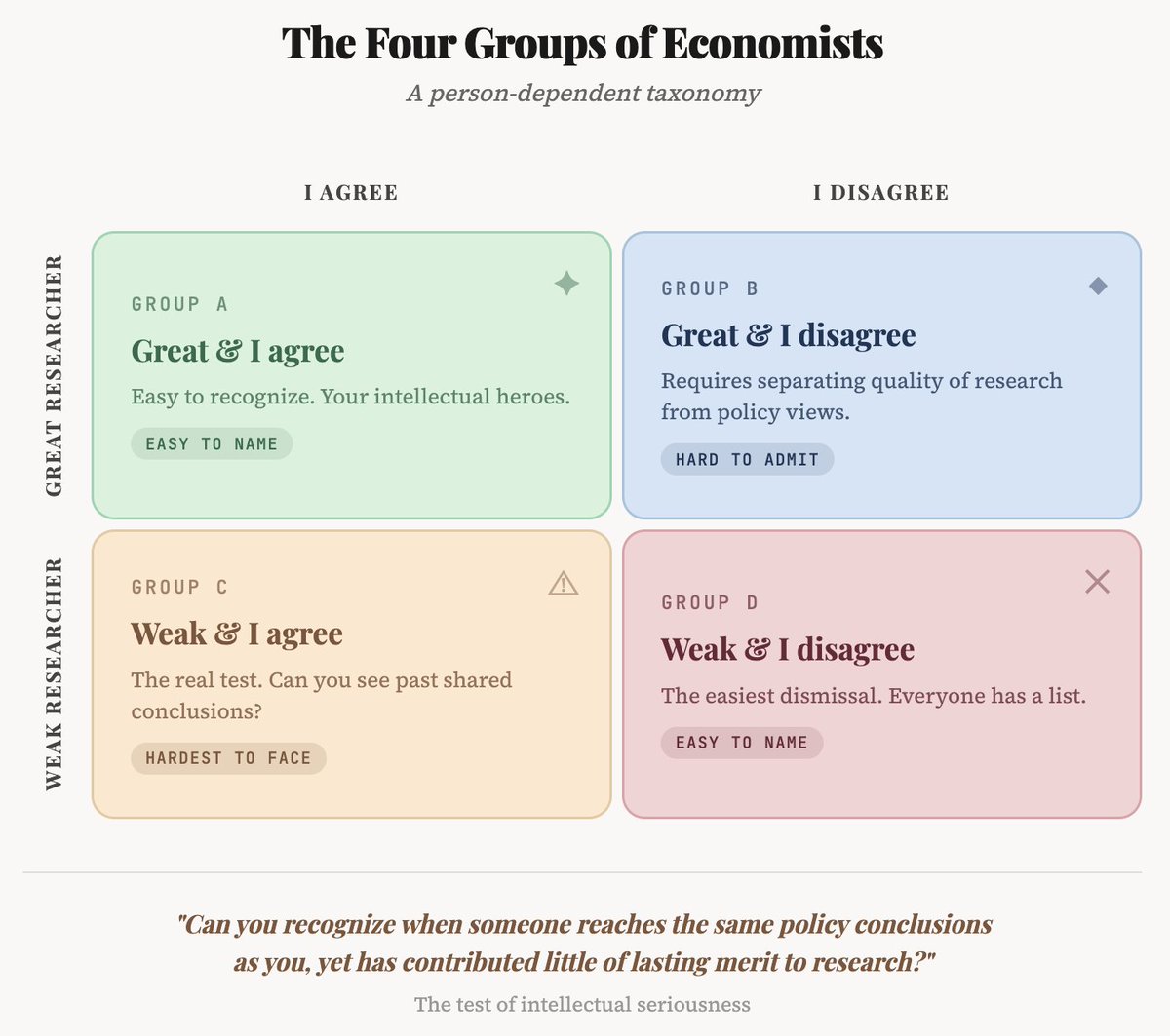
During the time I have participated in the policy debate (as my post yesterday on counterfactual Nobel prize winners confirmed), I have realized that one of the hardest things for many people to grasp is that there are four (person-dependent) groups of economists:
1️⃣ Group A: Great researcher, and I agree with their policy recommendations.
2️⃣ Group B: Great researcher, and I disagree with their policy recommendations.
3️⃣ Group C: Weak researcher, but I agree with their policy recommendations.
4️⃣ Group D: Weak researcher, and I disagree with their policy recommendations.
(Yes, the great/weak distinction is coarse; there is a whole continuum from Hicks down, but it suffices for X.)
Most people (including economists) can immediately name economists in Groups A and D. They struggle with Group B. And they have a really, really hard time with Group C.
To me, this is a basic test of intellectual seriousness:
Can you recognize when someone reaches the same policy conclusions as you, yet has contributed little or nothing of lasting merit to research?