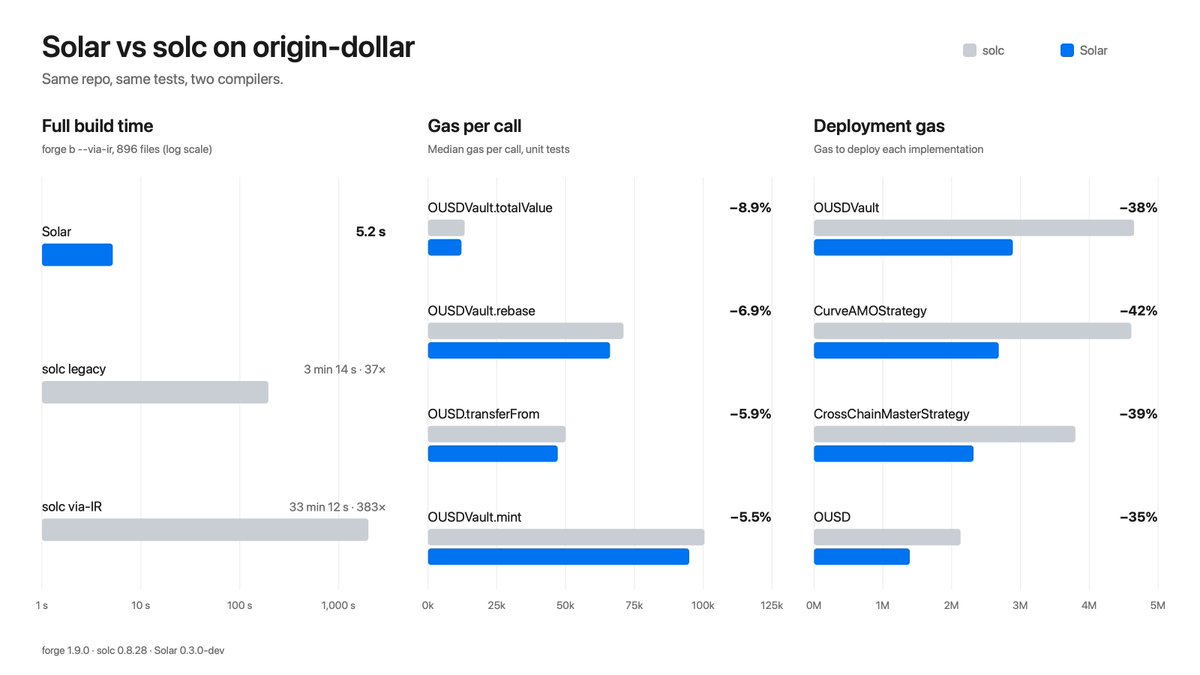
Solar on @OriginProtocol's OUSD repo: full build 37× faster than solc (383x faster against via-ir), deploys 35% cheaper, ~4% gas saved per call. Zero code changes. Wild.
Thank you so much @gakonst@DaniPopes@djtodoro 🔥
@d_gusakov That’s why Origin Protocol limits the initial deposit to 1 ETH and requires a beacon Merkle proof confirming the validator’s withdrawal credentials before allowing further deposits.
@d_gusakov A node operator can already front-run a validator deposit with their own 0x02 deposit for the same pubkey, pointing to their withdrawal address. That remains possible after Glamsterdam.
@standard_rsv How is ordinary transferability guaranteed when venue identification is outside URC-5’s scope? What prevents an implementation from classifying a Safe wallet or EOA as a venue and blocking transfers?
@sam_battenally EEZ’s proposed synchronous composability could go a long way towards enabling this, assuming both chains join. The venues would still need shared margin accounting and liquidation rules. https://t.co/TijSv5lVb2
5/5
OTTER is currently a research proposal.
Its guarantees depend on censorship-resistant transaction inclusion and sufficient block capacity.
Read the paper:
https://t.co/J7Ebmnq7aX
1/5
@LayerZero_Core's OTTER proposes a new step in DEX design: an intent-style exchange built on top of a Uniswap-like liquidity pool.
Instead of settling swaps one-by-one in block order, OTTER clears them together as a batch.
🧵
4/5
Instead of leaving residual value for builders to capture as MEV, OTTER removes it from the batch.
The paper says it could subsidize trader fees, reward OTTER pool LPs, deepen the pool or support the underlying chain and validators—but it does not define a distribution policy.
Memecoin launchpads are the McDonald's of on-chain issuance.
Mass-produced, fast, and you think you're the customer.
In the first 5 days of Uniswap's launchpad, 4% of wallets took 65% of all the positive PnL.
So turns out you're on the bots menu.
Lido now has $1B+ in pending withdrawals.
Lido estimates ~15 days for withdrawals.
Current Lido validator exits cover just 58% — and take ~8 days to process.
Without a lot more validator exits, the real wait will be much longer.
@OriginProtocol's Lido ARM is helping users exit while generating strong yield for LPs.
https://t.co/QH2TXLteMm
@OriginProtocol I spent most of last year working on merkle proofs of beacon chain data for Origin's OETH LST.
It's so pleasing to see that the different proofs are now working on mainnet. 🚀