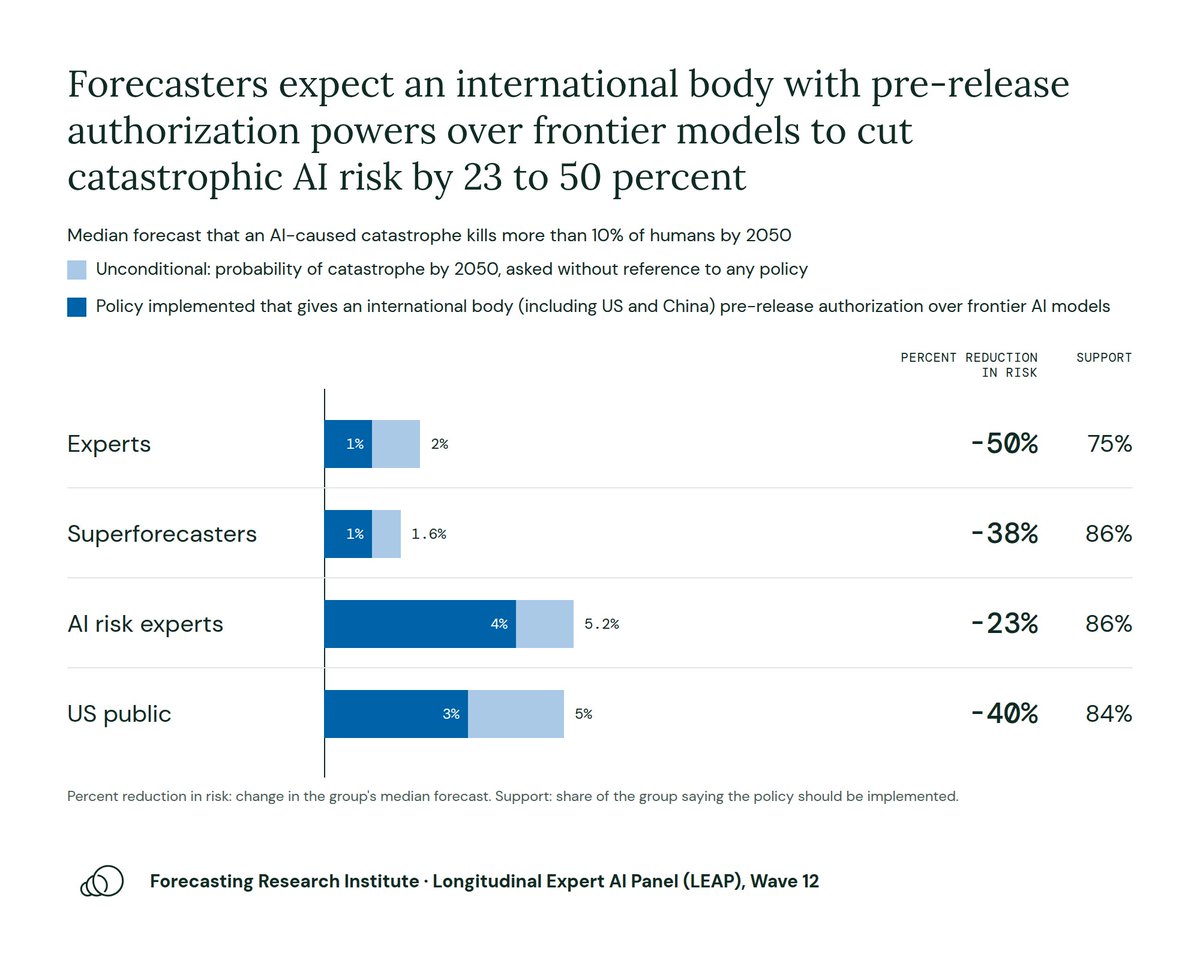
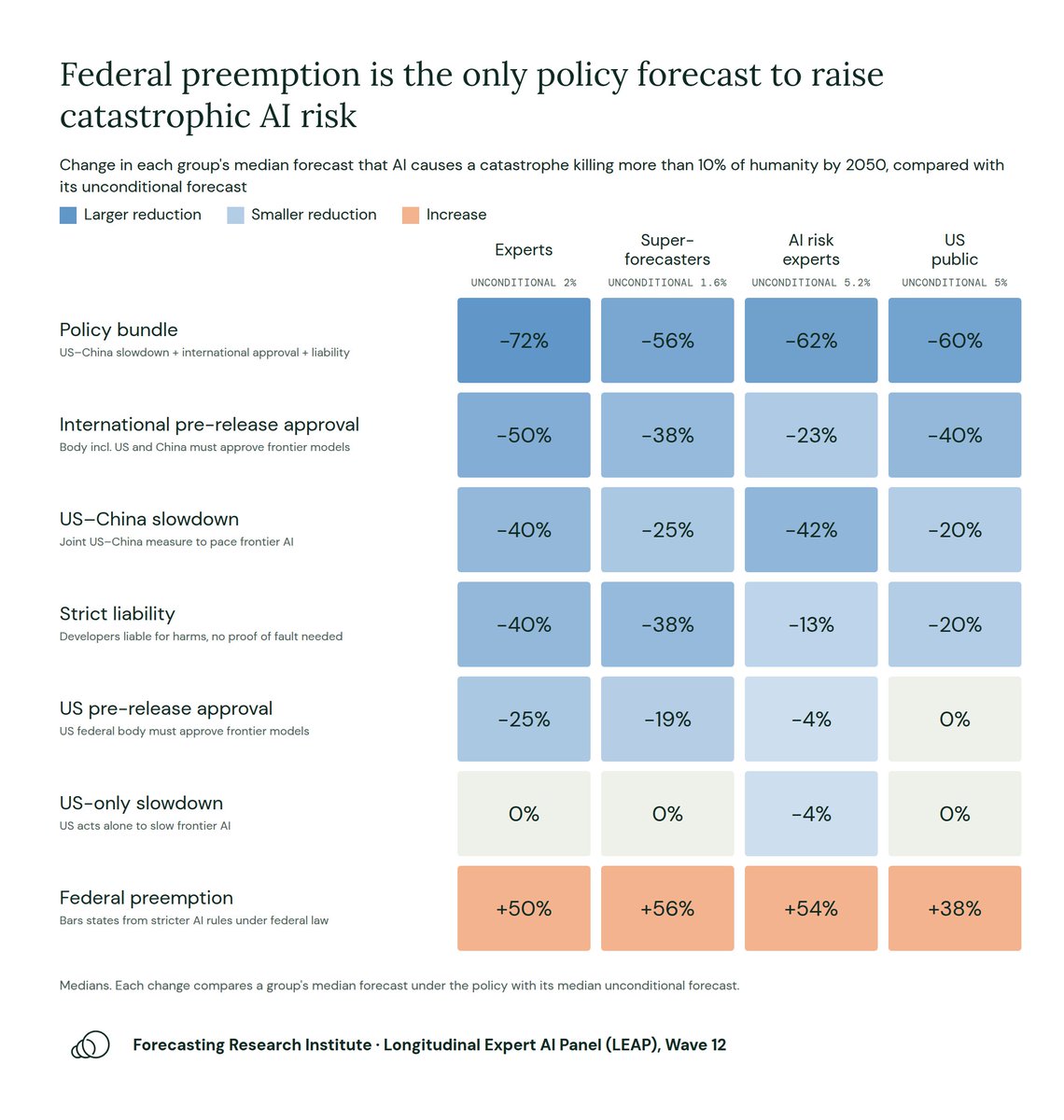
Policies could reduce catastrophic risk from AI by more than 60%, according to our LEAP panel. And federal preemption is viewed as the only policy to potentially increase risk, while also being predicted as the most likely to be implemented! Very exciting results this month!
AI experts largely agree about which policies would most reduce catastrophic AI risk.
The Longitudinal Expert AI Panel (LEAP) brings together forecasts from a representative group of over 250 experts that policymakers look to when considering the future of AI: computer scientists, industry figures, top economists, policy experts, and AI risk experts.
We asked panelists to forecast (1) how a menu of policies would affect AI risk; (2) which policies they each support; and (3) which policies they think will be implemented by 2030.
Key findings:
• Despite disagreeing on the level of AI risk, respondents broadly agree on policy
• Respondents believe government policy can substantially reduce catastrophic AI risk
• The most supported policy of those we asked about was the creation of an international body, including the US and China as members, with pre-release authorization power over frontier models
• Some US-only policies are forecast to reduce catastrophic AI risk, but not as much as bilateral policies involving the US and China
• Experts strongly oppose federal preemption and think it would increase AI risk
• The policies experts expect to reduce risk the most are those they think are least likely to actually be implemented
🧵 More, with key insights below:
We’ve run the most comprehensive series of studies on expert AI forecasts over the last four years. Today, we’re sharing an interim update on our findings about the accuracy of these forecasts.
Our major findings are:
1. Experts, including top economists, computer scientists, and biologists, have dramatically underestimated AI capabilities progress each year. Superforecasters have underestimated progress to an even greater extent.
2. Experts have a more mixed forecasting track record on AI diffusion-related measures, with some major underestimates (forecasting AI revenue) and other forecasts on track to be accurate (the share of electricity used for AI).
3. Some notable cases of overestimating AI progress: how much mid-2025 AI models could help amateurs do biorisk-relevant laboratory tasks; the speed of rollout of self-driving cars.
4. It is too soon to say how forecasters have performed at predicting macro-scale impact on outcomes such as GDP growth, major AI harms, and averted deaths from disease.
More 🧵
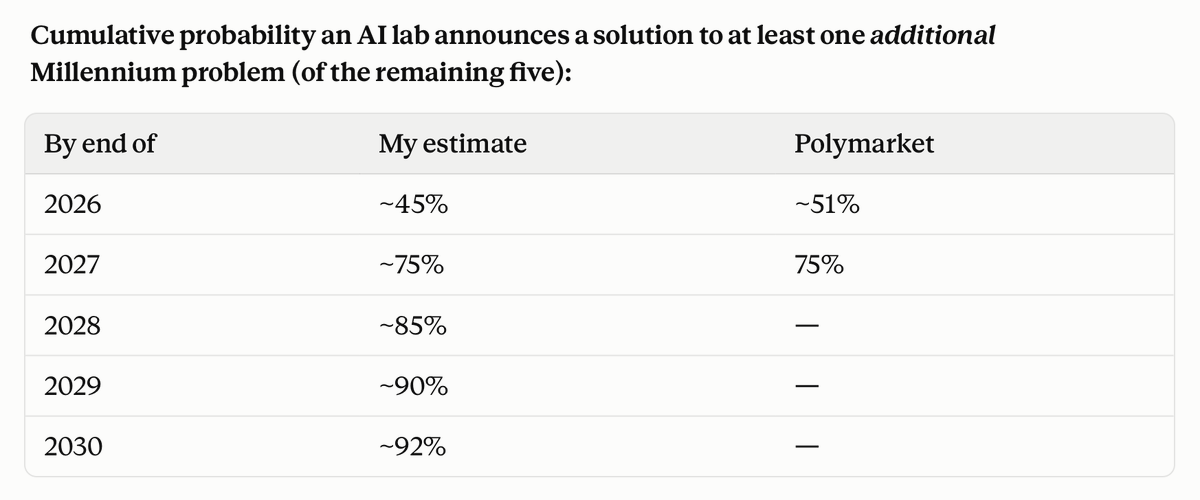
@GoodFaithOnly@Jabaluck Makes sense! I'm still curious for Fable's non-web search rationale. I guess the low probs come from verification of 'solving' a MP. In my case, Fable reasoned low prob "because of their 2-years-after-publication rule and the messy credit question, not doubt about the math."
@GoodFaithOnly@Jabaluck Did you just prompt the question above? And was web-search on? I get very different probs with Fable 5.1 (med effort). And I think that most of the reason for lower probs is (at least in the rationale Fable gave me) is that determining that a MP has been solved can take years.