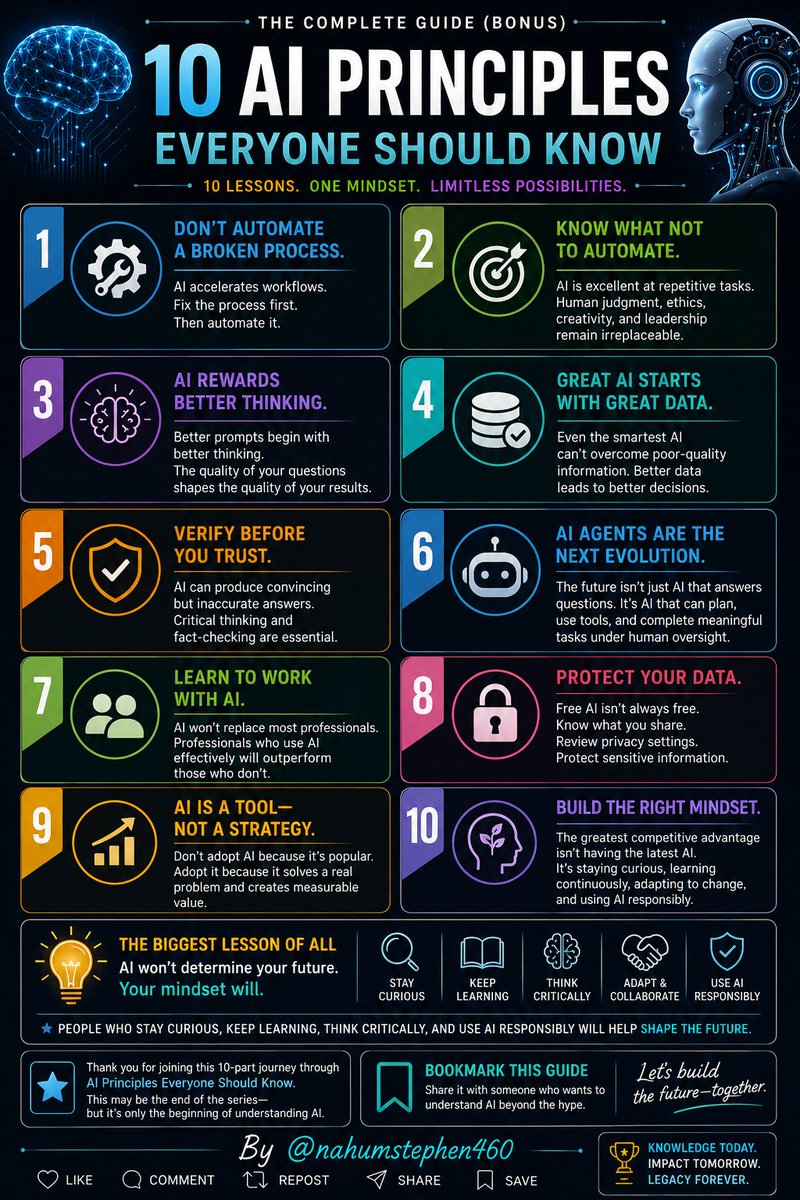
🚀 After 10 posts, countless insights, and meaningful discussions... we've reached the end of the "AI Principles Everyone Should Know" series.
This wasn't about chasing hype.
It was about understanding the principles that will still matter years from now.
If you followed this journey, you now know that:
✅ AI doesn't fix broken systems—it amplifies them.
✅ Better thinking beats better prompts.
✅ Better data beats bigger models.
✅ AI can be wrong, so verification matters.
✅ AI agents are changing how work gets done.
✅ Learning to work with AI is becoming a competitive advantage.
✅ Protecting your data is just as important as using AI.
✅ AI is a tool—not a strategy.
✅ Your mindset will always matter more than the latest technology.
The biggest lesson of all?
AI won't define your future.
Your willingness to learn, think critically, adapt, and use it responsibly will.
I created this guide to be a resource you can return to whenever AI feels overwhelming.
📌 Bookmark it.
🔄 Share it with someone who wants to understand AI beyond the headlines.
I'd also love to hear from you:
Which of these 10 principles changed the way you think about AI the most?
Thank you for being part of this journey.
Next up: Technology Principles Everyone Should Know—where we'll explore the foundational technologies shaping our world, one principle at a time.
#AI #ArtificialIntelligence #AITools #Technology #MachineLearning #Innovation #FutureOfWork #DigitalTransformation #TechEducation #FutureTech #Leadership #LearnAI
🚨 Cybersecurity Isn't Just an IT Problem. It's Everyone's Responsibility.
Most people think hackers only target large companies.
The truth?
Cybercriminals often target ordinary people because they're easier to exploit.
Here's what everyone should know:
---
1. People are often the weakest link. 🎣
Many cyberattacks don't begin with sophisticated hacking.
They begin with a fake email...
A fraudulent text...
Or a malicious link.
This is called social engineering—tricking people instead of breaking technology.
---
2. Strong passwords aren't enough anymore. 🔑
A long, unique password is essential.
But adding Multi-Factor Authentication (MFA) gives you an extra layer of protection, making it much harder for attackers to access your accounts.
---
3. Think before you click. ⚠️
Scammers create fake websites and messages that look convincing.
Before entering sensitive information:
• Check the sender
• Verify the website address
• Avoid clicking unexpected links
A few seconds of caution can prevent major losses.
---
4. Keep your software updated. 🔄
Updates aren't just about new features.
They often fix security vulnerabilities that attackers actively look for.
Delaying updates can leave your devices exposed.
---
5. Cybersecurity is a daily habit. 🛡️
Good security isn't built on one tool.
It's built on consistent habits:
• Use strong, unique passwords
• Enable MFA
• Update your devices
• Back up important files
• Stay alert to scams
Technology can help protect you.
Awareness protects you even more.
---
💡 Remember:
The safest device isn't the newest one.
It's the one used wisely.
💬 What's one cybersecurity habit everyone should start practicing today?
#Technology #CyberSecurity #OnlineSafety #DigitalSecurity #Privacy #TechEducation #Innovation #Technology #Internet #FutureTech #DigitalLiteracy #CyberAwareness
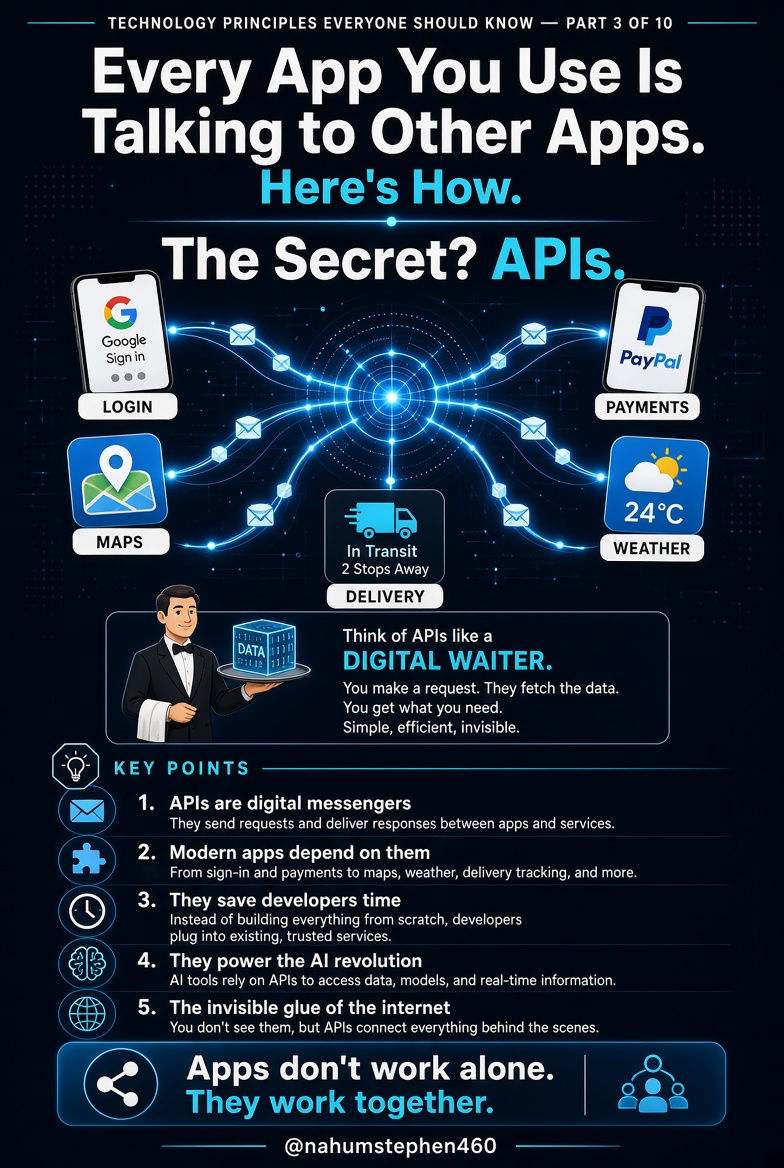
🚨 Every App You Use Is Talking to Other Apps. Here's How.
You open an app.
Tap a button.
Instantly, information appears.
It feels effortless.
But behind the scenes, there's constant communication happening.
The secret?
APIs.
Here's why they're one of the most important technologies you've probably never thought about.
---
1. APIs are digital messengers. 🔗
An Application Programming Interface (API) allows different software systems to communicate with each other.
Think of it as a waiter in a restaurant.
You tell the waiter what you want.
The waiter takes your request to the kitchen.
Then brings back your order.
Apps use APIs in the same way.
---
2. Most modern apps depend on APIs. 🌐
When you:
• Sign in with Google
• Pay with PayPal
• View Google Maps inside another app
• Check the weather
• Track a delivery
You're using APIs—even if you don't realize it.
---
3. APIs save developers time. ⚡
Instead of building everything from scratch...
Developers connect to trusted services that already exist.
This makes apps faster to build, more reliable, and easier to improve.
---
4. APIs power the AI revolution. 🤖
Many AI tools work through APIs.
Developers can integrate powerful AI models into websites, apps, and businesses without creating their own models from scratch.
That's one reason AI adoption has accelerated so quickly.
---
5. APIs are the invisible glue of the internet. 🧩
Without APIs...
Many of your favorite apps wouldn't function the way they do today.
They're one of the key technologies enabling today's connected digital world.
💡 Remember:
Apps don't work alone.
They work together.
And APIs make that collaboration possible.
💬 Before today, did you know that almost every app you use relies on APIs behind the scenes?
#Technology #API #SoftwareDevelopment #Programming #CloudComputing #AI #TechEducation #Innovation #DigitalTransformation #FutureTech #Developers #TechnologyExplained
🚨 The Cloud Isn't a Place. It's Someone Else's Computer.
When people hear "the cloud," they often imagine data floating somewhere in the sky.
The reality is much simpler.
The cloud is a network of powerful data centers around the world that store and process information for you.
Here's why that matters:
---
1. Your files aren't inside your phone. ☁️
When you save a photo to cloud storage...
Or stream a movie...
Or use an online document...
Your data is often stored on remote servers, not your device.
---
2. The cloud powers modern life. 🌍
Every day, billions of people rely on cloud computing for:
• Social media
• Email
• Online banking
• Video streaming
• AI tools
• Gaming
• Business software
Without the cloud, much of the internet would stop working as we know it.
---
3. It makes technology more powerful. ⚡
Instead of every device doing all the work...
Powerful remote computers handle the heavy processing.
That's why even a smartphone can run advanced AI applications.
---
4. Convenience doesn't replace security. 🔒
Cloud providers invest heavily in security.
But users still play a critical role.
Strong passwords...
Multi-factor authentication...
And regular backups remain essential.
Technology is only as secure as the habits of the people using it.
---
5. The future is increasingly cloud-powered. 🚀
From AI and streaming...
To healthcare, finance, education, and scientific research...
Cloud computing has become one of the foundations of the digital world.
The more you understand the cloud, the better you'll understand modern technology.
💡 Remember:
The cloud isn't magic.
It's global computing infrastructure working behind the scenes—every second of every day.
💬 What's one cloud service you use so often that you couldn't imagine living without it?
#Technology #CloudComputing #Cloud #TechEducation #Innovation #DigitalTransformation #Internet #AI #FutureTech #CyberSecurity #TechnologyExplained #Learning
🚨 The Internet Isn't Just a Website. It's the World's Largest Network.
Most people use the internet every day.
Very few understand how it actually works.
Here's why that matters:
---
1. The internet isn't one thing. 🌍
It's a global network of billions of devices connected through standardized communication protocols.
No single company or country owns the entire internet.
---
2. Every click travels farther than you think. 📡
When you visit a website, your request passes through multiple networks and servers before reaching its destination.
That journey usually takes only milliseconds.
---
3. Websites are only the surface. 🌐
Streaming videos...
Sending emails...
Using cloud apps...
Online banking...
Video calls...
They're all powered by the same underlying internet infrastructure.
---
4. Speed depends on more than your Wi-Fi. ⚡
Your experience is affected by:
• Your internet provider
• Network congestion
• Server location
• Data routing
• Website optimization
A fast Wi-Fi connection doesn't always mean a fast internet experience.
---
5. Understanding the internet makes you a smarter technology user. 💡
The more you understand the systems behind everyday technology...
The better you'll understand cybersecurity, cloud computing, AI, blockchain, and nearly every major innovation shaping our future.
Technology becomes less mysterious when you understand its foundations.
💬 If the internet disappeared for just 24 hours, what part of your daily life would be affected the most?
#Technology #Internet #Networking #TechEducation #Innovation #DigitalWorld #CyberSecurity #CloudComputing #FutureTech #TechExplained #DigitalTransformation #Learning
A weaker DXY removes one headwind, but it doesn't guarantee upside.
With Bitcoin's Risk Index rising to 58, the market is signaling that internal selling pressure is now a bigger concern than macro dollar strength.
The next move will depend on whether buyers absorb the supply or sellers take control. #Bitcoin
@okx@hackenclub@SlowMist_Team@CertiK Regular security audits aren't just a best practice—they're essential in crypto. Continuous monitoring, independent reviews, and rapid response help strengthen trust and resilience. Security is a process, not a milestone.
@unusual_whales Buffett reducing cash reserves is a signal worth watching.
When one of history's most patient investors starts deploying billions, it often means fear is creating opportunities—not that the market is risk-free.
@unusual_whales When Buffett starts putting cash to work after sitting on the sidelines, it's usually because he's seeing value others are missing.
Smart money doesn't chase hype—it buys when the odds improve.
@cryptorover Because markets hate staying quiet.
When both BTC implied volatility and the VIX are this compressed, it often signals complacency. The next major catalyst—good or bad—can trigger an outsized move.
The setup is clear. The direction isn't.
Low volatility rarely lasts. It usually means the market is coiling before a major move—not that anyone knows the direction.
Possible catalysts include:
• Macro data (inflation, Fed expectations)
• Institutional positioning and ETF flows
• Large options expiries
• A shift in global risk appetite
The only thing volatility compression guarantees is that volatility eventually returns. The real question is: which side breaks first?
Whether the world stands with or against Israel, lasting peace will never be achieved by taking sides alone. It begins with addressing the root causes of conflict rather than reacting only to its consequences.
I believe Israel has profound religious significance to many people, and many also see its existence through the lens of biblical promises. At the same time, every nation has a responsibility to protect its citizens when they come under attack. That principle should apply consistently to all nations.
What concerns me is the inconsistency in public discourse. Too often, many remain silent when innocent people are attacked, yet become vocal only after retaliation begins. If we condemn retaliation, we should also condemn the violence that started the cycle. Justice loses its credibility when it is selective.
None of this means every military response is beyond criticism. Civilian lives are precious, and every effort should be made to protect them. Peace cannot be built by excusing attacks on civilians, regardless of who commits them.
If we truly want peace, we must confront those who plan, fund, encourage, or carry out terrorism and violence—not merely debate the responses after the damage has been done. We should challenge ideologies and organizations that promote hatred or seek to impose their beliefs through violence, while recognizing that the overwhelming majority of followers of any religion do not support terrorism.
No one should be forced to abandon their faith, culture, or identity through intimidation or violence. Every person deserves the freedom to live in peace and practice their beliefs without fear.
Real justice requires consistency: condemn the aggressor, condemn the targeting of innocent people, hold everyone accountable under the law, and work to remove the root causes of violence. Only then can we move closer to lasting peace.
@CoinMarketCap Markets mature, but innovation never stops. The question isn't whether another alt season will happen—it's whether you're holding the right projects when it does.
@CoinMarketCap The days of buying anything and making 20x may be over. The next winners will likely be projects with real utility, strong teams, and sustainable growth.