Let me boil it down to 2 culprits for your convenience-
1. Punjab Preservation of Subsoil Water Act, 2009.
2. Too much of preaching to only Hindus about how they should celebrate Deepavali.
Rest everything is wastage of kilobytes and seethe.
A live example of how meteorology governs air quality!
At 4.15 PM today, #Badlapur recorded an AQI below 50, while most parts of the #MumbaiMMR region were below 100. The impact of #Diwali firecracker emissions has virtually disappeared, with clear blue skies and good visibility across #Mumbai.
As highlighted earlier, firecracker emissions cause a sharp but temporary deterioration in air quality, generally lasting a few hours say for 4-6hrs, depending on atmospheric conditions. The subsequent recovery across the region is a good example of how quickly air quality can improve when meteorological conditions favour pollutant dispersion.
Currently, relatively strong and dry easterly winds are facilitating ventilation and dispersing accumulated pollutants. Improved atmospheric mixing and horizontal transport are helping clear the polluted air mass.
This is where #weather becomes the kingmaker.
Emissions determine how much pollution enters the atmosphere, but wind speed, wind direction, boundary-layer mixing and atmospheric stability largely determine how long pollutants remain concentrated near the surface.
Today's conditions across Mumbai–MMR are a practical example. The same atmosphere that traps pollutants under stagnant winter conditions can clear them relatively quickly when favourable winds and ventilation take over.
This is precisely why India's air pollution problem needs a 365-day emission-control strategy rather than selective outrage over a few hours of #DiwaliCelebrations.
Vehicles, aircraft, air conditioners and industrial activities also contribute to the overall pollution burden. So, are we going to ban all of them as well ?
Let's assume banning firecrackers completely eliminates the additional pollution associated with Diwali for those 1–2 days. What about the remaining 363 days of the year, when pollution continues unabated?
The priority should be to tackle the major, persistent emission sources first rather than focusing disproportionately on a temporary pollution episode.
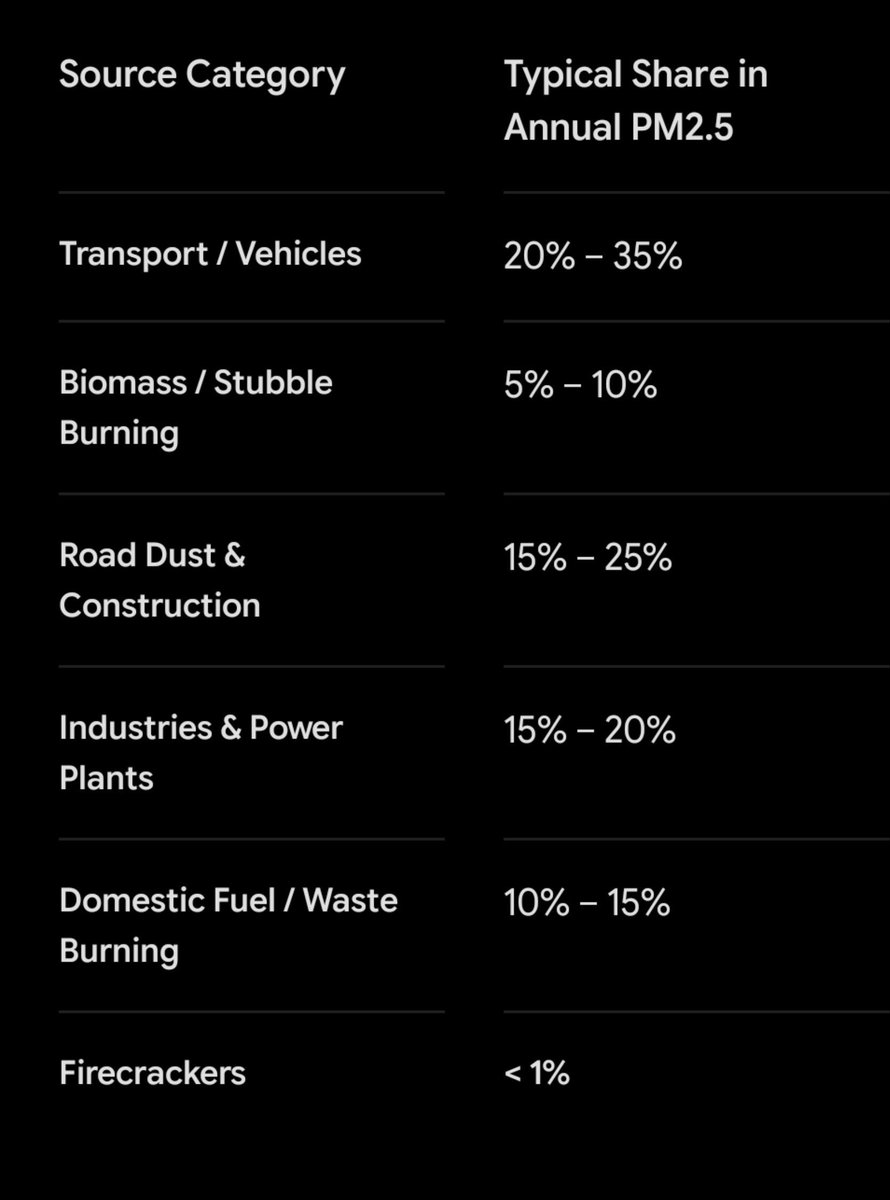
Address the 99% of the problem that persists throughout the year before making the remaining 1% the centre of the entire pollution debate.
Clean air is a 365-day necessity, not a two-day social media campaign !
#AQI #AirPollution #MumbaiWeather #Meteorology #WeatherUpdate #WeatherAnalysis #Diwali
Every year, immediately after #Diwali, social media is flooded with discussions about #AQI, with #crackers being portrayed as the primary reason behind #India's air pollution crisis. There is no denying that firecrackers cause a significant, short-term deterioration in air quality. However, the real question is: Why is there so much selective outrage over 1–2 days, while the remaining 360 days of the year receive hardly the same attention?
This Diwali, even the https://t.co/nLd5cgSWCr servers reportedly struggled with the massive volume of requests between 9 PM and 11 PM across the country.
Firecrackers can temporarily dominate local pollution levels, sometimes contributing 50–60% or even more of the particulate pollution during peak hours in severely affected locations. Their impact can persist for 6-8 hours, depending on meteorological conditions. However, their contribution to annual average #pollution is considerably smaller to mere 1% . The exact contribution varies by location, emission inventory and averaging period.
If we genuinely want cleaner air, there is no objection to reducing even those 5–6 hours of additional pollution. But why don't we first address the much larger, persistent sources that affect air quality throughout the year? Vehicular emissions, industrial activities, construction dust, road dust, waste burning and other combustion sources continue releasing pollutants every single day.
The irony is that many who question an AQI spike of 500–1000 for a few hours conveniently overlook persistent AQI levels of 200–300 on ordinary days. The former is an acute pollution episode, while the latter represents prolonged exposure and a continuous public-health burden. Both deserve attention, not selective outrage.
Look at the 24-hour average. On 8 November, #Badlapur's AQI was on 158, broadly comparable to the levels observed on several other days. This illustrates why hourly peaks and daily averages must be understood separately. A few hours of extreme pollution do not necessarily translate into an equally extreme 24-hour average !
The meteorological dimension is equally important.
India's geographical location and winter climatology play a major role in the seasonal deterioration of air quality, particularly between November and February. During this period, nocturnal cooling, shallow boundary layers, weak surface winds and temperature inversions frequently create favourable conditions for pollutant accumulation.
Under inversion conditions, temperature increases with height over a certain layer, suppressing vertical mixing. This limits the upward dispersion of pollutants and keeps emissions concentrated closer to the surface. Consequently, even without a major emission spike, AQI can remain elevated or easily hover around 150–200 in several urban regions.
Wind speed, wind direction, atmospheric stability, mixing-layer height and the passage of active weather systems are crucial factors in determining how quickly pollutants disperse. Meteorology does not create the emissions, but it largely determines their atmospheric concentration and persistence.
India also faces a unique demographic and geographical challenge. It is the world's most populous country, with a substantial population concentrated across densely populated urban corridors and limited land areas. Daily activities involving transportation, industrial production, construction, energy consumption and waste disposal generate a continuous pollution load.
Comparisons with the US, Europe or Australia often overlook their different geographical, climatic and demographic settings. Many regions in these countries experience stronger ventilation and periodic frontal passages or other active weather systems that help disperse accumulated pollutants. India, particularly its northern and central regions, frequently experiences prolonged winter stagnation under stable high-pressure conditions, shallow mixing layers and temperature inversions.
AQI in cities of Punjab today.
Bathinda: Hazardous (AQI ~1,265)
Barnala: Hazardous (AQI ~1,126)
Bazidpur: Hazardous (AQI ~1,435)
Ludhiana: Hazardous (AQI ~435 to 619)
Amritsar: Hazardous (AQI ~572)
Patiala: Hazardous (AQI ~476)
But Dipke has eyes only on Delhi and Mumbai.
Hypocrisy has departed to Boston.
Mumbai Fire Brigade received 142 fire calls on November 8, of which 137 were attributed to firecrackers, making it one of the busiest days for the department in recent times. Region 4, covering Borivli to Kandivli, tops the list with 53 calls
The number of calls surged through the day, particularly after 8 pm, leaving fire brigade personnel stretched as they rushed from one incident to another across the city.
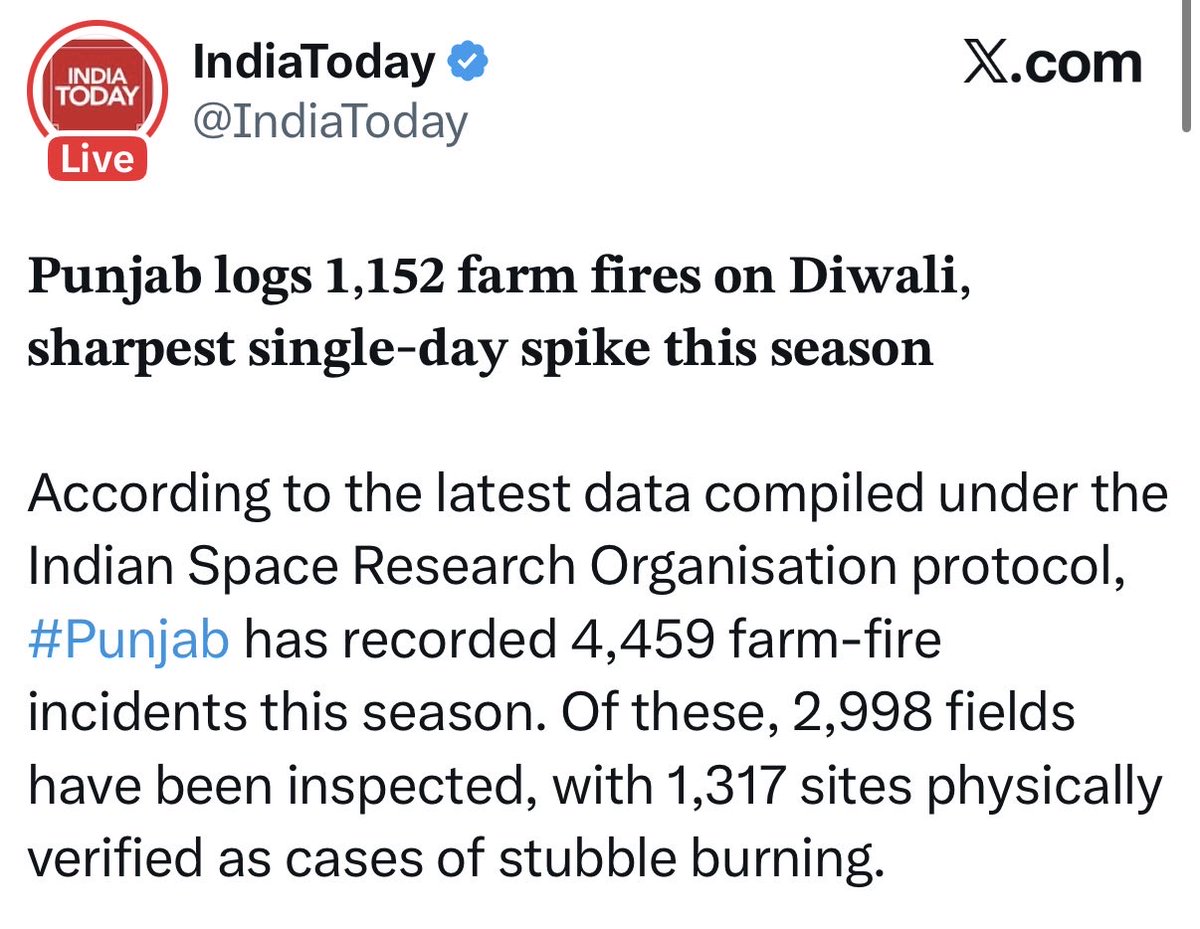
𝐏𝐮𝐧𝐣𝐚𝐛 𝐥𝐨𝐠𝐬 𝟏,𝟏𝟓𝟐 𝐟𝐚𝐫𝐦 𝐟𝐢𝐫𝐞𝐬 𝐨𝐧 𝐃𝐢𝐰𝐚𝐥𝐢, 𝐬𝐡𝐚𝐫𝐩𝐞𝐬𝐭 𝐬𝐢𝐧𝐠𝐥𝐞-𝐝𝐚𝐲 𝐬𝐩𝐢𝐤𝐞 𝐭𝐡𝐢𝐬 𝐬𝐞𝐚𝐬𝐨𝐧
According to the latest data compiled under the Indian Space Research Organisation protocol, #Punjab has recorded 4,459 farm-fire incidents this season. Of these, 2,998 fields have been inspected, with 1,317 sites physically verified as cases of stubble burning.
Read more: https://t.co/er1YPBzBPA | @kamaljitsandhu
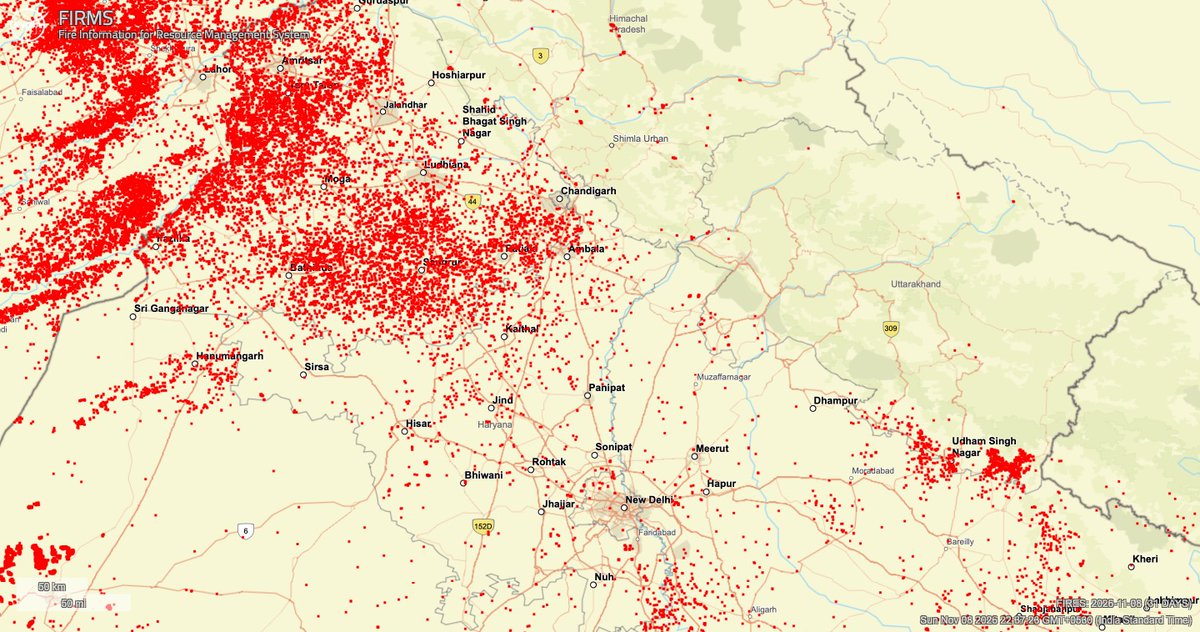
Starting tomorrow, some lobbies will convince you that these farm fires never happened over the last 31 days, and everything around you is due to Diwali firecrackers.
Do not buy that nonsense.
Mera Pota (grandson) meri jaan. May God’s blessings be always with my Puttars. Vihaan has brought so much happiness in our lives. Rab di meher te Rab da shukar. 🙏🙏
#WATCH | Uttar Pradesh: The grand 10th Deepotsav celebrations are underway in Ayodhya as firecrackers light up the night sky.
Vice President CP Radhakrishnan, UP Governor Anandiben Patel and Chief Minister Yogi Adityanath are present here.
So Deepinder Goyal posted about the Blinkit ambulance service, which was running free of cost.
People started using it for routine check-ups.
Now he has said that they'll charge ₹2,500 for such cases and ₹0 for genuine emergency cases.
People will always exploit good services in India and make everyone suffer.
Sometimes, it feels like we're becoming a low-trust society.
You are from Maharashtra. How can you forget A. R. Antulay? He was a former Chief Minister. Is that a small thing? Member of Parliament (MP) from the Kulaba (now Raigad) Lok Sabha constituency four times (1989, 1991, 1996, and 2004). At the state level, he repeatedly won elections to the Maharashtra Legislative Assembly from the Shrivardhan constituency in the Raigad district. Both of these areas were majority Hindu!!! Yaar, I expect better from Rajdeep because he is from Maharashtra.