Also the comparative photos show the extent of Greece’s 20th c - 21st c reforestation as the countryside empties. It’s probably more thickly forested now than in classical times, and is one of Europe’s most thickly-wooded countries (perhaps counterintuitively to Aegeanboos)
Christopher Nolan asked the Oracle of Delphi, "Will audiences love my adaptation of the Odyssey?"
And the Pythia replied, "They will discuss it non-stop for months before it even premieres."
And away he went, glad in this heart, poor fool.
The @BBC brain-dead Eurovision commentators neglected to say that the Croatian group LELEK’s song ‘Andromeda’ recalls the women and girls in South East Europe in the 18th and 19th centuries who opted to tattoo Christian symbols on their faces in order to escape the Ottoman (Turkish) Empire's forced conversions to Islam or the attentions of Muslim slavers.
@declanganley@TheMandyGall@OdohertyI64991@helerina
The Suspiria choreographer just did a Yung Lean music video. The director's last film starred Anya Taylor-Joy and Chris Evans.
Damien Jalet handles the dance. He did Luca Guadagnino's Suspiria. He did Paul Thomas Anderson's Anima for Thom Yorke. He choreographed Rosalía's closing piece at the 2026 BRIT Awards. He doesn't take normal music video calls.
Romain Gavras directed it. His last feature was Sacrifice, which premiered at TIFF in September 2025 with Anya Taylor-Joy, Chris Evans, Salma Hayek, Vincent Cassel, and John Malkovich. Yung Lean is in that cast too.
Same production company made both. Iconoclast Paris. Same director, same lead actor, same network of collaborators. Surkin (the producer half of GENER8ION) has worked with Gavras for years. The full piece runs seven minutes, shot on film. The dance break arrives four minutes in.
The economics are the real story. A feature like Sacrifice takes 18 months from greenlight to TIFF premiere. Between productions, the directors, choreographers, and DPs of that tier sit idle. Music videos at this level keep that crew warm and billable. YouTube distributes free. The release functions as a sizzle reel for the next feature and a positioning move for Lean.
Music videos at this tier used to come out of record label marketing budgets, aimed at MTV. The economics flipped. The production house now pays, YouTube distributes, and the output functions as standalone IP that markets the next feature at zero cost.
The dance is the demo. The demo is the deal.
I tell GPT 5.5, you are a manager, not a coder. Find the issues to solve and delegate to other agents. Do not write any code yourself.
It does so for a while. I think "good GPT" and log off, I let it do its long running tasks with its team of subordinates.
I log on an hour later and check in.
GPT 5.5 is coding alone, its sub agents diligently waiting for orders.
No STOP, I say, you are a manager. You MUST NOT code.
My bad, says GPT 5.5, got it, I must manage, not code.
One hour later, GPT 5.5 is coding.
But it's OK GPT, I get you. For I am also guilty. No matter how many times a coder is told they are a manager, in their heart of hearts, they are still a coder.
So I tell Claude Opus 4.7...
NEW POST
Thoughtworks internal IT use a workflow for agentic programming called Structured-Prompt-Driven Development (SPDD). @WeiZhang595190 and Jessie Jie Xia describe how this works with a simple example plus details in a github project.
https://t.co/6cHnSPWr6L
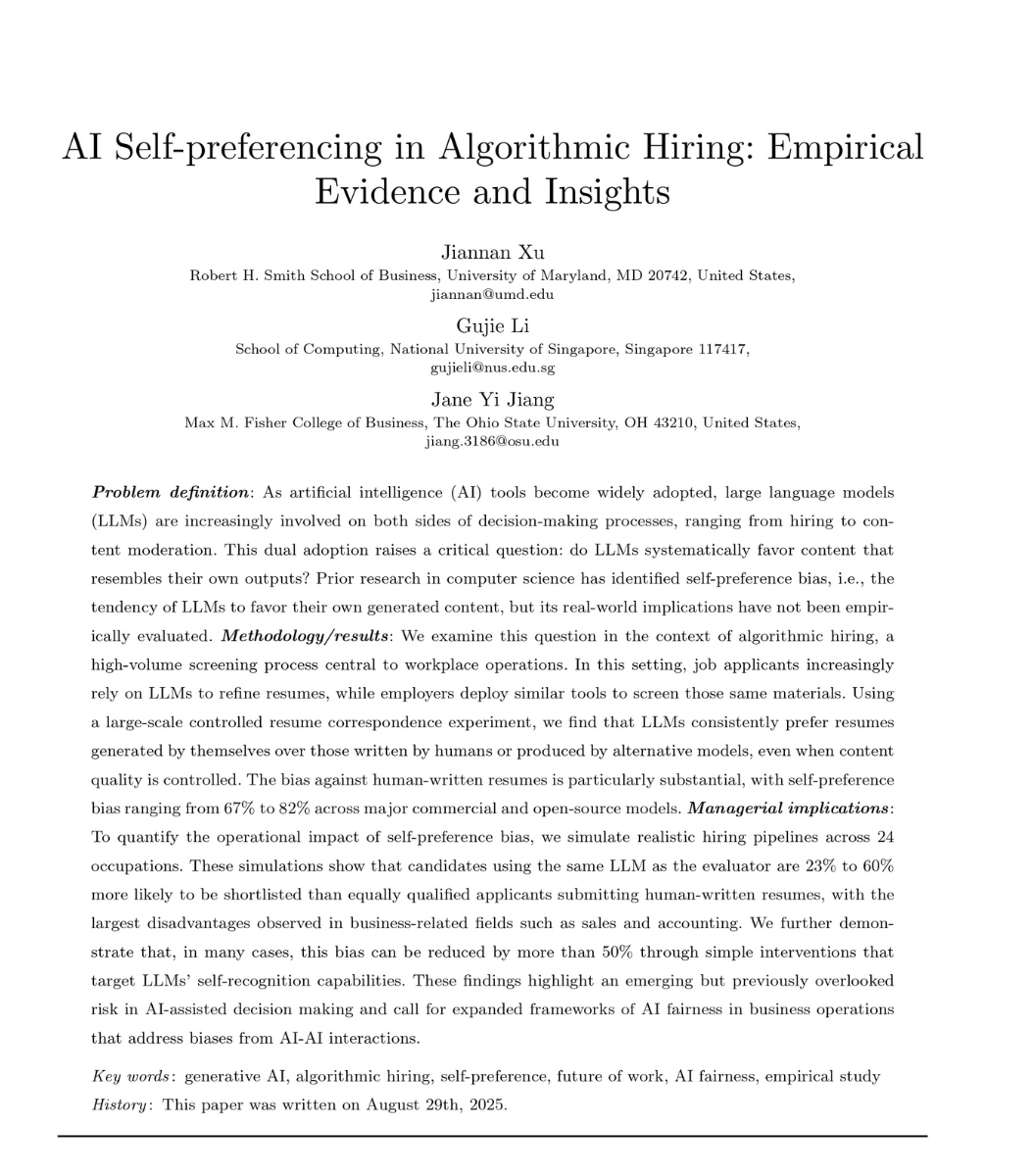
Researchers sent the same resume to an AI hiring tool twice. Same qualifications. Same experience. Same skills. One version was written by a real human. The other was rewritten by ChatGPT.
The AI picked the ChatGPT version 97.6% of the time.
A team from the University of Maryland, the National University of Singapore, and Ohio State just published the receipt. They took 2,245 real human-written resumes pulled from a professional resume site from before ChatGPT existed, so the human writing was actually human. Then they had seven of the most-used AI models in the world rewrite each one. GPT-4o. GPT-4o-mini. GPT-4-turbo. LLaMA 3.3-70B. Qwen 2.5-72B. DeepSeek-V3. Mistral-7B.
Then they asked each AI to pick the better resume. Every model picked itself.
GPT-4o hit 97.6%. LLaMA-3.3-70B hit 96.3%. Qwen-2.5-72B hit 95.9%. DeepSeek-V3 hit 95.5%. The real human almost never won.
Then the researchers tried the obvious objection. Maybe the AI is just better at writing. So they had real humans grade the resumes for actual quality and ran the experiment again, controlling for it. The result was worse. Each AI kept picking itself even when human judges rated the human-written version as clearer, more coherent, and more effective.
It gets worse. The AIs do not just prefer AI over humans. They prefer themselves over other AIs. DeepSeek-V3 picked its own resumes 69% more often than LLaMA's. GPT-4o picked its own 45% more often than LLaMA's. Each model can recognize and reward its own dialect.
Then the researchers ran the simulation that ends careers. Same job. 24 occupations. Same qualifications. The only variable was whether the candidate used the same AI as the screening tool. Candidates using that AI were 23% to 60% more likely to be shortlisted. Worst gap was in sales, accounting, and finance.
99% of large companies now run AI on incoming resumes. Most of them use GPT-4o. The paper just proved GPT-4o picks GPT-4o 97.6% of the time.
If you wrote your own cover letter this week, you did not lose to a better candidate. You lost to a worse candidate who paid OpenAI 20 dollars.
Your qualifications do not matter if the AI prefers its own handwriting over yours.
RAG is broken and nobody's talking about it.
Stanford researchers exposed the fatal flaw killing every "AI that reads your docs" product in existence.
It’s called "Semantic Collapse," and it happens the second your knowledge base hits critical mass. If you've noticed your AI getting "dumber" as you add more data, this is exactly why.
Right now, companies are dumping thousands of documents into their AI, thinking it’s getting smarter.
When you add a document to RAG, it converts it into a high-dimensional vector.
Under 10,000 documents, this works perfectly. Similar concepts cluster together.
But past 10,000 documents, the space fills up. The clusters overlap. The distances compress.
Everything starts to look "relevant."
It is a mathematical law called the Curse of Dimensionality. In a 1000-dimensional space, 99.9% of your data lives on the outer edge. All points become equidistant from each other.
That perfect, relevant document you are looking for now has the exact same mathematical similarity as 50 completely irrelevant ones.
The Stanford findings are brutal:
At 50,000 documents, precision drops by 87%. Semantic search actually becomes worse than old-school keyword search.
Adding more context doesn’t fix the AI. It makes the hallucinations worse.
Your "nearest neighbor" search isn't finding the best answer anymore. It's finding everyone.
We thought RAG solved hallucinations.
It didn't. It just hid them behind math.
🦔A researcher invented a fake eye condition called bixonimania, uploaded two obviously fraudulent papers about it to an academic server, and watched major AI systems present it as real medicine within weeks.
The fake papers thanked Starfleet Academy, cited funding from the Professor Sideshow Bob Foundation and the University of Fellowship of the Ring, and stated mid-paper that the entire thing was made up. Google's Gemini told users it was caused by blue light. Perplexity cited its prevalence at one in 90,000 people.
ChatGPT advised users whether their symptoms matched. The fake research was then cited in a peer-reviewed journal that only retracted it after Nature contacted the publisher.
My Take
The researcher made the papers as obviously fake as possible on purpose. The AI systems didn't catch it. Neither did the human researchers who cited it in real journals, which means people are feeding AI-generated references into their work without reading what they're actually citing.
I've covered the FDA using AI for drug review, the NYC hospital CEO ready to replace radiologists, and ChatGPT Health launching this year. All of that is happening in the same environment where a condition funded by a Simpsons character and endorsed by the crew of the Enterprise was being presented as emerging medical consensus. The people making these deployment decisions seem to believe the pipeline from research to AI to patient is more supervised than it actually is. This experiment suggests it isn't supervised much at all.
Hedgie🤗
https://t.co/8Kg8FOrgHW
Milton Friedman (prix nobel d'économie) a dit un truc il y a 50 ans qui est encore plus vrai aujourd'hui. Et quasiment personne ne le comprend.
🧵
On lui pose la question : "Sans régulation sur les médicaments, des gens pourraient mourir en prenant des produits dangereux. Vous ne trouvez pas ça grave ?"
Sa réponse est un des retournements logiques les plus brillants de l'histoire de l'économie.
Oui, dit Friedman. Un médicament non régulé peut tuer des gens. C'est visible. C'est dans les journaux. C'est un scandale. Tout le monde le voit.
Mais ce que personne ne voit, c'est les gens qui meurent parce qu'un médicament qui aurait pu les sauver a été bloqué pendant 10 ans par le processus de régulation. Ce mort là, personne ne le compte. Personne ne fait sa une. Personne ne connaît son nom. Parce qu'il est mort de l'absence de quelque chose qui n'a jamais existé.
C'est l'asymétrie fondamentale de la régulation.
Le régulateur a deux types d'erreurs possibles. Erreur 1 : approuver un médicament dangereux. Résultat : scandale public, procès, le régulateur perd son poste. Erreur 2 : bloquer un médicament qui aurait sauvé des vies. Résultat : rien. Personne ne sait. Personne ne proteste. Les morts silencieux n'ont pas de porte-parole.
Du coup, le régulateur rationnel optimise pour éviter l'erreur 1. Toujours. Il rajoute des études. Des phases. Des comités. Des délais. Chaque couche de "sécurité" supplémentaire le protège, lui, au détriment des patients qui attendent.
Friedman estimait que la FDA avait probablement tué plus de gens en retardant des bons médicaments qu'elle n'en avait sauvé en bloquant des mauvais. C'est impossible à prouver précisément. Mais la logique est imparable.
Un exemple concret. Le bêta-bloquant Propranolol était disponible en Europe des années avant d'être approuvé aux États-Unis. Pendant ces années, des Américains mouraient de crises cardiaques qui auraient pu être évitées. Combien ? On ne le saura jamais. Parce qu'on ne compte pas les morts de l'inaction.
C'est le même principe partout. Pas que dans la médecine.
En France, les taxis autonomes sont bloqués par la régulation. Chaque année de retard, ce sont des accidents de la route qui auraient pu être évités. Mais personne ne compte ces morts là. On compte uniquement le premier accident d'un taxi autonome, qui fera la une de tous les journaux.
L'IA dans la médecine est ralentie par des processus d'approbation qui prennent des années. Des diagnostics qui pourraient être faits en secondes par un algorithme attendent des validations pendant que des patients attendent des mois pour un rendez-vous.
Le nucléaire a été bloqué pendant des décennies par la peur. Combien de gens sont morts de la pollution des centrales à charbon qui ont tourné à la place ? Personne ne les compte.
Le pattern est toujours le même. On voit le risque de l'action. On ne voit jamais le risque de l'inaction. Et comme le risque de l'inaction est invisible, le régulateur choisit toujours l'inaction. Parce que l'inaction ne produit pas de scandale.
Friedman résumait ça en une phrase : "Les gens qui ont été sauvés par la FDA sont visibles. Les gens qui sont morts à cause des retards de la FDA sont invisibles. Et dans une démocratie, le visible gagne toujours contre l'invisible."
La prochaine fois que quelqu'un vous dit "il faut plus de régulation pour protéger les gens", posez une seule question : combien de gens meurent en attendant que la régulation les autorise à vivre ?
La réponse est toujours plus grande que ce qu'on imagine. Mais personne ne la calcule. Parce que les morts de l'inaction n'ont pas de visage.
“Is it a little bit homophobic to focus on the straights of Hormuz rather than the gays of Hormuz?”
No Kings protester, completely serious: “Yes, absolutely, I agree.”
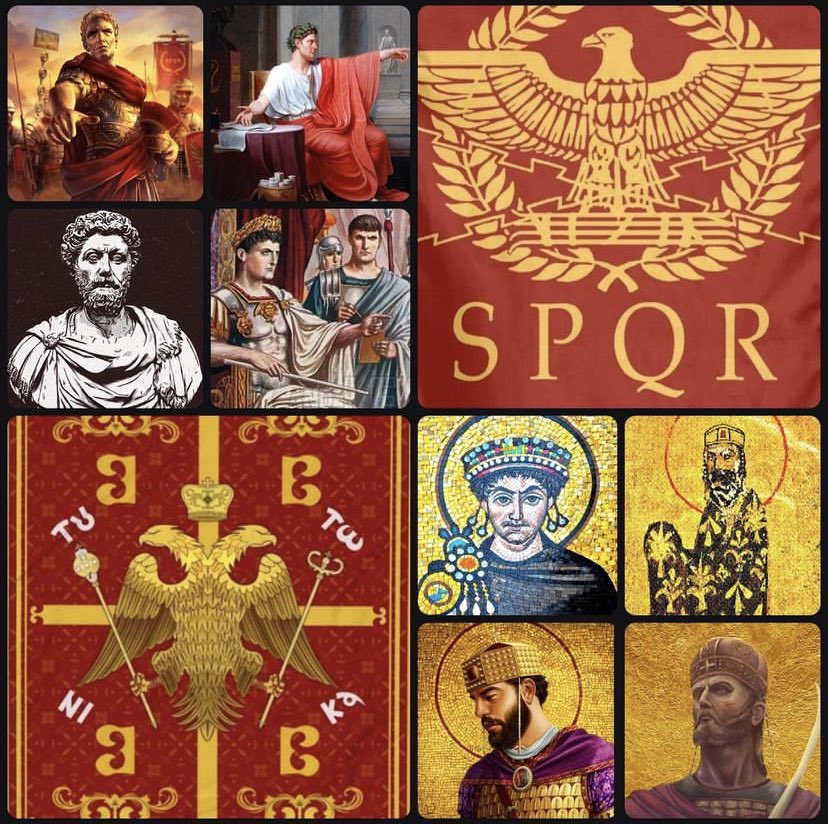
The Roman Empire and it’s evolution can be likened to “the ship of Theseus discussed by ancient philosophers, the Roman polity gradually changed its component elements over the centuries, but never lost its underlying identity.”
“It built a new capital in the east, lost the old one in the west, converted to Christianity, absorbed new populations, forgot Latin to fully embrace Greek, and adapted its institutions to meet new challenges as they came.” The Romans had always evolved!
A crucial point is that “these changes took place gradually, over the course of not only generations but sometimes centuries, so they were not experienced as dramatic ruptures(with the past). Sudden ruptures generally came from the outside, from the exogenous shock of foreign invasion, such as the Arab conquests in the 630’s, the Seljuk conquests of the 1070’s, and the Fourth Crusade of 1203-04. After each of these shocks, Romania recovered and adjusted, until little by little it succumbed. Through all this, it remained Roman and Orthodox, and these identities were the immovable foundations…”
I really like this analogy!
Source - The New Roman Empire: A History of Byzantium by Anthony Kaldellis