my 2026 goals :
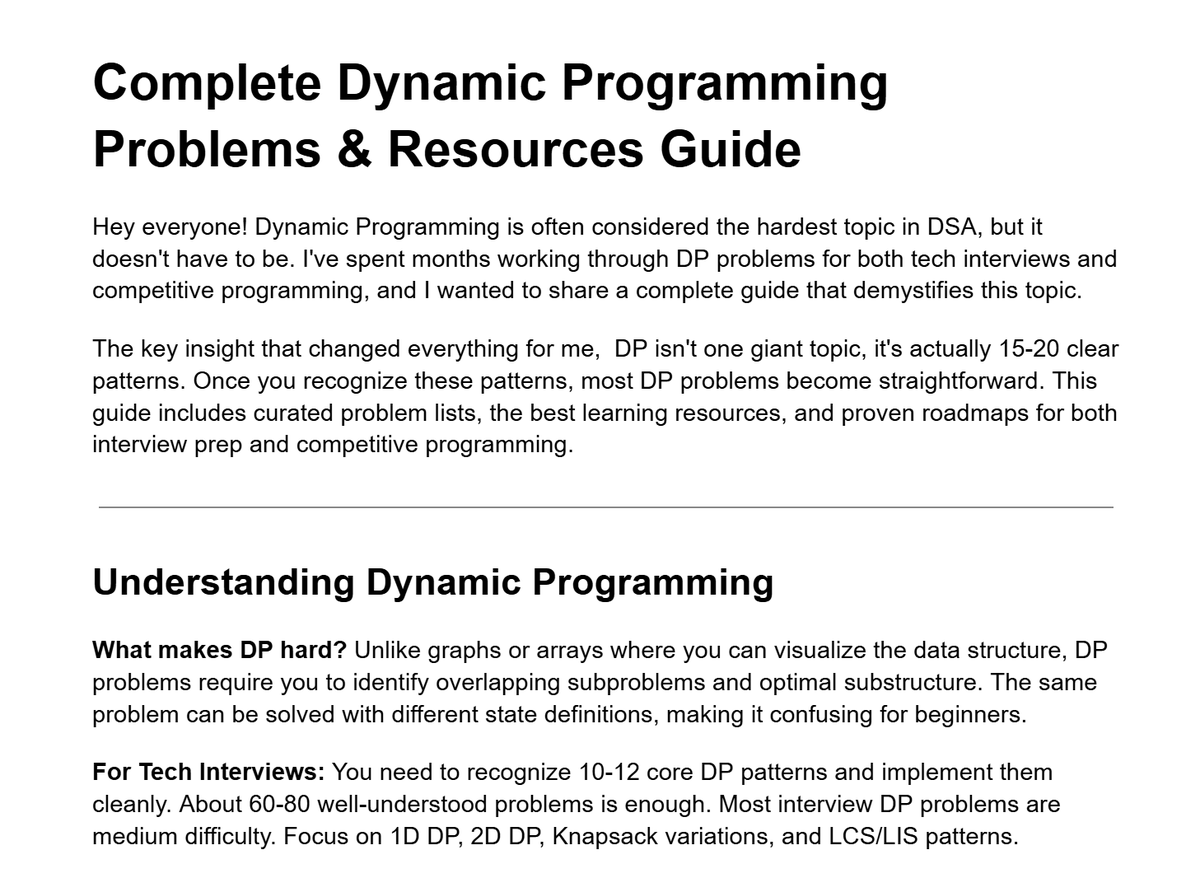
- study dp and graph
- practice BS and sliding win. more
- guardian at leetcode
- specialist at codeforces
- dev - frontend + backend
- 1-2 major project
- and my portfolio site
- maintain 9+ cg
(had to achieve all, no other option )
Everyone says "think from first principles" in competitive programming, but very few explain what it actually looks like when you're stuck on a problem.
It's not any trick or formula. It's a way of thinking.
It means you stop asking "which algorithm fits here?" and instead ask "what is actually happening here?'
Let's understand this with a simple example.
Problem: You're given an array. In one operation, you can choose any element and decrease it by 1. Your goal is to make all elements equal using minimum operations.
> Most people instantly jump to ideas like sorting, greedy templates, or some known pattern. But first principles thinking starts differently.
1. You ignore everything and just observe.
2. Take a small example:
[3, 1, 2]
3. Now simulate manually.
To make all elements equal, you can only decrease values. So clearly, everything has to come down to the smallest element.
Why? Because you can't increase anything.
So our target is minimum element.
Now count:
3 -> 1 takes 2 operations
2 -> 1 takes 1 operation
Total = 3 operations.
You didn't use any fancy algorithm. You just asked:
1. What operations are allowed?
2. What is even possible?
That's first principles. To think fundamentally
Let's go one step deeper.
Consider another problem:
You're given a binary string. In one move, you can delete any adjacent pair "01". What's the maximum number of deletions?
Now instead of guessing "stack?', "greedy?", pause.
Try small cases:
"01" -> 1
"0011" -> try manually
Remove middle -> "01" -> 1 more -> total 2
Now observe:
Every deletion removes one '0' and one '1'.
So the total deletions can never exceed:
min(count of 0s, count of 1s)
That:s it.
You didn't derive this from memory. You discovered it.
This is the real difference.
Average approach:
'Which topic is this? Have I seen this before?"
First principles approach:
"What must always be true here?"
Another important habit is asking extreme questions:
1. What if n = 1?
2. What if all values are same?
3. What if operations are applied infinitely?
These questions expose constraints and invariants faster than any template.
Also, Please for the God's sake don't rush coding.
The biggest mistake in contests is forcing a known approach too early.
You see something slightly similar to a DP problem -> you start writing DP.
You see a graph -> you start BFS/DFS.
But first principles thinking says:
"Understand first. Code later."
Spend time breaking the problem. Write examples. Find patterns. Only then translate into code.
At the end of the day, first principles thinking is simple:
- Strip the problem.
- Understand the rules.
- Observe small cases.
- Find what must always hold.
- Build the solution from zero.
Do this consistently, and you'll notice something:
You will stop fearing new problems.
Because no matter how unfamiliar they look, you know how to start.
Reposts are appreciated ♥️♥️
Next time, don’t try rage-bait or engagement-farm on us. We’ve been here for a long time. If needed, we can do reverse rage-bait and pull in more eyeballs than you ever have.
Just wanted to share something.
- The videos you watch, the sheets you use, and the platform that may allow unlimited submissions in the next few days may look free to you, but they are not free. Someone is paying that cost so you can use them without paying anything.
- The monthly salary I gave up at Google (YouTube AdSense is not even half of it, FYI)
- AWS bills (way, way more than my Google salary, FYI)
- Employee costs (~35 people as of today)
- Office Rentals
- Laptops, Insurance etc for people who work for us
Do you know who pays for it?
The TUF+ users.
Because of them, millions of people are able to use TUF for free today. YT pays peanuts, till data I have not even made 1 crore from ad-sense despite having ~180M views. I don't want to sell myself for betting apps, I will prefer running a paid model to run this. Obviously I make more in this, and I get a lot more mental peace, which is why I chose this path.
So when you promote theft, defend piracy, or support reselling, you are not just hurting us - you are hurting yourself, or someone you know, who benefits from the free content because they cannot afford paid options elsewhere.
Who hasn’t pirated at some point? Fair point.
But I can assure you, most of us did not turn that into a business and make ₹2L out of it. It is ₹2L today. Tomorrow it can be ₹20L. Eventually, it starts damaging the funnel that keeps all of this running - and that leads to the exact problem you see below.
Cheers.
This is not going anywhere. It was just a one-time post to remind you that the “free” things you see are not actually free.
Someone, somewhere, is paying for them.
We’re giving away:
• 1 Elite yearly membership
• 1 Pro yearly membership
• 3 × 90 Day FAANG DSA Roadmaps
What you get
Structured editorials and videos on 90+ DSA patterns,Mock interviews. Code feedback through AI. Structured learning paths across DSA system design and AI, Resume Analysis and generation based on any Job URL.
No random PDFs.
If you’ve been watching from the sidelines, this is your entry point.
To participate:
Follow
Repost
Comment “thita”
Winners picked randomly after 48 hours.
Giveaway valid only if minimum participation criteria of atleast 100 participants is met.
All these DSA courses - free or paid - are somehow the real reason people get stuck in tutorial hell.
I've seen a guy who just watches lectures, codes exactly what the instructor codes, then practices that same code 5-10 times on his own…
and then memorizes it.
Like wtf?
That's not problem solving. That's just copying with repetition.
You didn't think. You didn't struggle. You didn't get stuck. You didn't debug your own idea.
You just replayed someone else's brain.
And then people say they are "doing DSA seriously".
No. You're just training memory, not logic.
Real DSA starts when: You open a problem. You don't know what to do. You try. You fail. You rethink. You build the solution yourself.
Until then, it's nothing but tutorial dependency.
So here I am with my new project CODEFORGE, which aims to help cp'ere . Now generate customized rating (epsilon) and topic wise(delta) sheet for cf
Explore the platform live here at
https://t.co/I6B0xfXxu6
Consider reposting if u like🙏
@kirat_tw@striver_79@Priyansh_31Dec
@indische_Waffen took me almost a yr to reach pupil , 40-50+ contests,
and idk why but now i dont really enjoy cf like i used to , so just started exploring dev & aiml now