USS Kentucky (BB-66) was never completed, but part of her did eventually go to war. This photograph shows the unfinished Iowa-class battleship under tow toward Baltimore in 1959, where she was destined to be dismantled. Tugboats guide the massive hull through the water, while the remains of her wartime construction can still be seen—including the dual 5-inch gun mounts along the starboard side.
But look closely at the bow. It is missing.
That section had already found a second life. After USS Wisconsin (BB-64) suffered severe bow damage in a 1956 collision, the Navy removed the unfinished bow of Kentucky and fitted it onto Wisconsin.
The unusual repair earned Wisconsin the unofficial nickname “Big Wisky”—part Wisconsin, part Kentucky.
A strange but practical solution that meant one unfinished battleship would literally live on inside another, even as the rest of Kentucky was being towed away to be dismantled.
The wreck of the Soviet Sverdlov-class light cruiser Murmansk lies stranded near Sørvær, Norway, after a failed final voyage.
Decommissioned by the Russian Navy in 1992, the 210-meter warship was sold to India in 1994 for scrapping, but ran aground during a storm while being towed.
For nearly two decades, her rusting hull remained a striking reminder of the Soviet Navy’s once-formidable fleet, until the cruiser was finally dismantled in 2013.
USS Wisconsin (BB-64) was halfway through her overhaul at Ingalls Shipbuilding in Pascagoula, Mississippi, when this photo was taken in September 1987 — the last of the four Iowa-class battleships chosen for reactivation under Reagan's 600-ship Navy plan, reportedly because a fire she'd suffered in mothballs raised doubts about whether she was worth the investment.
Behind that scaffolding, crews were fitting more than new paint. Wisconsin was getting Tomahawk and Harpoon missile launchers, Phalanx defense systems, and gear to launch RQ-2 Pioneer drones that would fly ahead of the ship to spot targets for her 16-inch guns — 1940s naval gunnery paired with technology barely a decade old.
She recommissioned at this same yard on October 22, 1988, and fired those guns in anger one more time, over the Persian Gulf in 1991.
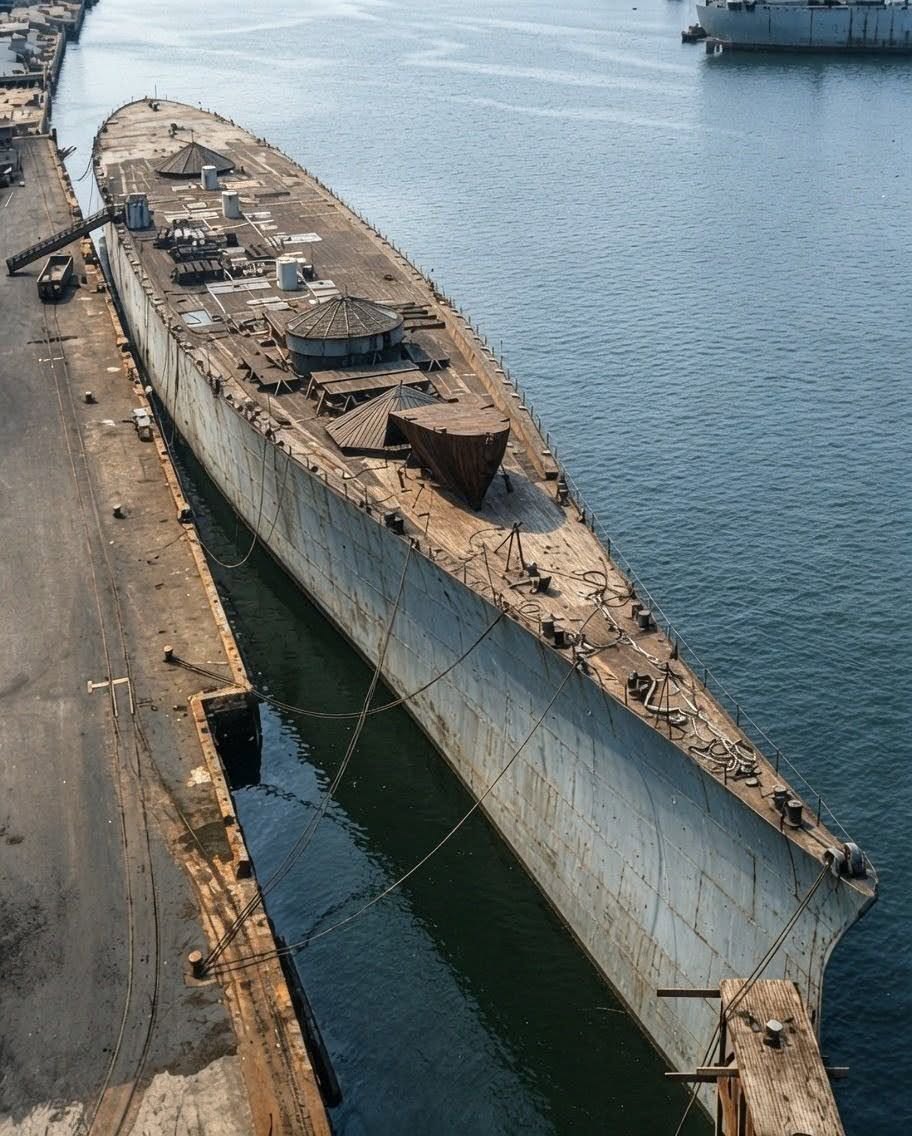
The never-completed hull of Iowa-class battleship USS Kentucky (BB-66), photographed in March 1955—about a year before the Navy removed her bow for transplant to USS Wisconsin (BB-64).
Kentucky was laid down in 1942 but construction was suspended before the battleship could be completed. Her unfinished hull remained at the Norfolk Naval Shipyard for years, a silent reminder of a warship that would never enter service.
Then, in 1956, USS Wisconsin suffered serious damage to her bow after colliding with the destroyer USS Eaton. Rather than build an entirely new bow from scratch, the Navy turned to Kentucky. A massive section of the unfinished battleship’s bow was cut away, transported, and fitted onto Wisconsin.
The never-completed Kentucky would never fire a shot—but part of her ultimately went to sea aboard her sister ship.
This photograph compares three German "pocket battleships"—Deutschland (Lützow), Admiral Scheer, and Admiral Graf Spee—with five Revenge-class battleships of the British Royal Navy: HMS Royal Oak, HMS Revenge, HMS Ramillies, HMS Royal Sovereign, and HMS Resolution. ⚓🇬🇧
The Revenge-class ships are pictured sailing in formation around 1930, symbolizing the power of the British fleet at the time. The Deutschland-class ships, meanwhile, were designed to be smaller but more powerfully armed, earning them the nickname "pocket battleships" and posed a threat to Allied shipping early in World War II.
More than eight decades after the attack on Pearl Harbor, USS Arizona (BB-39) still lies beneath the waters of the harbor where she was destroyed on December 7, 1941. The battleship rests in relatively shallow water, with significant portions of her hull remaining on the seafloor despite the immense damage inflicted during the attack.
The explosion that tore through her forward magazine destroyed much of the bow and caused the loss of more than 900 sailors and Marines, whose remains are still entombed within the wreck. For this reason, USS Arizona is not simply a sunken battleship, but a protected war grave and one of the most significant military memorial sites in the United States.
Above the submerged hull stands the USS Arizona Memorial, completed in 1962. The structure was deliberately designed to span the wreck without resting directly upon it, allowing the battleship to remain undisturbed below. From the memorial, visitors can look into the water and see parts of the ship that still remain beneath Pearl Harbor.
Even today, the wreck continues to change. Corrosion and marine growth slowly affect the remaining steel, while small amounts of fuel oil continue to escape from the ship, producing the phenomenon widely known as the “black tears” of USS Arizona. The site is carefully monitored by the National Park Service and the U.S. Navy, ensuring that the wreck remains both a protected historic site and a lasting memorial to those who never returned from the attack.